Famous Last Meals / Illustrated food history

John F. Kennedy: Breakfast Before Dallas

Room service, a crowded ballroom, and a luncheon never reached

Evidence: A reported room-service breakfast; a separately documented public breakfast menu

On the morning of 22 November 1963, breakfast in Fort Worth was also a presidential appearance. The Hotel Texas ballroom held a Chamber of Commerce audience, a head table and a speech. Outside, another crowd had gathered in the rain. Later, a local television report would identify room-service waiter Marvin Love as the man who prepared Kennedy’s last meal. The public breakfast and that private service belong to the same hotel morning, but their surviving records tell different parts of it. The presidential remarks; WBAP-TV’s next-day waiter script.

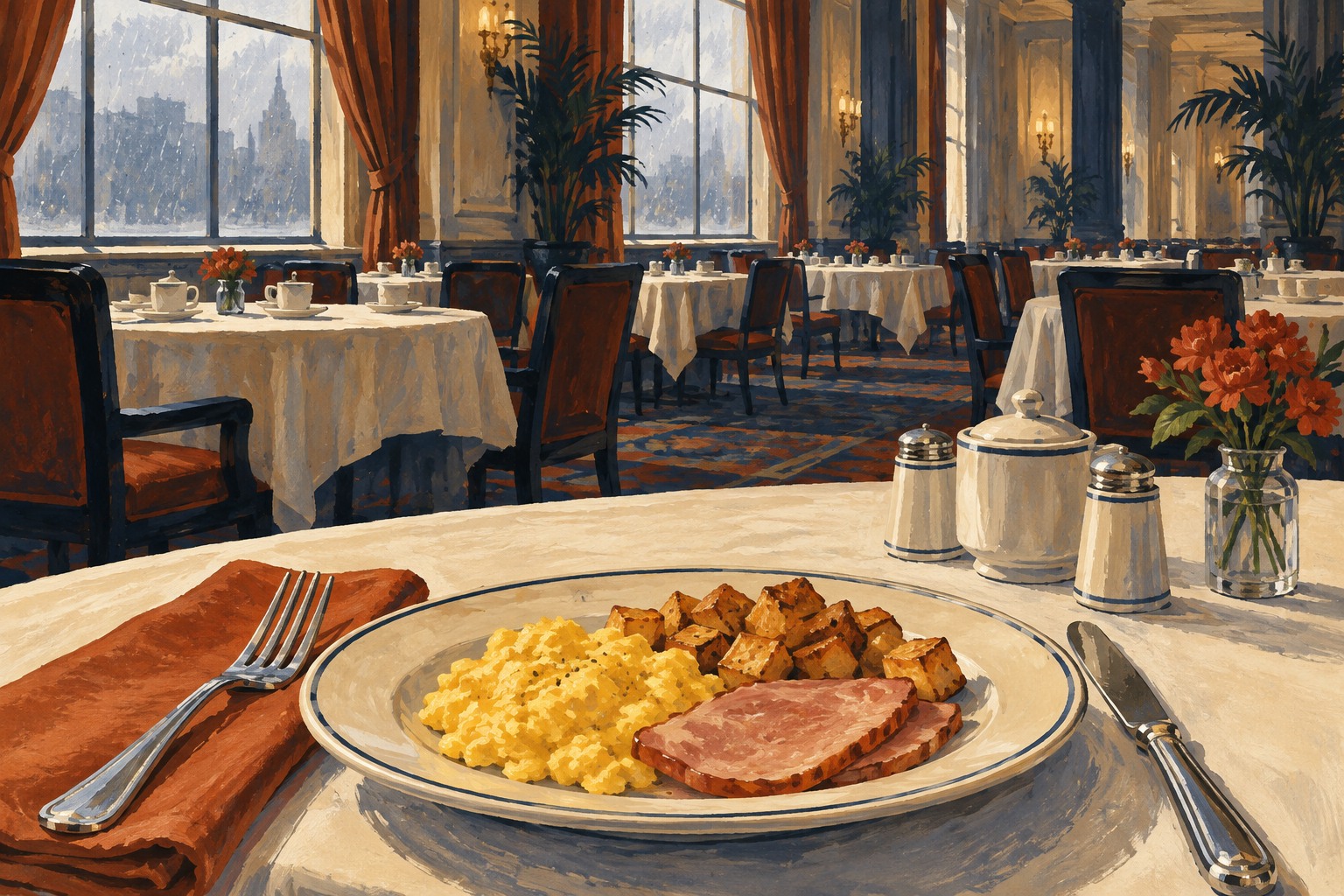
An imagined Hotel Texas-era public breakfast setting: a modest place setting with eggs, ham and potatoes and a broad suggestion of a ballroom beyond. It represents the guests’ menu, not a documented plate eaten by Kennedy or an exact reconstruction of the head table.

Who would get a place?

Advance man Jeb Byrne had spent ten days helping prepare the Fort Worth visit. In his later recollection, backed by papers he kept, the breakfast was an exercise in access as well as hospitality. Chamber members, political offices and labor organizations wanted tickets. Local demands for a public appearance helped produce the outdoor event, where a ticket would not be the condition of seeing the president.

Byrne also described arranging additional invitations for Black residents through Dr. Marion Brooks and obtaining tickets for a local Spanish-speaking political organization. A place in the ballroom was not distributed evenly by chance; people had to work to widen attendance. The museum’s surviving breakfast ticket is a small object from those arrangements. Byrne’s account; the Sixth Floor Museum’s ticket record.

Outside at a quarter to nine

The official record places Kennedy’s parking-lot remarks at 8:45 a.m. Central time, across from the hotel. He thanked the people standing in the rain, then spoke about defense, space and the economy. Fort Worth’s aircraft industry gave the national subjects a local setting. The short appearance ended before the ballroom breakfast address. The published presidential remarks and time note.

Byrne watched the transition from the hotel kitchen doorway. In his account, the guests had reached their coffee when Kennedy entered and went to the head table. Jacqueline Kennedy subsequently came down from the suite. For the staff and organizers, service, introductions, music and seating still had to follow their sequence. Byrne.

The speech beside the plates

At nine, Kennedy addressed the Chamber breakfast. He began with a joke about the attention paid to his wife on their travels and praised Fort Worth’s congressman, Jim Wright. Then the speech turned to military aircraft, alliances and the burdens of the Cold War. It was a working public address, with the city’s industry running through it.

The Sixth Floor Museum’s curator identifies the guests’ breakfast as scrambled eggs, ham and fried potatoes, with breakfast breads and drinks. That is the documented connection for the modern plate below. The ticket record describes the event’s catering; it does not by itself establish which foods Kennedy personally ate. The speech; the museum’s curatorial record.

A waiter in the next day’s news

The following day, WBAP-TV prepared a brief item headed “WAITER.” Its script names Marvin Love, describes his room-service work at the Texas Hotel and introduces an interview. A cue then directs the broadcast to sound on film.

The surviving page preserves that introduction and cue, not the interview’s food list. It is a valuable contemporary trace of the hotel worker who became part of the story, without furnishing a complete private menu on the page. The waiter’s name and work remain concrete; an attractive later list of breakfast foods cannot simply be inserted into his missing recorded words. The original script, 23 November 1963.

Another room was waiting in Dallas

After Fort Worth, Kennedy flew to Dallas. A Trade Mart luncheon was waiting at the other end of the motorcade route. The museum preserves a newspaper photograph of the guests there and identifies the planned meal, including steak. It was an event Kennedy never reached. He was shot in the motorcade; Governor John Connally was wounded, and Kennedy was pronounced dead at Parkland Hospital at one o’clock. The museum’s luncheon photograph; its event timeline.

The hotel breakfast survives through several kinds of work: the organizer’s papers, a ticket, public remarks and a television script about a waiter. They bring the morning into focus without making a single verified plate out of all its separate meals.

Cook the recipe

An original modern home recipe, with its historical connection and adaptations explained below.

Famous Last Meals / Modern companion recipe

Ham, Eggs and Crisp Potato Breakfast

Boil small potato cubes, dry them well and crisp them in a skillet. Warm the ham next, then scramble the eggs in the same pan just before serving. These are the public ballroom menu’s main foods, given original modern quantities and a small-household cooking route.

2 breakfast plates, each half of the eggs, ham and potatoes; no bread or drink includedActive 20 minCooking 45 minTotal 1 hr 5 min

Read John F. Kennedy: Breakfast Before Dallas →

Print recipe · PDF
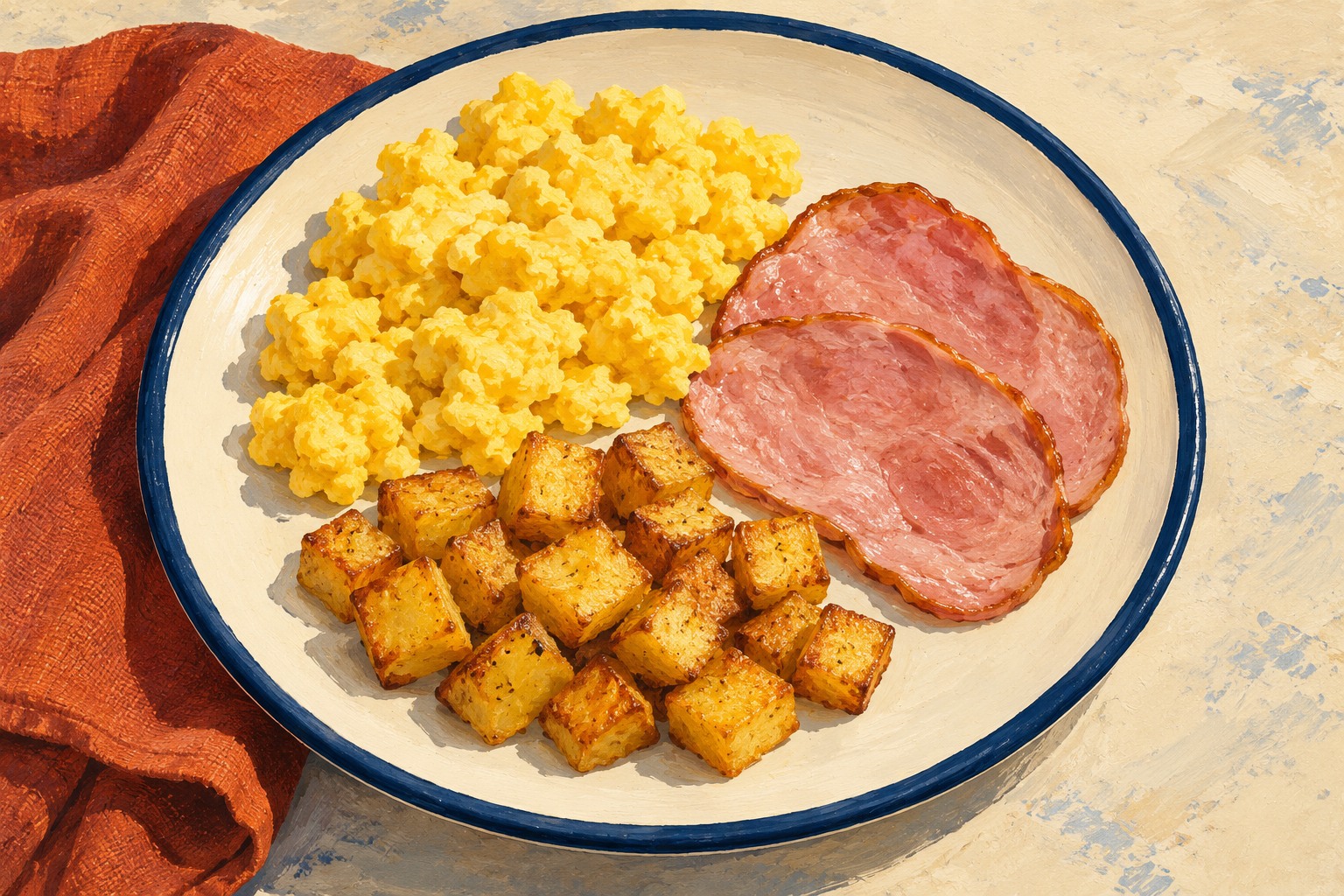
One of two complete modern breakfast plates: fully set moist yellow scrambled egg curds from two eggs, two thin pink ham slices heated with slight golden edges, and half the batch of golden 1.5 cm potato cubes. Three simple groups on a plain plate, no toast, coffee, orange juice, bacon, herbs, cheese, ketchup or garnish.
Original modern recipe illustration: Ham, Eggs and Crisp Potato Breakfast. See the measured recipe for portions and cooking instructions.

Dry cubes brown more readily

Draining alone leaves a film of water. Give the cooked potatoes their two minutes to release steam before they reach the oil, and avoid shaking them into mash. Turning less often at first gives a face time to color. Boiling and crisping are different stages: the first cooks the centers, while the second gives the outside its contrast.

Read the ham label before starting

The method is for a commercially cooked product already labeled ready to eat. A raw slice or a package instructing the cook to cook before eating requires a different route. Use the original opening or cooking date when deciding whether a packet still has storage time left; heating it in a new breakfast does not create a new shelf life.

Make the eggs the last job

The potatoes tolerate a few minutes on a plate better than scrambled eggs do. Keep the beaten bowl cold until needed, then lower the skillet heat before adding butter. A broad spatula makes larger curds, and a thermometer checks their endpoint. The finished eggs can be moist without remaining liquid. Divide them straight from the pan rather than leaving them over heat while arranging drinks.

Ingredients

  • 10½ oz potatoes after peeling, cut into ⅝ in/1.5 cm cubes (300 g prepared raw potato)
  • 4 large eggs (about 200 g without shells)
  • 4 thin slices commercially fully cooked ready-to-eat ham (120 g total)
  • 2 tablespoons pasteurized milk (30 ml)
  • 1 tablespoon neutral cooking oil (15 ml), divided into 2 teaspoons/10 ml for potatoes and 1 teaspoon/5 ml for ham
  • 2 teaspoons butter (10 g)
  • ¼ teaspoon fine salt (1.5 g), divided equally between potatoes and eggs
  • ¼ teaspoon black pepper (about 0.5 g), divided equally between potatoes and eggs
  • Drinking water for boiling potatoes; drain after cooking
Set out

Stovetop, 2-liter/about 2-quart saucepan, Colander, Nonstick skillet about 10 in/26 cm across with a usable flat base at least 8½ in/22 cm, Knife and board, Bowl and fork or whisk, Scale, measuring jug and spoons, Heatproof spatula, Food thermometer, Two serving plates and a clean cover for brief holding, Shallow leftover containers and refrigerator

Allergens

Egg; Milk. Eggs, milk and butter are included. Ham may contain soy, wheat or other added ingredients; check its label and all intended dietary requirements. The water variation still contains butter.

Make it

  1. Put the prepared potato cubes in the saucepan and cover with drinking water by about 1 in/2.5 cm. Bring to a boil, about 5–10 minutes, then simmer 8–10 minutes until a fork enters with slight resistance but the cubes hold together. Drain thoroughly and let steam escape for 2 minutes. During this stage, beat eggs with the milk and half the salt and pepper; keep the covered bowl refrigerated at 40°F/4°C or below until the last step.
  2. Heat 10 ml oil in the skillet over medium heat. Add the drained potatoes in one uncrowded layer on its usable base. Cook 10–12 minutes, turning gently several times, until golden in places and tender throughout. Add the remaining half of salt and pepper. Divide the potatoes between the two plates and cover while finishing the ham and eggs; serve the whole breakfast promptly after this short sequence.
  3. Add the remaining 5 ml oil to the same skillet and warm the ham for about 3–4 minutes, turning as needed, until hot throughout at 165°F/74°C. If the slices overlap, turn and separate them so all heat evenly. Divide between the plates, two slices each. This calls for fully cooked ham, not raw gammon, bacon or a cook-before-eating product.
  4. Lower the heat to medium-low. Add the butter; as soon as it melts, pour in the cold beaten eggs. Draw a spatula slowly across the base, folding soft curds without letting a dry skin form. Cook about 3–5 minutes until set, with no runny egg, and 160°F/71°C in the center of the egg mixture. Divide all eggs between the plates. Serve immediately with the potatoes and ham; there is no extra oil or garnish.

A useful detail

The 65-minute total includes 20 minutes for peeling, cutting and preparing the eggs, then a full sequential potato-boil, draining, crisping, ham and egg route of about 45 minutes. One skillet is used in sequence. Potatoes and ham wait only for the brief final cooking stages, not for extended room-temperature holding. Smaller skillet bases need potato batches and longer time; the specified base avoids relying on crowded browning.

Keep it well

Freshly scrambled eggs are best eaten promptly. Put any planned leftovers into shallow containers and refrigerate at 40°F/4°C or below within 2 hours, or 1 hour above 90°F/32°C. Use within 2 days or the ham’s earlier original deadline, whichever comes first. Reheat only the portion needed to 165°F/74°C throughout. Do not extend an older ham packet’s safe storage period by cooking it into this plate.

How this recipe relates to the story

The three main foods connect to the public breakfast guests’ menu in the museum’s curatorial record. The measurements and sequential skillet method are original. The recipe makes no claim about Kennedy’s private room-service order or personal consumption at the public event.

Another way

  • For a different modern plate, replace the ham with 120 g sliced mushrooms. Cook them in the allocated 5 ml oil for 7–9 minutes until tender and their released liquid has evaporated; extend the total time. Keep all four eggs and the potato portion. This variation is not the documented ballroom menu.
  • Use 30 ml drinking water instead of milk for slightly firmer egg curds. Butter still contains milk, so this single substitution is not a milk-free claim.

Cooking and storage references

Sources for this story

  1. News Script: Waiter, WBAP-TV, 23 November 1963 · NBC 5/KXAS-TV collection, University of North Texas Libraries; UNTA_AR0787-017-1963-11-23-12
  2. The Hours before Dallas: A Recollection by President Kennedy’s Fort Worth Advance Man · National Archives Prologue, Summer 2000
  3. Fort Worth Chamber of Commerce Breakfast Ticket · The Sixth Floor Museum at Dealey Plaza, object 2017.018.0002; curatorial commentary by Stephen Fagin
  4. Remarks at a Rally in Fort Worth in Front of the Texas Hotel, 22 November 1963 · Public Papers of the Presidents, institutional transcription by The American Presidency Project, UCSB
  5. Remarks at the Breakfast of the Fort Worth Chamber of Commerce, 22 November 1963 · Public Papers of the Presidents, The American Presidency Project, UCSB
  6. Image of Guests at the Dallas Trade Mart Luncheon · The Sixth Floor Museum, Dallas Morning News collection, object 2014.080.0221.0001
  7. As It Happened: chronology · The Sixth Floor Museum at Dealey Plaza