Famous Last Meals / Modern companion recipe
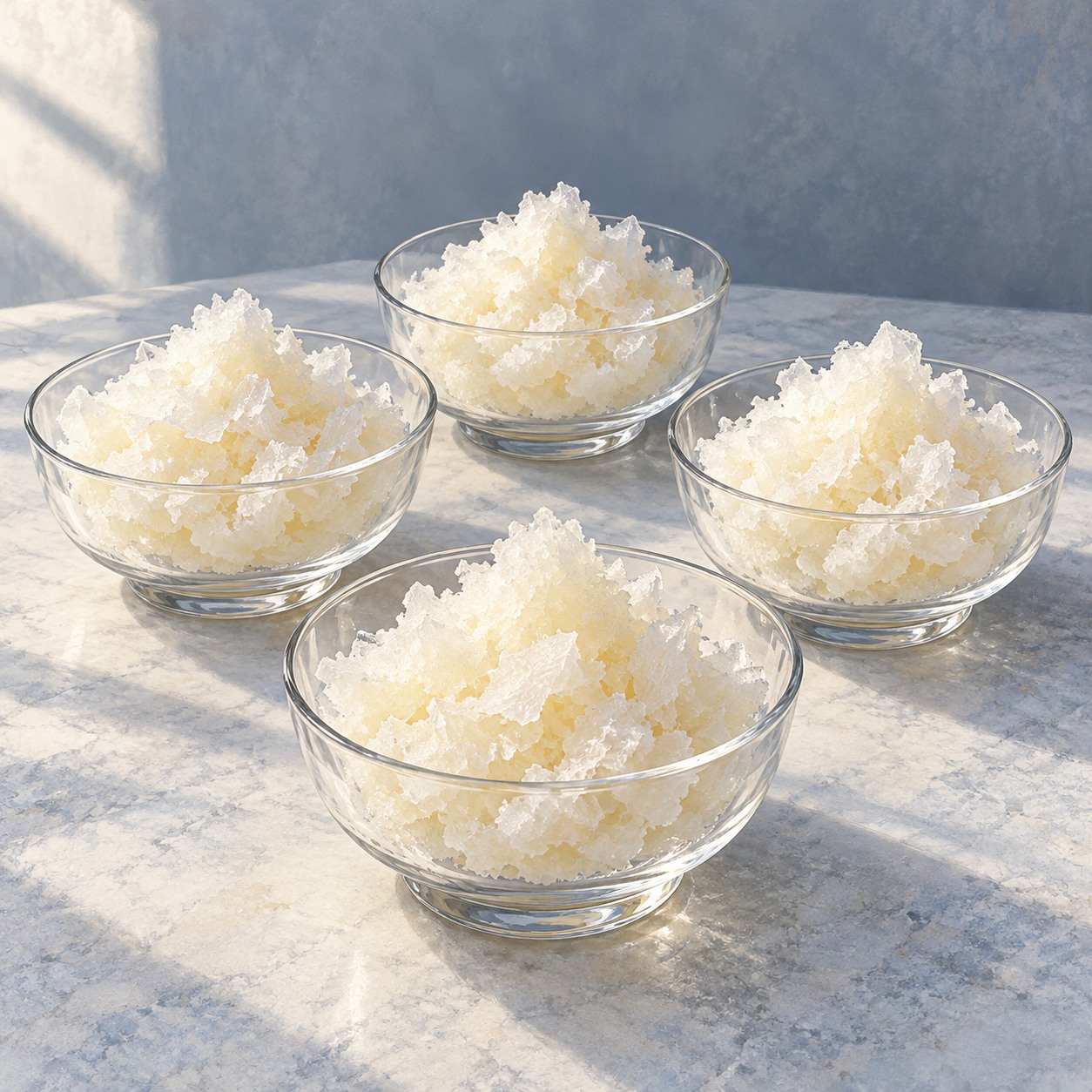
Fork-Scraped Milk Ice
Pasteurized whole milk, a measured amount of sugar and a little vanilla become a light, crystalline frozen dessert. A fork breaks the freezing sheet into flakes instead of a machine churning it smooth. This new dessert joins the milk and frozen-confection motifs from two separate days; the memoir records no such combined dish. The ingredients, flavour and technique are entirely modern choices.
Dissolve the sugar in a small part of the milk
The pan only needs enough milk to dissolve the sugar without scorching. Adding the rest cold brings the temperature down before the ice-water bath. Warming every drop would create a longer cooling job. Stir along the saucepan’s base and sides; crystals left there will feel gritty in the final dessert even after the milk freezes.
A shallow layer makes the fork useful
A deep tub develops a hard wall around a soft center and is awkward to scrape evenly. Use the stated flat base and a genuinely level freezer shelf. Work the frozen edges into the middle at each visit, turning large plates of ice into smaller flakes. Keep the door open only while working and return the covered pan promptly. The result is deliberately crystalline, not scoop-shop ice cream.
Serve the texture you have just made
Loosen the finished batch with the fork before dividing it. Small chilled dishes help the flakes reach the table before they soften. If you make it ahead, the crystals may knit together again; scrape just the portion you plan to serve. A little resistance is expected, but do not force a sharp utensil toward your supporting hand or against a brittle glass dish.
Ingredients
- 1 2/3 cups pasteurized whole milk (400 ml), refrigerated, divided
- 1/4 cup plus 1 1/4 teaspoons granulated sugar (55 g)
- 1/2 teaspoon vanilla extract (2.5 ml)
- Small pinch fine salt (about 0.2 g)
- Ice and cold water for an external cooling bath; none enters the dessert
Set out
Refrigerator at 40°F/4°C or below and freezer at 0°F/−18°C or below, Shallow freezer-safe metal pan with usable internal base about 8 x 6 in/20 x 15 cm, sides at least 1 1/2 in/4 cm high and capacity at least 1 quart/1 L; check it fits level in the freezer, Cover that fits the pan or food-safe freezer wrap, Small saucepan of at least 1 quart/1 L, Kitchen scale, measuring jug, whisk and spoon, Heatproof jug or bowl of at least 3 cups/750 ml, Larger bowl for an ice-water bath, with enough room to hold the jug securely, Food thermometer, Sturdy fork and flexible spatula, Four small serving dishes
Allergens
Milk. Read milk and vanilla labels for ingredients and cross-contact information. This recipe uses dairy milk; changing to a plant drink changes solids, sweetness and freezing behavior and has not been specified by this formula.
Make it
- Clear a level place in the freezer and chill the clean metal pan. Prepare the ice-water bath in the larger bowl, with enough space for the heatproof jug to sit securely and the bath water to stay below its rim. Use pasteurized milk with a known cold-storage history and time remaining before its use-by deadline.
- Put 100 ml of the milk, all the sugar and the salt in the saucepan. Heat gently for 3–5 minutes, stirring, just until the sugar is completely dissolved and the milk is hot with small bubbles at the edge; it need not boil. Take off the heat and whisk in the remaining 300 ml cold milk and the vanilla. This warming step dissolves sugar; it is not a method for making raw milk safe.
- Pour into the heatproof jug and stand it in the ice-water bath, keeping bath water out. Stir frequently for about 10–15 minutes, replacing melting ice if necessary, until the mixture is 40°F/4°C or below. If not cold enough, continue cooling, then refrigerate promptly; do not leave it on the counter waiting. Transfer all the cold mixture to the chilled metal pan. The roughly 430–450 ml mixture should make a layer around 5/8 in/1.5 cm deep on the stated base, with plenty of headroom.
- Cover and freeze level. After about 45 minutes, open briefly and scrape the frozen edges and base inward with the fork, breaking them into flakes and stirring them through the softer middle. Cover and return promptly to the freezer. Repeat every 30–45 minutes, including the center as it firms. Allow about 4–5 hours in total from the time the cold pan enters the freezer, until the whole batch is frozen and fork-scrapable with no liquid pool. A warm or crowded freezer can take longer.
- Give the fully frozen batch a final thorough scrape into small flakes. Divide all of it equally between the four dishes and serve immediately. If stored hard, let only the portion needed stand for 5–10 minutes, just until it can be scraped; do not let the whole pan melt and repeatedly refreeze it.
A useful detail
The formula contains 400 ml milk, 55 g sugar, 2.5 ml vanilla and a small pinch of salt. Depending on milk density, its mass is roughly 465–470 g, about 115 g per portion before any negligible pan residue. The sugar is about 12% of the mixture mass; it moderates hardness without making this a smooth churned ice cream. A 20 x 15 cm usable base gives 300 cm² of area, so about 440 ml liquid starts around 1.5 cm deep. Allow about 40 hands-on minutes across setup, warming, frequent cooling-bath stirring, repeated fork-scraping and serving. The 330-minute overall schedule includes setup, up to 5 minutes warming, up to 15 minutes cooling and up to 5 hours in the freezer; scraping time overlaps that freezing period. Wait for the fully frozen texture, not the last minute alone.
Keep it well
Keep covered at 0°F/−18°C or below and use within 2 weeks for quality, starting with properly refrigerated pasteurized milk before its use-by deadline. Freezing does not rescue milk that was already unsafe. Use a clean dry fork and return the pan promptly to the freezer. Do not refreeze a melted serving or save portions left in serving dishes. If the dairy mixture has been above 40°F/4°C for more than 2 hours in total, or 1 hour above 90°F/32°C, discard it. No medicinal ingredients or procedures are used.
How this recipe relates to the story
An original present-day frozen dessert, not a historical reconstruction. Pasteurized whole milk, sugar quantity, vanilla, yield, freezer temperature, shallow metal pan and fork-scraping method are all specified for this modern recipe. It is not labelled Elisabeth’s ice cream, a royal favourite or her final meal.
Another way
- For a plain modern milk ice, omit the 2.5 ml vanilla; keep the milk, sugar, shallow layer and freezing method unchanged. No flavour is presented as historical.