Famous Last Meals / Modern companion recipe
Crisp Camp Biscuits with Water-Cocoa
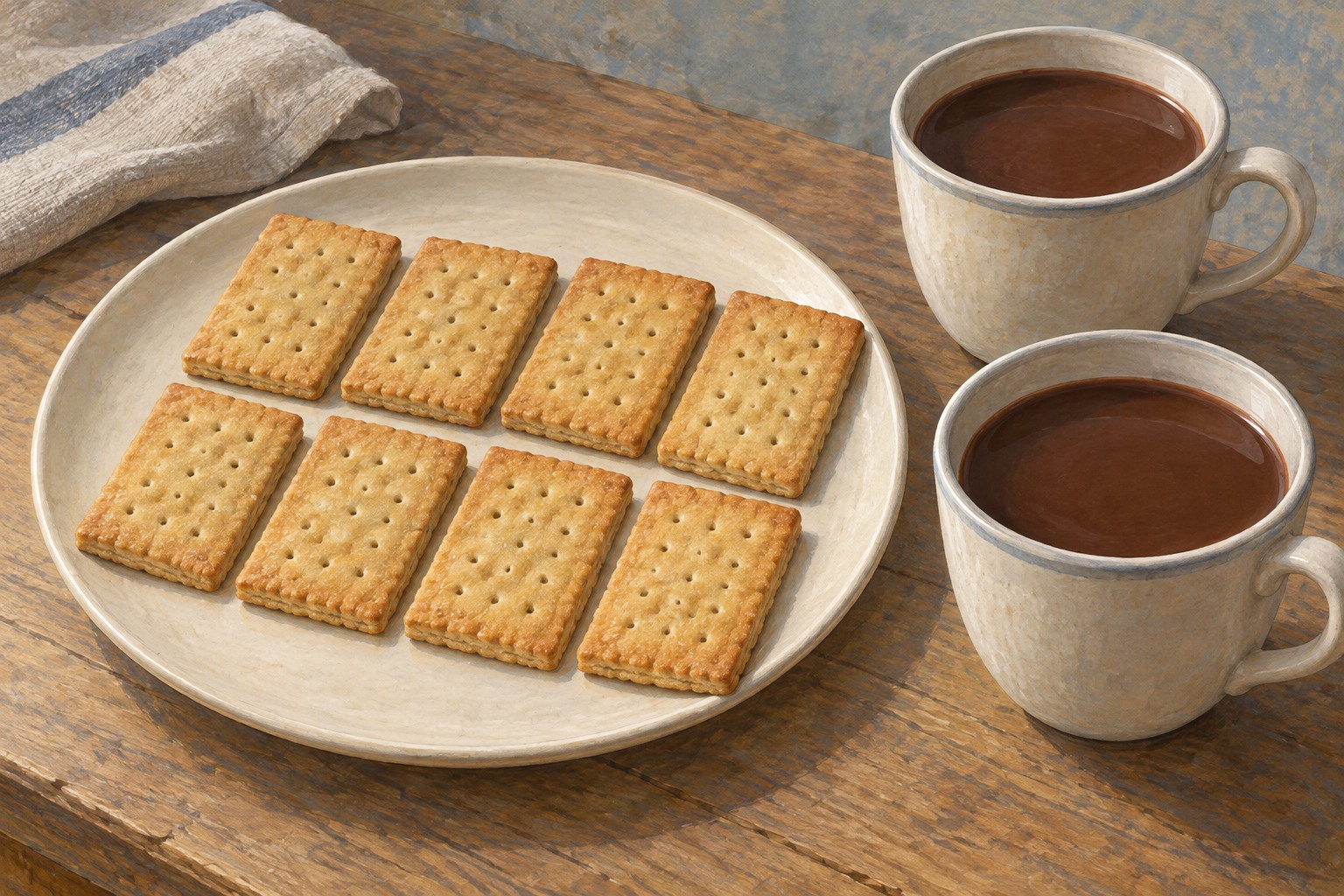
These thin, unleavened biscuits use a little butter for a crisp bite. A small pan of cocoa is mixed with water rather than milk. Biscuit and cocoa echo two named components; pemmican is deliberately omitted. The formula, sweetening, shape, oven and household portions are modern choices.
Rest the dough before asking it to roll
This small dough has much less fat than a shortbread and no raising agent. A covered rest gives the flour time to absorb its measured water and makes the rectangle easier to roll without tearing. Use the ruler for thickness as well as length. If one side is thicker, roll that area before cutting rather than expecting the longer drying stage to correct an uneven sheet.
Two temperatures, one crisp center
The first bake sets the shape and starts a little color. Turning and lowering the heat gives the middle more time to dry without making the edges very dark. Break one biscuit to check a fully baked center instead of tasting dough. Judge crispness only after cooling. Keep them pleasantly crisp and biteable; there is no reason to imitate the extreme hardness of a long-stored ration.
Make a smooth paste before adding the water
Cocoa powder tends to sit in dry islands when added straight to a pan of water. Work it with the sugar and the small measured portion of water first, then whisk that paste into the hot remainder. The drink will be lighter than milk cocoa and can settle as it stands. Stir before dividing it so one cup does not receive all the cocoa sediment.
Ingredients
- About 3/4 cup plus 1 tablespoon all-purpose flour (100 g), weighed, plus up to 2 teaspoons (5 g) for rolling
- 2 teaspoons cold unsalted butter (10 g), finely diced
- 1 1/4 teaspoons granulated sugar (5 g) for the biscuits
- Scant 1/4 teaspoon fine salt (1 g) for the biscuits
- 3 tablespoons drinking water (45 ml) for the dough
- 2 tablespoons unsweetened cocoa powder (10 g), not a sweetened drink mix
- 1 tablespoon granulated sugar (12 g) for the drink
- 1 1/2 cups drinking water (360 ml) for the cocoa, divided
Set out
Conventional oven, Kitchen scale, measuring jug and spoons, Mixing bowl, fork and cover, Clean board, rolling pin, ruler and dough scraper or knife, Rimmed metal baking sheet with usable flat base at least 12 x 10 in/30 x 25 cm, Baking paper rated for at least 350°F/175°C, Wire cooling rack and oven gloves, Small saucepan of at least 2 cups/500 ml, Small whisk and heatproof cup for the cocoa paste, Thin broad spatula for turning the biscuits, 2 heatproof drinking cups, each at least 1 cup/240 ml
Allergens
Wheat; Milk from butter. Read the flour, butter and cocoa labels for ingredients and cross-contact warnings. No dairy appears in the water-cocoa itself, but the biscuits contain butter; this is not an allergen-free serving.
Make it
- Mix the 100 g flour, biscuit sugar and salt. Rub in the cold butter with clean fingertips until no large pieces remain. Add the 45 ml dough water and stir, then press and knead briefly into a firm, cohesive dough. Cover and rest for 20 minutes. Do not taste raw dough; wash flour-dusted hands and tools before handling ready-to-eat food.
- During the rest, heat the oven to 350°F/175°C, conventional, with a middle rack. Line the cold tray with suitable baking paper. Use only as much of the measured rolling flour as needed. Roll the dough into an 8 x 6 1/4 in/20 x 16 cm rectangle, about 1/6 in/4 mm thick. Square the edges by pressing the dough inward, not by throwing away trimmings. Cut 4 columns and 2 rows to make 8 rectangles, about 2 x 3 1/8 in/5 x 8 cm each; divide any trimming evenly among them and roll those pieces to the same thickness.
- Place all 8 biscuits in one layer on the tray, leaving at least 3/8 in/1 cm between them. The 4-by-2 arrangement occupies about 9 x 6 3/4 in/23 x 17 cm before the surrounding clear tray space. Prick each biscuit in several places with a fork. Bake for 20–25 minutes, rotating the tray once, until the surfaces are set and the edges begin to color.
- Turn the biscuits with a spatula, reduce the oven to 300°F/150°C and bake for another 15–20 minutes. They should be lightly golden, dry and firm through their centers, with no wet or floury seam when a sacrificial edge is broken. Continue in short intervals if necessary. Move to the rack and cool completely, about 30 minutes; they become crisper as they cool. These are crisp household biscuits, not deliberately rock-hard preserved rations.
- Near the end of cooling, whisk the cocoa powder and drink sugar with 2 tablespoons/30 ml of the cocoa water in the heatproof cup until smooth. Heat the remaining 330 ml cocoa water in the saucepan. Whisk in the paste, bring to a gentle boil and simmer for 1 minute, whisking. Divide all the drink between the two cups, let it cool to a comfortable drinking temperature and serve each with 4 biscuits.
A useful detail
The dough weighs about 161 g before the optional rolling flour, roughly 20–21 g per raw biscuit. A 20 x 16 cm sheet at about 4 mm is a practical geometry target; keep the cut pieces uniformly thin rather than making thick blocks. The 120-minute schedule allows 25 active minutes, 20 minutes resting, up to 45 minutes baking and 30 minutes cooling, with the cocoa cooked during the final cooling stage. A thicker dough or slower oven needs longer. The drink uses its own 360 ml water; the 45 ml dough water is separate.
Keep it well
Cool the plain biscuits completely before closing them in a clean dry airtight container. For best texture, use within 2 days in a cool dry place, or freeze well wrapped for up to 1 month for quality; thaw covered. This short household storage guidance is not a shelf-stable or expedition-ration claim. Make the cocoa fresh if possible. Refrigerate any leftover drink separately within 2 hours, or 1 hour above 90°F/32°C, at 40°F/4°C or below; use within 1 day and bring back to a boil while whisking. Do not store biscuits soaking in the drink.
How this recipe relates to the story
An original domestic snack and drink inspired by two documented food categories. It does not reconstruct a ration, identify a historical biscuit recipe, equate the cup with a pannikin, or reproduce the whole supper. No raw dried meat, foraged ingredients, camp fuel or survival use is involved.
Another way
- For a slightly sweeter modern drink, increase only the cocoa sugar from 12 g to 16 g; keep the biscuit formula and both water allocations unchanged.