ANCIENT MEALS · 099 / 100
Lapita and early post-Lapita horticultural communities · Efate and nearby islands, Vanuatu · c. 1000–500 BCE
Evidence: archaeological reconstruction. The historical evidence and modern cooking choices are distinguished below.
Settlement carried a plant history
Early Pacific settlement involved more than a boat arriving at an empty shore. People also needed food resources and cultivation knowledge. Research using sedimentary biomarkers on Efate links evidence of human presence and taro cultivation near the beginning of settlement roughly 2800 years ago. It adds a line of evidence beyond the decorated pottery commonly associated with Lapita.
A study of diet at Teouma discusses animal foods, cultivated plants, and the possible availability of coconut in early Vanuatu. The evidence for each resource is not equally direct at every site. Our combination of taro and coconut is therefore a reconstruction within a Pacific food landscape, not an excavated parcel with a complete ingredient analysis.
A leaf keeps the mixture together
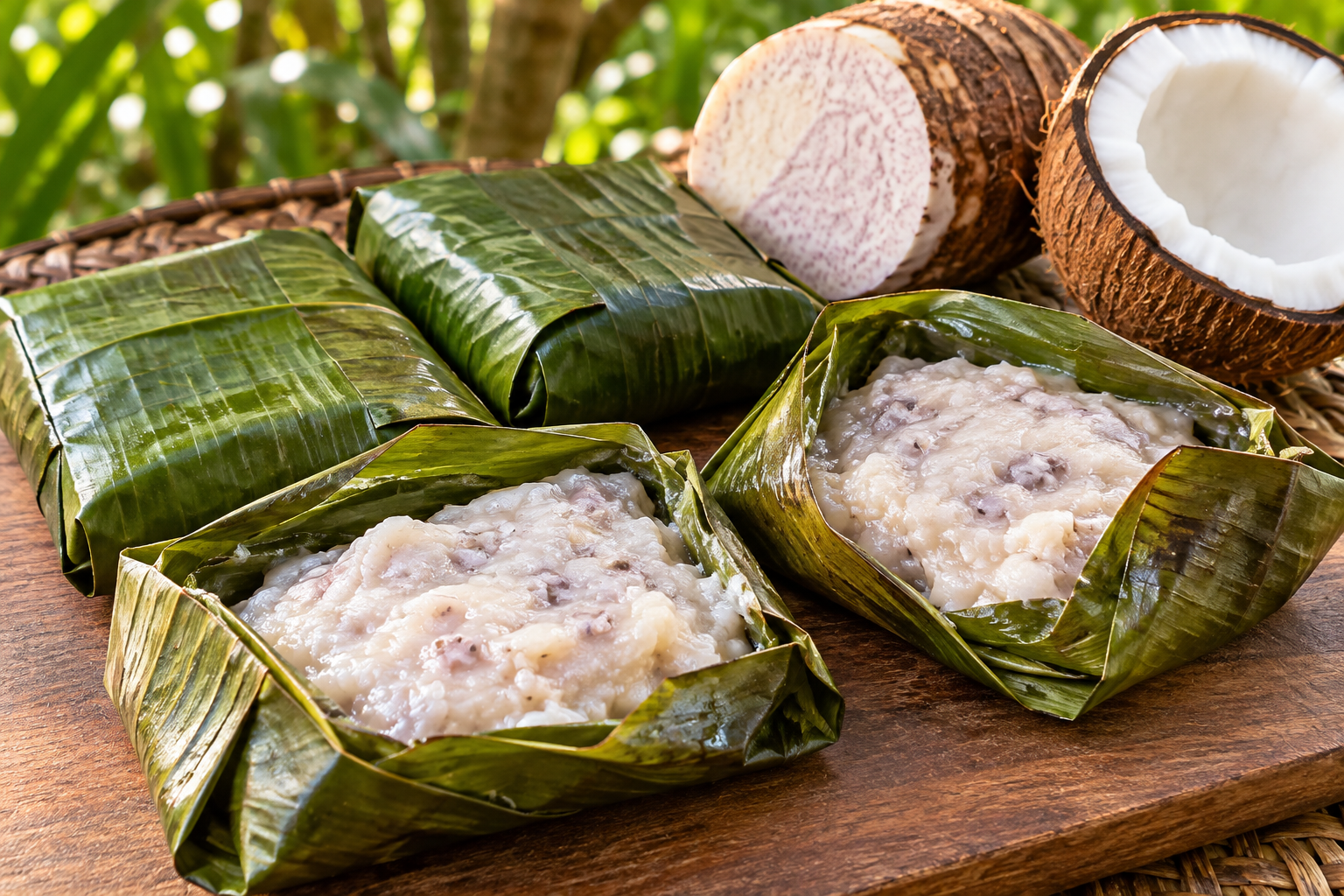
We boil commercially sold taro until fully tender, mash it with plain coconut milk, wrap portions in food-grade banana leaves, and bake them. The leaf-packet method gives a distinct enclosed texture and presentation. It is a modern plausible technique choice, not proved by the sedimentary biomarkers. No claim is made that a contemporary named laplap recipe is unchanged from the ancient period.
Taro requires thorough cooking. Raw corm and especially raw leaves can irritate because of their calcium oxalate crystals. Our recipe uses peeled food-grade corms and a full boiling stage before wrapping. Banana leaves are wrappers and are discarded. That modern safety design is separate from reconstructing ancient knowledge, which cannot be replaced by a romantic instruction to taste an unfamiliar plant.
What can travel, what must be tended
A crop can move with people, but a productive garden also needs suitable soil, water, and sustained work. A tree crop such as coconut has a different timetable from a harvested corm. Putting them into one modern dish lets us think about those differences without assuming every ancient household had them together at every meal.
Open the parcels at the table to show their pale mashed center and moist leaf surface. Taro cultivation and the broader food setting have researched support; coconut-milk proportion, banana wrapping, prior boiling, oven heat, and portion size are our interpretation. The food offers a practical introduction to early Pacific horticulture while leaving the limits of plant identification, dating, and cooking reconstruction visible.
Cooked-taro and coconut leaf parcels
Serves 4 · Preparation 30 min · Cooking 65 min · 5 minutes rest
A modern adaptation for home cooking. Times are approximate.
Ingredients
- 700 g commercial food-grade taro corms, peeled and cut into 3 cm cubes
- 200 ml plain unsweetened coconut milk
- 3 g salt, optional modern seasoning
- 4 pieces, about 30 × 30 cm food-grade banana leaves
Method
- Wear gloves if peeling taro irritates skin. Rinse cubes, cover with water, boil 25–35 minutes until completely tender; drain. Do not taste raw taro.
- Mash hot taro with coconut milk and optional salt.
- Heat oven to 190°C. Soften banana leaves with hot water and pat dry. Divide mixture into four portions and wrap each tightly, folding edges underneath.
- Place packets in a covered baking dish and bake 25–30 minutes until steaming hot throughout.
- Rest 5 minutes, open carefully and discard leaves before eating.
Substitutions and adjustments
- Commercial frozen plain taro can be used; cook fully according to package directions before mashing.
- Use baking paper as an explicit modern wrapper if food-grade banana leaves are unavailable.
Historical choices: Taro and the Pacific coconut-food setting are supported; this leaf-parcel formula and its safety-first cooking sequence are reconstructed.
Kitchen note: Taro must be thoroughly cooked; do not use raw taro leaves. Wrappers are discarded. Beware steam and refrigerate leftovers within 2 hours.
Sources and further reading
- Sedimentary biomarkers of human presence and taro cultivation, Efate. Primary evidence for early horticulture and taro-related biomarkers; no leaf-parcel recipe.
- Lapita Diet in Remote Oceania, Teouma. Peer-reviewed dietary context and discussion of plants/coconut availability; some plant inferences are indirect.