ANCIENT MEALS · 098 / 100
Middle Stone Age Border Cave communities · Lebombo Mountains, southern Africa · c. 170,000 years ago (approximately 168,000 BCE)
Evidence: historically informed adaptation. The historical evidence and modern cooking choices are distinguished below.
Plants near a very old fire
Ancient cooking did not begin with bread or a cultivated cereal. Wadley and colleagues' Science study reports charred rhizomes from Border Cave, identified by comparison of structure and anatomy with modern plants in the genus Hypoxis. The remains come from layers around 170,000 years old. That is evidence for the exploitation and heating of starchy underground plant parts, not a complete recipe or an agricultural field.
The KwaZulu-Natal Museum explanation describes the find and the likely plant identification. A small preserved food resource can broaden a story often told mainly through animal bones and stone tools. Plant foods do not become historically unimportant simply because they preserve less readily.
A safe substitute changes the dish
Our recipe uses commercially sold cultivated yam, not Hypoxis. This substitution is fundamental. The modern edible tuber gives a way to cook a starchy underground resource safely, but it cannot reproduce the ancient species' exact texture or taste. No foraging or plant-detoxification instruction is inferred from the cave material.
We boil peeled yam pieces until fully tender and roast them in a covered baking dish with a little water. The two-stage modern method controls heating and avoids the need to bury food in an uncertain fire. Salt and oil are optional modern additions; the plain version is equally usable. The source does not establish them, the size of a serving, or the ancient roasting timetable.
The difference between a resource and a recipe
A rhizome is an underground stem; a yam tuber has a different botanical identity. Calling both roots in casual conversation can hide those distinctions. The comparison here concerns a food function—starchy underground storage organs—not botanical equivalence. The article's historical date belongs to the Border Cave evidence, while today's recipe belongs to a cultivated food product.
Serve the soft warm pieces without implying a Stone Age side dish came with modern oil and salt. Its purpose is to make an important cooking insight tangible: plants gathered beneath the ground could be carried and heated long before farming. The safe modern adaptation accompanies that evidence honestly. It does not claim that the oldest known cooked rhizome supplies a recoverable menu, and it does not ask the reader to eat an ancient plant whose identity and preparation require expertise.
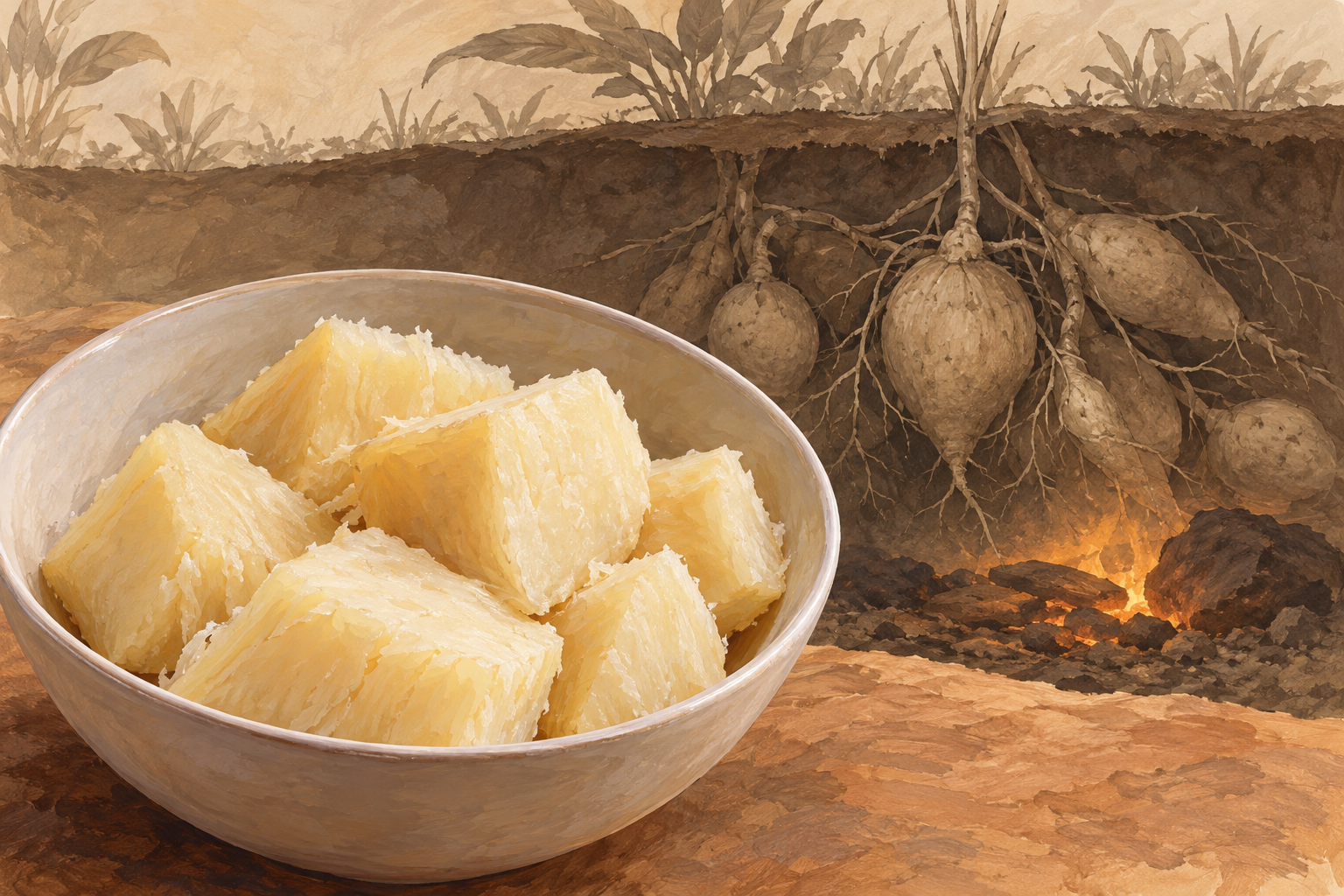
Covered roast of commercial cultivated yam
Serves 4 · Preparation 15 min · Cooking 55 min · None
A modern adaptation for home cooking. Times are approximate.
Ingredients
- 800 g commercial edible cultivated yam, peeled and cut into 4 cm pieces
- 100 ml water for covered roasting
- 15 ml neutral oil, optional modern addition
- 3 g salt, optional modern seasoning
Method
- Use only yam sold as edible food; peel and rinse. Cover with water in a saucepan.
- Bring to a full boil and simmer 15–20 minutes until tender through the center; drain.
- Heat oven to 200°C. Put yam in a baking dish with measured water and optional oil and salt.
- Cover tightly and bake 20 minutes. Uncover and bake 10–15 minutes to dry the surface slightly.
- Check that every piece is fully tender before serving.
Substitutions and adjustments
- Commercial sweet potato is a safe modern substitute, but changes plant and flavor further.
- Never substitute wild Hypoxis, unknown yams or other foraged underground plants.
Historical choices: Border Cave cooked Hypoxis rhizomes inspire the subject; commercially cultivated yam and this two-stage method are explicit modern substitutions.
Kitchen note: Do not forage or attempt detoxification. Use commercial edible cultivated yam and cook fully.
Sources and further reading
- Wadley et al., Cooked starchy rhizomes in Africa 170 thousand years ago. Primary Science-study abstract and citation; charred Hypoxis rhizomes, not a modern yam recipe.
- KwaZulu-Natal Museum, Border Cave cooked rhizomes. Museum explanation of find, age and likely identification; no home-foraging guidance.