ANCIENT MEALS · 097 / 100
Third-millennium BCE millet cultivation · Lower Tilemsi Valley and Sahel, Mali · c. 2500–2000 BCE
Evidence: historically informed adaptation. The historical evidence and modern cooking choices are distinguished below.
A cereal in the clay
Pottery can hold food evidence in its fabric as well as on its surface. Research on early pearl millet in the Lower Tilemsi Valley examined grains and plant material used in ceramic temper. The study considers both domestication traits and the challenge of dating organic components in pottery. A headline age should not replace its careful chronological discussion.
Later work on northern Malian ceramic temper traces a transition involving grain size and non-shattering structures. These are signs of changes in plants under cultivation, not a recipe. They make the Sahel a central part of grain history rather than merely a place where crops from elsewhere arrived.
A different way to cook flour
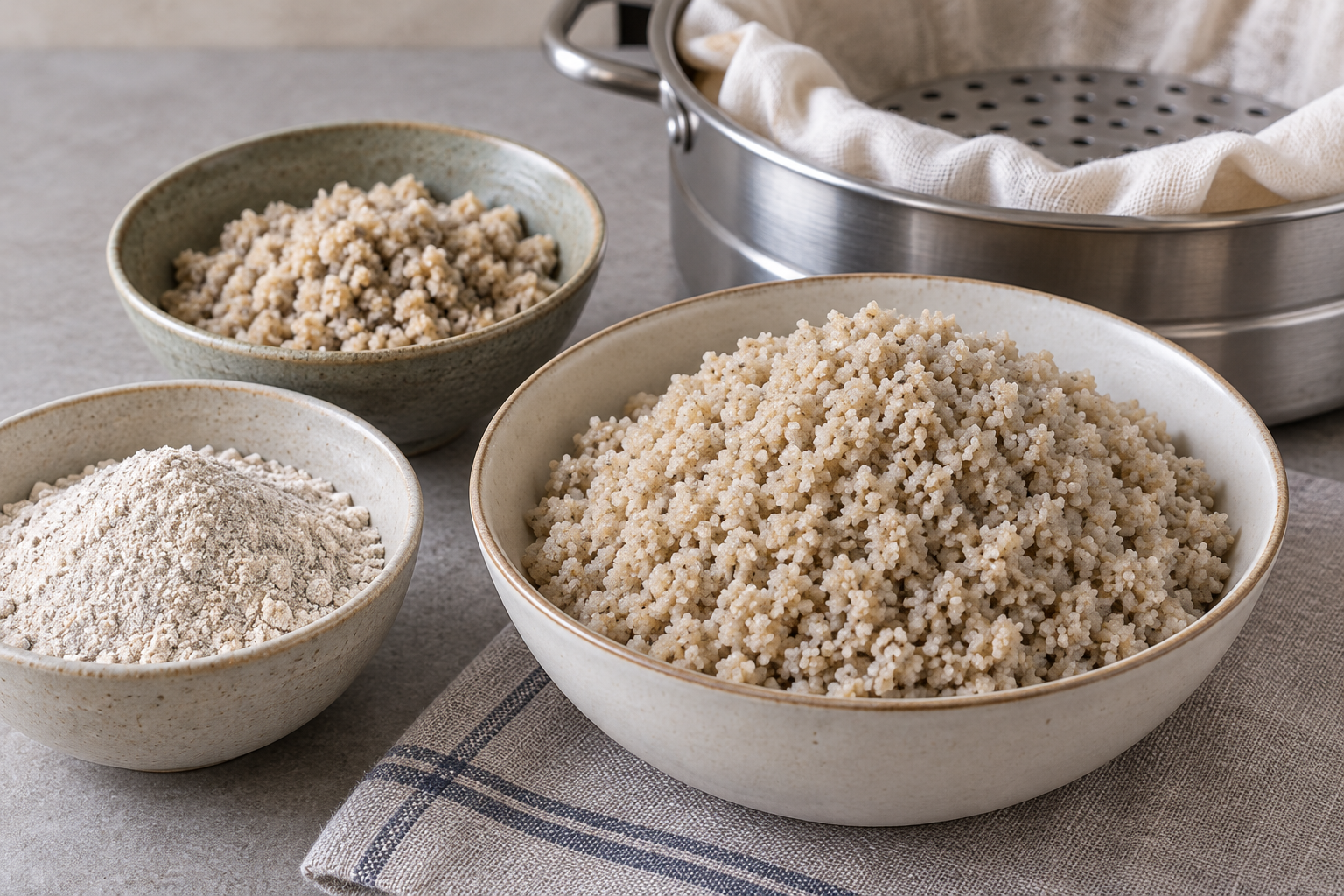
Our recipe dampens pearl-millet flour into small granules, steams them, fluffs them, and steams again. The loose granular format differs from a smooth porridge or a small flat cake. Pearl millet supplies the historical crop connection; the double-steaming technique is an explicitly modern adaptation, not established by the ancient chaff impressions.
Commercial pearl-millet flour may be sold as bajra flour. It is not interchangeable in the historical story with Chinese broomcorn or foxtail millet, which are different plants. Using the correct grain matters even when several English ingredient labels say millet. A fine sieve and lined steamer provide practical tools for keeping the granules separate.
A cooking method is not a dated claim
Do not call these the first couscous. A similar appearance cannot date a named dish or prove a continuous recipe tradition across thousands of years. The method is chosen because it gives an interesting, usable transformation of the documented cereal. The article keeps that choice separate from the archaeological argument about domestication.
Serve warm as a grain course, with a little plain oil stirred through. The flour's fineness may require adjustment of water. The instructions give texture checkpoints rather than an illusion of ancient precision. The evidence supports early Sahelian pearl millet; granulation, two steaming stages, seasoning, and quantities are ours. It is a way to taste a crop central to African agricultural history while recognizing that a potter's embedded chaff tells a different story from a cook's lost directions.
Twice-steamed pearl-millet granules
Serves 4 · Preparation 30 min · Cooking 40 min · 5 minutes between steaming stages
A modern adaptation for home cooking. Times are approximate.
Ingredients
- 250 g commercial pearl-millet flour (bajra)
- 100–140 ml water for initial granulation
- 40 ml additional water for second steaming
- 15 ml neutral cooking oil
- 3 g salt
Method
- Mix flour and salt in a wide bowl. Sprinkle in initial water a tablespoon at a time while rubbing with fingertips to form small damp crumbs, not a smooth dough.
- Pass crumbs through a coarse sieve or break large clumps by hand. Line a steamer with a clean fine-weave food-safe cloth.
- Spread crumbs loosely and steam over simmering water 20 minutes.
- Tip into a bowl carefully. Sprinkle with 40 ml water, separate clumps with a fork and let stand 5 minutes.
- Return to steamer and cook another 20 minutes until fully cooked and tender. Fluff, mix with oil, and serve.
Substitutions and adjustments
- Use packaged plain pearl-millet couscous if available, following its directions and identifying it as a modern prepared product.
- Broomcorn millet flour changes the defining crop and is not a historical equivalent.
Historical choices: Pearl millet is attested in early Tilemsi evidence; the loose twice-steamed granule method is a modern interpretation.
Kitchen note: Use a stable steamer, keep cloth away from flames, and beware trapped steam. Do not taste uncooked flour.
Sources and further reading
- Manning et al., early domesticated pearl millet in Tilemsi. Primary grain and ceramic-temper research with explicit dating caveats; no steamed-granule recipe.
- Transition from Wild to Domesticated Pearl Millet in Northern Mali. Peer-reviewed analysis of domestication traits from ceramic temper; no dated couscous claim.