ANCIENT MEALS · 096 / 100
Dia and early Jenné-jeno food-resource context · Middle Niger Delta, Mali · c. 500 BCE–500 CE
Evidence: historically informed adaptation. The historical evidence and modern cooking choices are distinguished below.
A rice with its own African history
African rice, Oryza glaberrima, has a history distinct from Asian Oryza sativa. Research at Dia examined ancient grains and dates from the first millennium BCE onward. The study also explains why distinguishing wild from domestic African rice is difficult when protective parts of a seed are absent. A food-history story should preserve that problem rather than declare every early grain unambiguous.
Archaeological work on early Inland Niger Delta subsistence identifies a resource complex involving rice, fish, and cattle. Floodplain food production and aquatic resources helped sustain settlements. Our article focuses on the early portion of this long history, not on the later Mali Empire or a famous modern rice dish.
From rice flour to dumpling
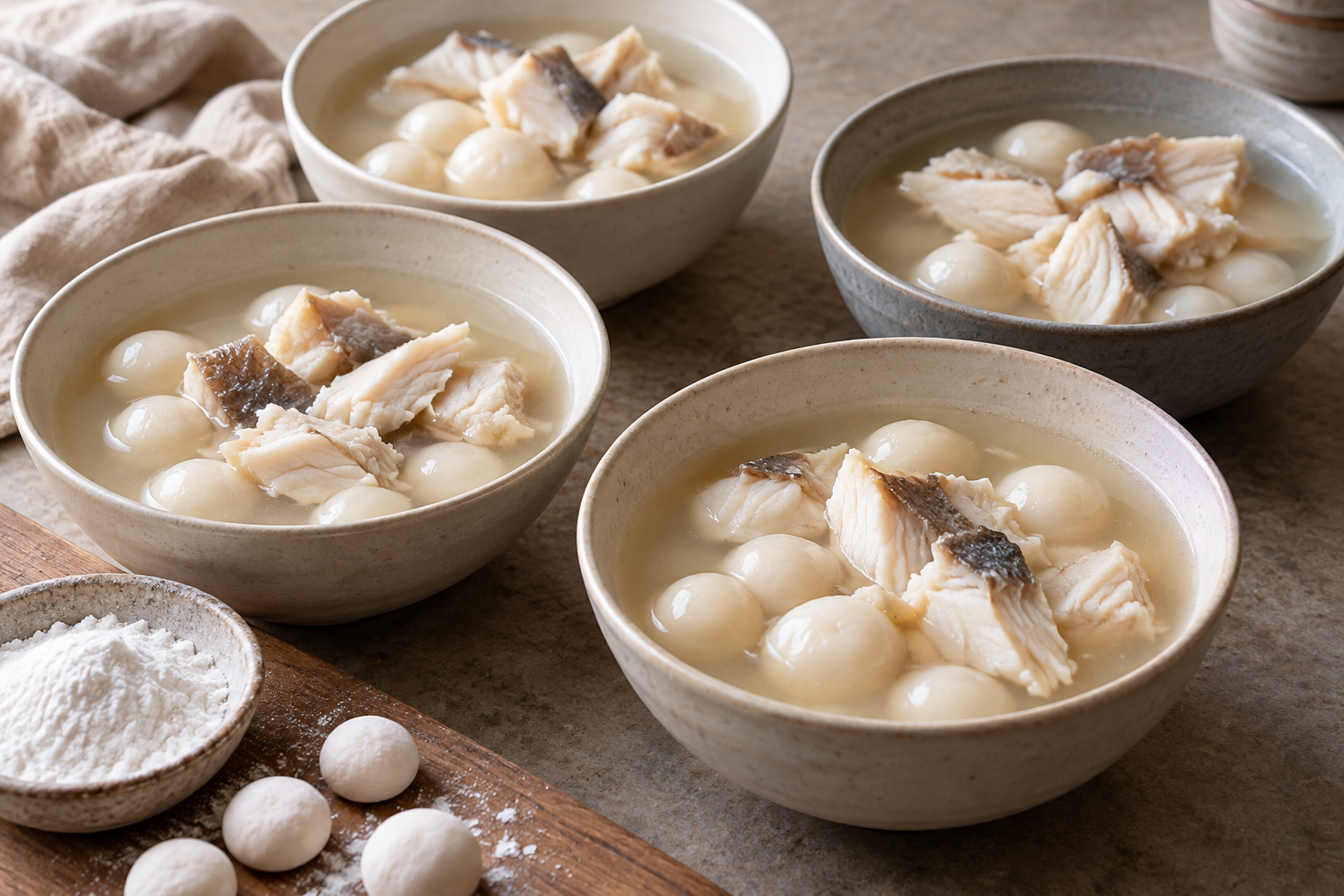
Our recipe cooks rice flour with boiling water into a firm paste, shapes small dumplings, and serves them in a plain freshwater-fish broth. That format is openly modern. The ancient studies support the regional resources; they do not describe rice dumplings or this cooking sequence.
Food-grade African-rice flour is difficult to buy in many places, so commercial plain Asian-rice flour is an explicit practical substitute. The replacement must not disappear from the historical account. It changes the species, processing, and potentially the texture. A cook with labeled edible African rice and a suitable grain mill may prepare flour from it, but the recipe does not require improvised milling.
A river is part of the meal
Fish is more than a garnish in this preparation. Its gentle cooking creates the broth after the dumplings have nearly finished. Boneless commercially sold freshwater fish replaces uncertain ancient species and avoids using preservation methods that the archaeological summary does not detail. Salt is our measured seasoning, and no modern tomato-rich sauce is projected into the early delta.
Serve the dumplings with large fish flakes so both components remain visible. Its measurements and hot-water dough method are adaptations, designed to make a distinct flour food rather than another minor variant of absorption-cooked rice. The historical value lies in bringing a separate rice-domestication history and an aquatic landscape into view. The usable modern recipe accompanies that evidence without claiming the evidence supplied a complete ancient formula.
Rice-flour dumplings in freshwater-fish broth
Serves 4 · Preparation 30 min · Cooking 25 min · 5 minutes dough cooling
A modern adaptation for home cooking. Times are approximate.
Ingredients
- 200 g food-grade African-rice flour, or commercial plain white rice flour as an explicit substitute
- 220–250 ml boiling water for dough
- 500 g boneless commercial freshwater fish fillet
- 1.3 litres water for broth
- 4 g salt, divided
Method
- Mix rice flour with 2 g salt in a heatproof bowl. Pour in 220 ml boiling water while stirring; add a little more if dry patches remain.
- Transfer paste to a saucepan over low heat and stir 2–3 minutes until it gathers into a firm mass. Let cool 5 minutes until safe to handle.
- With damp hands form twenty small dumplings about 2.5 cm wide. If dough is too soft, cool further before shaping.
- Bring broth water and remaining salt to a gentle boil. Add dumplings and simmer 10–12 minutes until cooked through; stir very gently.
- Add fish in large pieces and simmer another 6–10 minutes until it reaches 63°C and flakes. Check for bones and serve.
Substitutions and adjustments
- Plain commercial rice flour is usually Oryza sativa, a named modern species substitution.
- Use boneless tilapia, trout or another mild commercially sold freshwater fish; species is a modern choice.
Historical choices: African rice and fish are archaeologically supported in the delta; the flour-dumpling format and fish broth are a modern interpretation.
Kitchen note: Handle boiling-water dough cautiously; use boneless safe-source fish and cook to 63°C. Refrigerate leftovers within 2 hours.
Sources and further reading
- Murray, Searching for African rice domestication. Specific Dia rice dating and identification limits; no dumpling recipe.
- McIntosh and McIntosh, prehistoric subsistence in the Inland Niger Delta. Primary research describes rice, fish and cattle resource complex; no exact broth or flour technique.