ANCIENT MEALS · 095 / 100
Aksumite period, including Beta Samati · Northern Ethiopian highlands · c. 300–650 CE
Evidence: historically informed adaptation. The historical evidence and modern cooking choices are distinguished below.
Tiny grain at a substantial town
Teff's tiny seeds can be easy to overlook, yet they matter in the agricultural history of the Ethiopian highlands. Excavation research at Beta Samati reports charred teff, wheat, and barley among the plant remains. Its wider sequence includes periods before and after the dates selected here; the assemblage should not be treated as a precise menu for a single year.
Research on Aksumite crop cultivation describes the interaction of locally important cereals with Near Eastern crops, including lentils. This is a food landscape shaped by both continuity and exchange. The presence of teff does not automatically prove that today's injera preparation was practiced in the same form in ancient Aksum.
A soft baked slab, not a copied injera
Our adaptation cooks teff flour into a thick batter, folds in tender lentils, and bakes one shallow slab. It is served by spoon or cut into soft squares. The format makes it materially different from small pulse griddlecakes: a precooked cereal gel, whole cooked lentils, and one moist oven-baked dish are the defining features.
No ancient Aksumite spoon-bread recipe is preserved in the cited studies. Spoon bread is a useful modern description, not an ancient local name. We do not use home fermentation or claim that an unfermented dish recreates injera's flavor. The crop connection is historical; the assembly and baking are deliberate adaptations chosen to give those ingredients a cookable present-day form.
Archaeology is more than an ingredient list
Crop remains can illuminate choices about land, water, seasons, storage, and connections between communities. A cereal may be locally adapted while a pulse has an older history of arrival from elsewhere. Their presence together makes interesting questions possible, but does not tell us whether every household combined them in one dish.
Serve the warm slab in its baking dish and show the lentils across the cut surface. Commercial teff flour and a conventional oven replace the processing and heat equipment that would need separate investigation. Our quantities, salt, oil, soft texture, and cooking schedule are modern. The dish is an honest companion to an Aksumite crop story, with its inventions named and its regional ingredients kept central rather than turning a famous modern bread into unsupported ancient certainty.
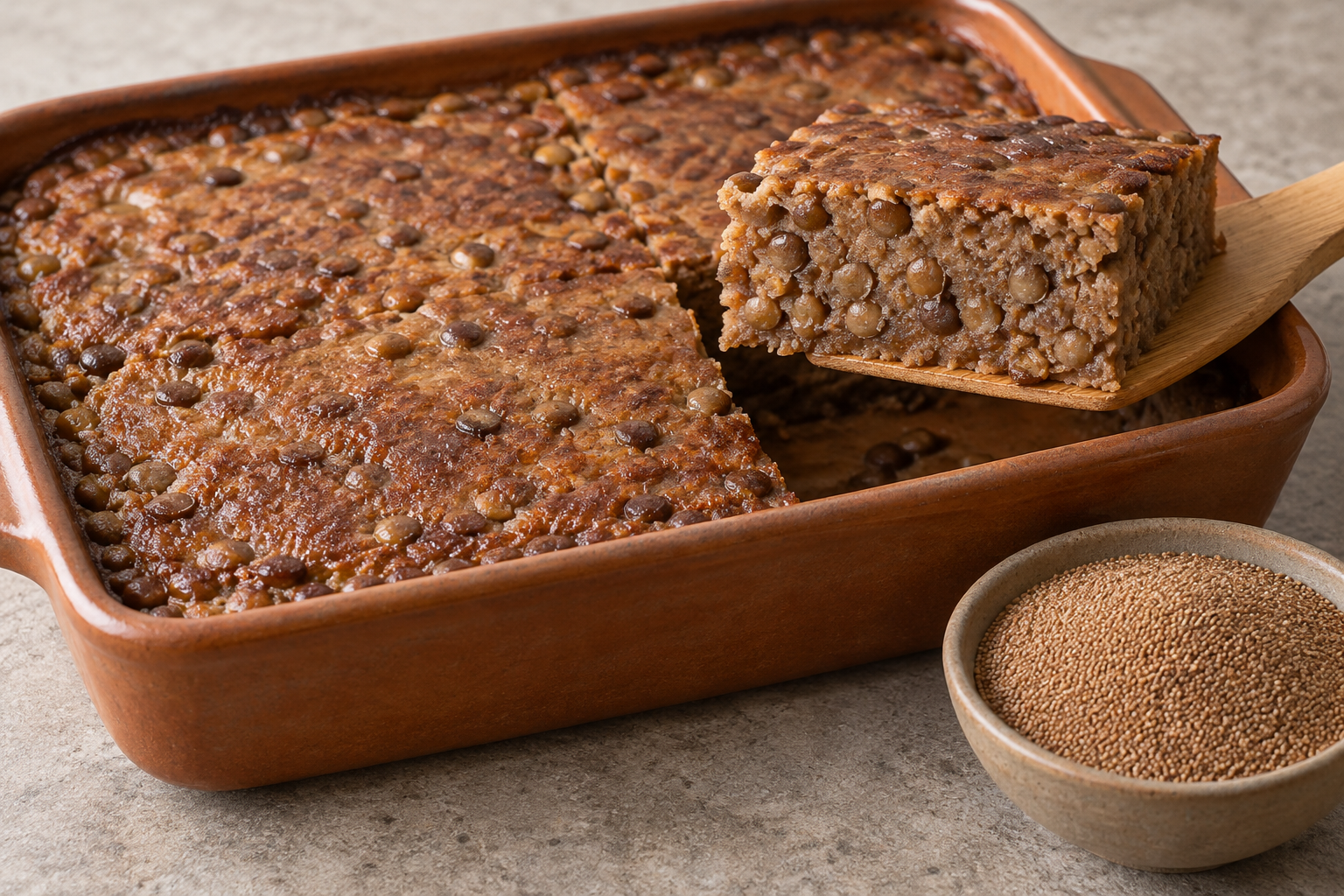
Soft teff-and-lentil baked slab
Serves 4 · Preparation 20 min · Cooking 55 min · 10 minutes rest
A modern adaptation for home cooking. Times are approximate.
Ingredients
- 160 g teff flour
- 600 ml water
- 300 g fully cooked plain brown lentils, drained
- 25 ml neutral cooking oil, divided
- 4 g salt
Method
- Heat oven to 190°C. Oil a shallow baking dish about 20 × 25 cm with 5 ml oil.
- Whisk teff flour into measured cold water in a saucepan. Bring slowly to a simmer, stirring constantly; cook 8–10 minutes until thick and smooth.
- Stir in lentils, remaining oil and salt. Spread about 2–3 cm thick in the dish.
- Bake 35–40 minutes until the surface firms and lightly browns and the center is hot throughout. Rest 10 minutes.
- Serve by spoon or cut into soft squares; it is intentionally not an airy risen bread.
Substitutions and adjustments
- Use commercial cooked canned lentils to simplify preparation.
- Millet flour can replace teff as a modern change, losing the defining regional crop.
Historical choices: Teff at Beta Samati and lentils in the Aksumite crop landscape are supported; the unfermented soft baked-slab format is a modern adaptation.
Kitchen note: Cook flour mixture fully and use completely cooked lentils. No home fermentation. Refrigerate leftovers within 2 hours.
Sources and further reading
- Harrower et al., Beta Samati discovery and excavation. Specific Aksumite-town crop evidence including teff, wheat and barley; no spoon-bread recipe.
- Ruiz-Giralt et al., Sorghum and Finger Millet Cultivation during the Aksumite Period. Regional agricultural context including lentils and mixed crop traditions; PDF research, not a precise baking method.