ANCIENT MEALS · 094 / 100
Eastern Agricultural Complex seed traditions · Eastern Woodlands, North America · c. 1800 BCE–500 CE
Evidence: historically informed adaptation. The historical evidence and modern cooking choices are distinguished below.
A crop can vanish from ordinary shopping
Ancient eastern North American farming included a cultivated goosefoot, Chenopodium berlandieri, whose domesticated form is no longer an everyday commercial grain. Bruce Smith's synthesis of regional domestication discusses the seed evidence, including changes in seed coats that help distinguish cultivated plants. A modern field full of wild lambsquarters is not automatically the same resource as an ancient domesticated crop.
The study of the cultural context of eastern North American domestication places such seed crops within changing food-production practices. These histories deserve attention even where the crop did not remain globally important. Survival in today's economy is not a reliable measure of ancient significance.
A substitute must remain a substitute
Our crackers use commercial quinoa flour, from the related South American Chenopodium quinoa. This is an explicit botanical and practical substitution. It does not claim that quinoa was grown in the ancient Eastern Woodlands or that two species are interchangeable as historical evidence. Naming the replacement is more useful than encouraging a reader to gather unidentified wild seeds.
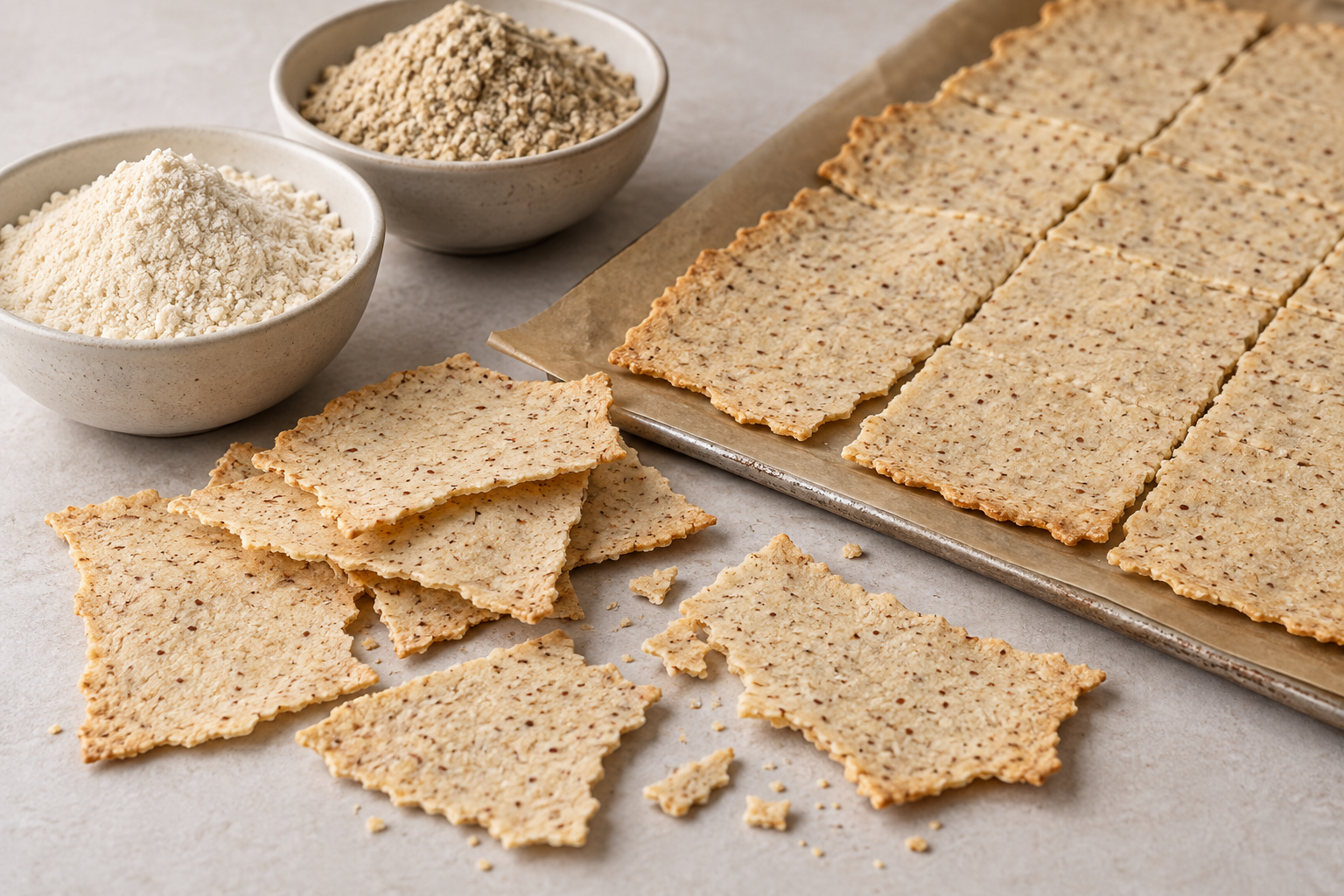
Thin baking creates a crisp food very different from boiling small seeds into gruel. No cited archaeological source supplies an ancient cracker formula, so the format is modern. Water and a little sunflower oil make a dough that can be rolled between sheets and baked thoroughly. Ground sunflower kernels add texture; they are historically relevant to the regional crop story, but this combination is still our choice.
What a missing crop teaches
A vanished domesticate can make the relationship between agriculture and taste less obvious. We often picture farming through plants we buy now. Archaeological seeds show that other choices were made, maintained, and eventually changed. Some food knowledge survived, some transformed, and some no longer has a direct culinary counterpart.
Break the cooled sheet into irregular crackers and serve them plain. The evidence anchors the cultivated goosefoot history; commercial quinoa, oil proportion, rolling, baking, and cracker form are a declared modern adaptation. The recipe cannot reproduce the extinct crop's flavor, but it gives a cook a usable way to think about small-seed flour. Its honesty lies in making the missing ingredient visible in the story rather than quietly replacing it and claiming authenticity.
Quinoa-and-sunflower small-seed crackers
Serves 6 · Preparation 20 min · Cooking 25 min · 10 minutes dough rest; 20 minutes cooling
A modern adaptation for home cooking. Times are approximate.
Ingredients
- 160 g commercial quinoa flour
- 40 g sunflower kernels, finely ground
- 110–130 ml water
- 20 ml sunflower oil
- 3 g salt
Method
- Heat oven to 180°C. Mix flour, ground kernels and salt.
- Add oil and 110 ml water, mixing to a firm dough; add more water by teaspoons if it cracks badly. Rest 10 minutes.
- Roll between baking-paper sheets to about 2 mm thick. Transfer to tray, remove top sheet and score into squares.
- Bake 20–25 minutes until dry and lightly browned, rotating the tray once. If the edges finish first, remove them and continue cooking the center.
- Cool completely, then break along scored lines and serve.
Substitutions and adjustments
- Quinoa flour is an explicit substitute for the unavailable ancient Eastern Woodlands domesticated goosefoot.
- Do not use wild goosefoot seeds without expert identification and food-processing knowledge; this recipe does not provide that.
Historical choices: Ancient cultivated goosefoot is the historical subject; South American quinoa flour and the crisp cracker format are modern substitutions.
Kitchen note: Use commercial edible seed flour and bake fully; do not taste raw dough.
Sources and further reading
- Smith, Eastern North America as an independent plant-domestication center. Primary synthesis of cultivated goosefoot and regional seed crops; distinguishes wild and domesticated evidence.
- Smith, Cultural Context of Plant Domestication in Eastern North America. Peer-reviewed context for regional cultivation milestones; no cracker recipe or ancient quinoa claim.