ANCIENT MEALS · 091 / 100
Jiskairumoko Late Archaic–Early Formative communities · Western Lake Titicaca Basin, southern Peru · c. 3400–1600 BCE
Evidence: archaeological reconstruction. The historical evidence and modern cooking choices are distinguished below.
A tuber leaves a microscopic trace
A potato rarely preserves as neatly as a charred grain. At Jiskairumoko, investigators recovered starch from groundstone tools and compared it with reference samples. Their PNAS study identifies a group of starches consistent with cultivated or domesticated potato. It argues for intensive plant exploitation, while retaining caution about the exact trajectory of cultivation and domestication. Those careful phrases are more informative than a simple headline announcing the first potato.
The site dates roughly from 3400 to 1600 BCE, placing it in a transition toward more settled livelihoods and food production. Berkeley's archaeological overview of Andean work situates Titicaca Basin research within broader investigations of crop and animal domestication. An ingredient's beginnings are studied through many kinds of evidence, not recovered as one tidy origin event.
Cooking today's edible potato
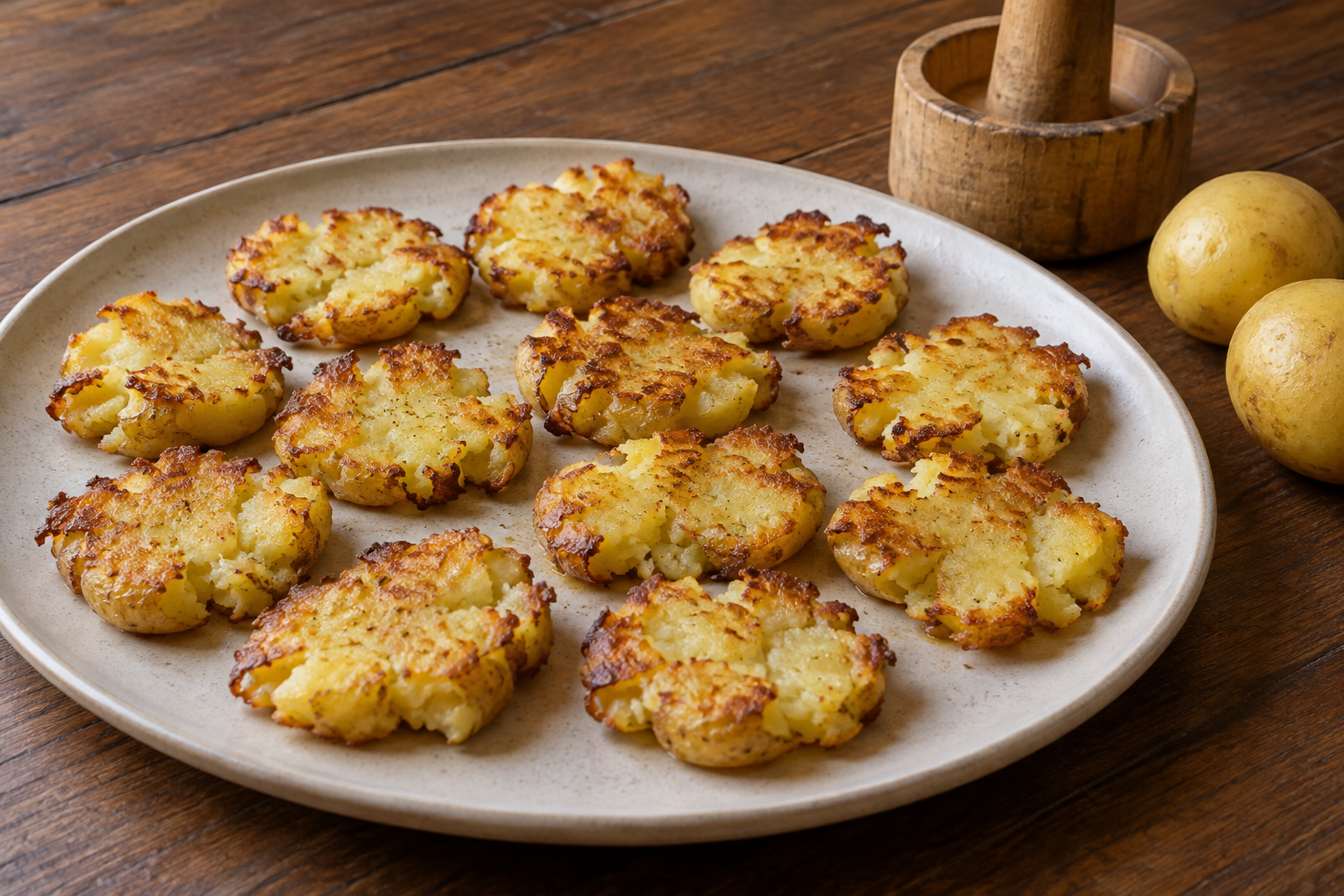
Our preparation boils commercial potatoes, crushes them into thick discs, and roasts them until their surfaces develop a crust. The crushing step makes the groundstone story tangible, but it is not proof that ancient Jiskairumoko cooks made smashed potatoes. No finished disc or roast recipe is identified in the study.
Modern cultivated potatoes are a deliberately safe choice. We do not recommend wild Andean tubers, green potatoes, clay dipping, or a home detoxification procedure. Ancient people possessed knowledge suited to particular plants; copying an isolated historical practice without the plant identity and expertise would make a poor cooking instruction. A contemporary oven and a little oil create a clear, controlled method.
Processing matters as much as growing
The food changes at each stage: a firm tuber softens in hot water, crushing exposes a wider surface, and dry heat makes crisp edges. Such transformations are reasons to examine tools rather than treating them as incidental objects. They can point to work that seeds or pollen alone do not show.
Serve several discs per person, showing their pale interior and browned surface. The historical evidence supports ancient potato processing at the named site; boiling, crushing into discs, oil, roasting temperature, quantities, and serving style are reconstructed. It offers an edible way to think about starch and tools while preserving the important distinction between identifying a plant and knowing exactly how someone cooked it.
Boiled-and-roasted crushed potato discs
Serves 4 · Preparation 15 min · Cooking 55 min · 5 minutes drying
A modern adaptation for home cooking. Times are approximate.
Ingredients
- 900 g small commercial potatoes, about 12
- 25 ml neutral cooking oil
- 4 g salt
Method
- Discard green, heavily sprouted or spoiled potatoes. Scrub remaining potatoes.
- Put in a saucepan, cover with water, bring to a boil and simmer 15–20 minutes until tender through the center. Drain and dry 5 minutes.
- Heat oven to 220°C. Put potatoes on a lined tray and press each gently with a flat cup into a thick disc about 1.5 cm.
- Brush with oil and sprinkle salt. Roast 25–30 minutes, turning once if practical, until surfaces brown. Serve hot.
Substitutions and adjustments
- Use commercial purple or yellow potatoes; variety changes texture and color.
- Do not substitute unidentified wild potatoes.
Historical choices: Potato microremains on grinding tools support early processing; these boiled-and-roasted discs are a declared modern reconstruction.
Kitchen note: Discard green and spoiled potatoes; use only commercial edible cultivars. No detoxification or edible-clay practice is reproduced.
Sources and further reading
- Rumold and Aldenderfer, potato evidence at Jiskairumoko. Primary microbotanical study; identifies starch consistent with cultivated/domesticated potato, not a recipe.
- Berkeley Archaeological Research Facility, Andes. University context for Titicaca Basin agricultural archaeology; no roast technique claimed.