ANCIENT MEALS · 086 / 100
Teotihuacan urban maize preparation · Basin of Mexico · c. 100–650 CE
Evidence: archaeological reconstruction. The historical evidence and modern cooking choices are distinguished below.
An ancient city needed lunch
Monuments draw visitors' eyes upward. Food production asks where the workers' daily meals came from. Martin Biskowski's study of staple preparation at Teotihuacan examines grinding stones and comales, the flat cooking surfaces associated with maize foods. Their distribution suggests specialized production in some areas of the city, with tortilla preparation potentially helping sustain large work projects. This is an archaeological interpretation of equipment and spatial patterns, not a surviving worker's menu.
Maize was a central crop, but the plant has a long, complicated domestication history. Smithsonian reporting on multidisciplinary research describes movement and improvement across regions. A modern cob or bag of flour is not biologically identical to all maize grown in the ancient city. Crop histories and finished foods must be connected carefully.
A thin disc makes a distinct food
Our recipe uses nixtamalized masa harina, already prepared commercially from alkali-treated maize. Add water, portion, flatten, and cook on a dry griddle: those actions make a thin, flexible food quite different from a steamed tamal. The key is an evenly hydrated dough. Cracked edges indicate that it needs a little more water; a sticky surface suggests too much.
We use a tortilla press or two flat surfaces with food-safe plastic sheets. That is modern convenience, not excavated Teotihuacan equipment. We also avoid home ash or construction-lime treatment. A commercial product supplies a safer, predictable starting material, while the article keeps the historical role of maize processing visible.
Meals could involve specialists
Grinding is labor, not merely a picturesque background to cooking. A concentration of preparation tools can suggest households or groups producing beyond their immediate needs. It also raises questions about fuel, supply, trade, and who performed daily tasks. The archaeological study gives those questions a spatial basis without naming every ancient cook.
Make twelve small tortillas and serve immediately wrapped in a clean cloth. Its historical anchor is maize dough cooked on a flat heated surface within an urban production setting; hydration ratio, disc size, press, skillet, and timings are ours. These plain tortillas are complete food rather than a vehicle for an anachronistic filling. Their simplicity makes it easier to notice the cereal's aroma and the considerable technology hidden behind a thin round.
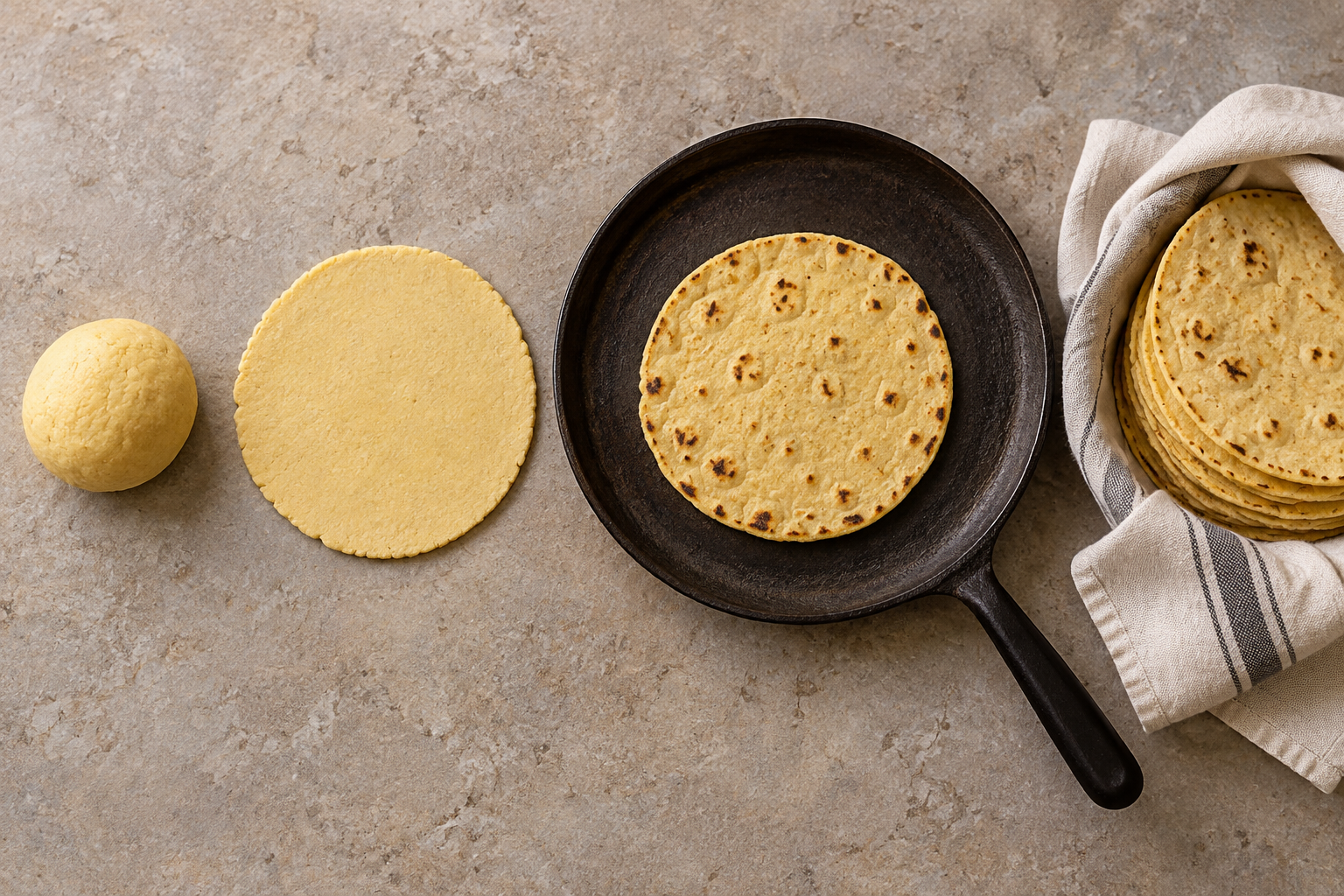
Plain nixtamalized maize griddle tortillas
Serves 4 · Preparation 25 min · Cooking 20 min · 15 minutes dough rest
A modern adaptation for home cooking. Times are approximate.
Ingredients
- 250 g commercial nixtamalized masa harina
- 330–370 ml warm water
- 3 g salt
Method
- Mix masa harina, salt and 330 ml warm water. Knead 2 minutes, cover and rest 15 minutes.
- Add water by teaspoons if edges crack when flattened. Divide into twelve balls.
- Flatten each between food-safe sheets using a press or a heavy flat pan, to a disc about 14 cm wide and 2 mm thick. Peel sheets away.
- Heat a dry heavy skillet over medium-high heat. Cook each tortilla about 45–60 seconds on the first side, 60–90 seconds on the second, then briefly turn again until fully cooked with brown spots.
- Keep cooked tortillas wrapped in a clean cloth and serve warm.
Substitutions and adjustments
- Fresh commercial nixtamalized masa can be used; it already contains water, so add only what its texture needs.
- Plain cornmeal is not a direct substitute for masa harina.
Historical choices: Comales and grinding equipment support ancient maize-food production. Disc dimensions and the commercial flour method are a modern reconstruction.
Kitchen note: Use commercial food-grade nixtamalized flour; do not use construction lime or unidentified ash. Cook dough fully.
Sources and further reading
- Biskowski, Staple food preparation at Teotihuacan. Primary archaeological research on comales, grinding tools and specialized maize preparation; no hydration formula.
- Smithsonian, revised corn domestication history. Research context for maize movement and development; no claim modern flour equals an ancient variety.