ANCIENT MEALS · 082 / 100
Yayoi agricultural and coastal foodways · Kyushu and western Japan · c. 300 BCE–250 CE
Evidence: archaeological reconstruction. The historical evidence and modern cooking choices are distinguished below.
A paddy did not erase the coast
The introduction and expansion of wet rice farming changed livelihoods in ancient Japan, but it did not remove older sources of food. A National Museum of Japanese History study of Yayoi animal foods examines the diversity of animal resources within rice-growing western Japan. Hunting and aquatic foods need to be considered alongside grain, rather than imagined as a separate world that ended when fields appeared.
Rice cooking itself is not settled by simply finding rice. The research on scorching and soot in Yayoi cooking pots argues for absorption boiling as an important method. By contrast, Yoshinogari Historical Park's public guide discusses porridge as a possible interpretation of grain residues and ladles. These accounts show why a charred crust can be as informative as a seed, and why evidence must be interpreted.
A reconstructed mixed pot
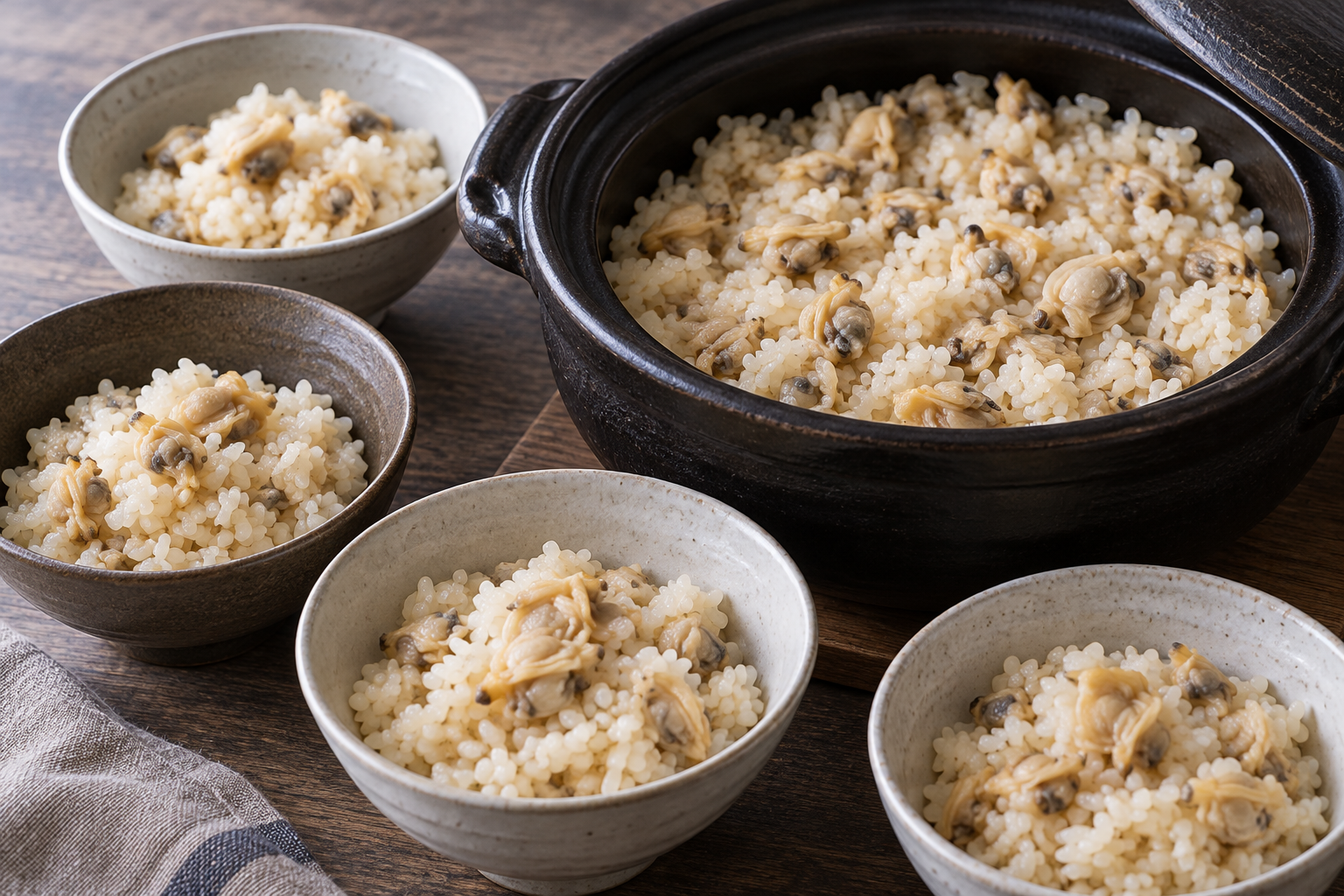
Our meal uses short-grain rice with cooked clam meat. The combination is a plausible way to bring cereal and coastal food into one vessel; no cited pot has yielded this exact recipe. Commercial clam meat makes the preparation convenient and avoids guessing which ancient shell species a modern shop should supply. Plain water rather than a modern dashi concentrate keeps the ingredient list focused.
We cook the rice by absorption and add the clams near the end. That schedule protects a tender modern ingredient from unnecessarily long simmering. A little salt is practical seasoning. There is no soy sauce, sake, seaweed garnish, or claim that this is an early version of a named contemporary rice dish. The aim is a specific historical question about combining food resources, not a retrospective national menu.
The pot is a technology
A covered vessel controls loss of water and helps grains finish evenly. Its design, heat, and position over a fire matter, even when they are absent from an ingredient list. Our saucepan and measured water supply repeatable starting conditions that a household cook can adjust to the rice packet's directions.
Serve the rice with visible clam pieces rather than burying them under decoration. Archaeology supports the period's grain and animal-food setting, and residue studies inform the chosen cooking approach. The combined pot, species substitution, proportions, and timing are reconstruction. A bowl can acknowledge both a cultivated field and a nearby shore without claiming they were always eaten together in this way.
Absorption-cooked rice with clams
Serves 4 · Preparation 15 min · Cooking 30 min · 10 minutes drain; 10 minutes rest
A modern adaptation for home cooking. Times are approximate.
Ingredients
- 260 g short-grain rice
- 420 ml water, or amount recommended on rice package
- 200 g commercial cooked clam meat, chilled or thawed
- 3 g salt
Method
- Rinse rice thoroughly and drain 10 minutes.
- Put rice, water and salt in a heavy saucepan. Bring to a boil, cover, reduce heat to very low and cook 15 minutes.
- Quickly scatter cooked clam meat on top without stirring much. Re-cover and cook 5 minutes more, or until rice is tender and clams are piping hot.
- Rest covered off heat 10 minutes, then fold gently and serve.
Substitutions and adjustments
- Use cooked mussel meat as a modern species substitute.
- Use rice package water and cooking instructions when they differ; add clams for the final 5 minutes.
Historical choices: A reconstructed combination of Yayoi rice and aquatic food resources; absorption cooking is informed by pot-residue research.
Kitchen note: Use commercially prepared clam meat from a safe supplier. Reheat fully and refrigerate rice and shellfish leftovers within 2 hours.
Sources and further reading
- Nishimoto, Yayoi animal foods, National Museum of Japanese History. Museum research on the range of animal foods within western Yayoi rice-farming sites; not an exact mixed-pot recipe.
- Scorching and soot evidence for Yayoi rice cooking. Primary research interpretation of absorption boiling from cooking pots.
- Yoshinogari Historical Park, Diet of the Yayoi People. Official public explanation gives a porridge interpretation, illustrating uncertainty in cooking reconstruction.