ANCIENT MEALS · 081 / 100
Sannai Maruyama Jōmon communities · Aomori, northern Honshu, Japan · c. 3900–2200 BCE
Evidence: archaeological reconstruction. The historical evidence and modern cooking choices are distinguished below.
A village among useful trees
At Sannai Maruyama, the food story reaches beyond a hunt. The official World Heritage site account describes a large settlement with storage features, tools, and remains of chestnuts, walnuts, fish, and animals. Woodland foods belonged to a varied resource landscape that helped sustain life in a settled place.
How dominant chestnuts were at every stage of occupation is a more specific question. Research on Jōmon pottery residues and charred remains discusses changing preservation and the interpretation of plant foods at Sannai Maruyama and neighboring sites. Abundant nuts or grinding stones do not automatically tell us the number of chestnut cakes eaten by each household.
A cake without a copied recipe
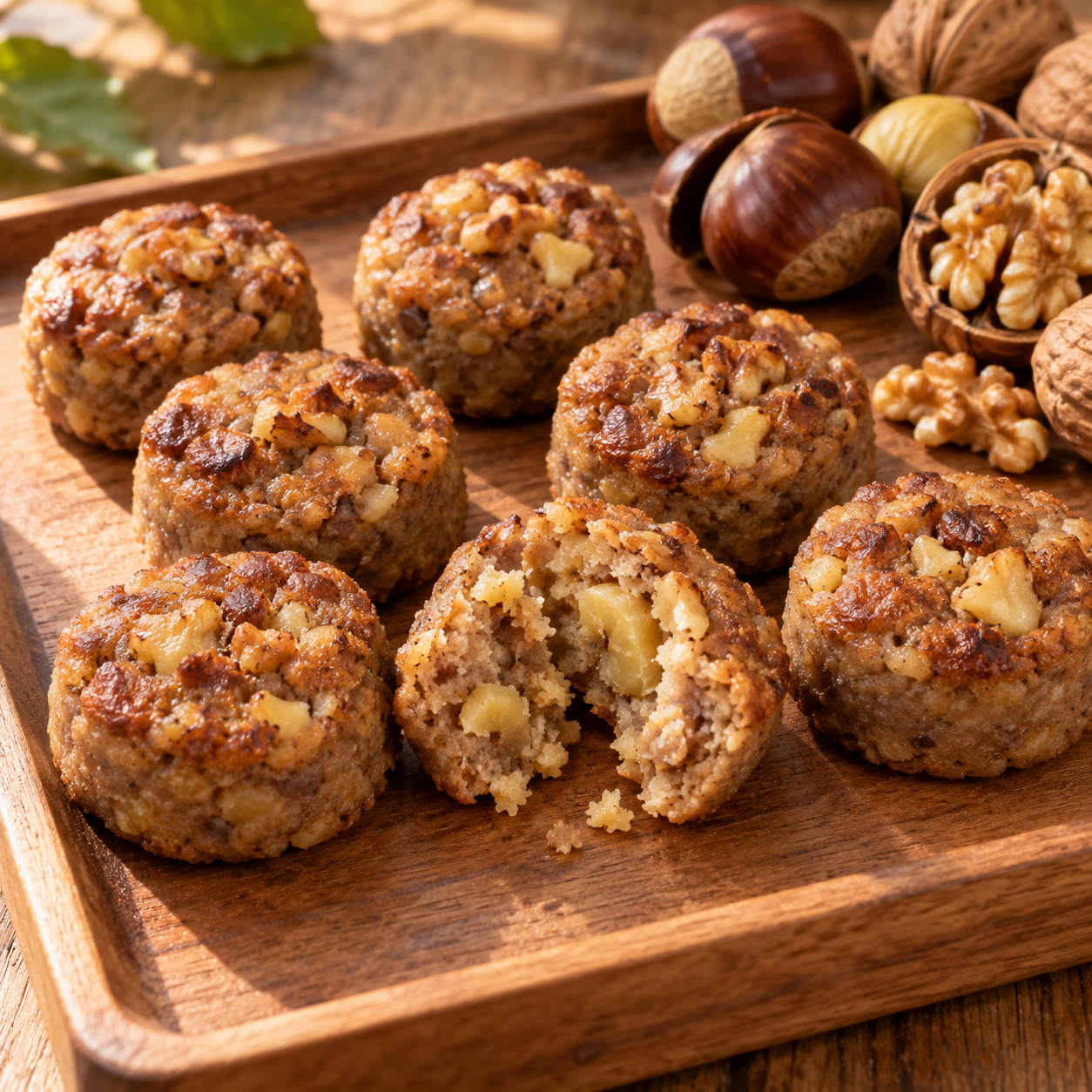
The recipe below mashes cooked edible chestnuts with walnut and chestnut flour, shapes the mixture into small rounds, and bakes it. The nuts fit the documented landscape, but this particular cake has not been excavated or translated from a Jōmon recipe. It is a reconstruction intended to make processing visible: shelling, cooking, crushing, mixing, shaping, and heating can change a stored resource into a convenient food.
Use genuine edible chestnuts of the genus Castanea. Horse chestnuts are different plants and cannot be substituted from a park. The distinction is especially important because archaeological discussions may include both kinds of nuts. This recipe avoids home detoxification and uses commercially cooked chestnuts so the ancient evidence does not become a risky foraging instruction.
The flavor of restraint
No wheat flour, butter, sugar, or honey is necessary here. Chestnuts supply starch and gentle sweetness; walnuts bring richness. Our water ratio holds the mixture together, while a lined oven tray replaces any hypothesized hearth surface. The cakes will be dense rather than airy. That intended texture follows from the modern formula, not a claim to know an ancient mouthfeel.
Serve them warm, and show a broken piece beside the whole rounds. The absence of written recipes does not make the food history empty. Archaeology can describe resources, tools, and settlement choices; cooks can explore plausible transformations while naming their inventions. This recipe keeps those two forms of knowledge connected but distinct. The ancient place and food resources are supported, and the exact cakes, measurements, baking schedule, and serving arrangement remain ours.
Chestnut-and-walnut rounds
Serves 4 · Preparation 20 min · Cooking 25 min · 5 minutes cooling
A modern adaptation for home cooking. Times are approximate.
Ingredients
- 300 g commercial cooked edible chestnuts
- 70 g edible chestnut flour
- 50 g walnuts, finely chopped
- 40–70 ml warm water
- 1 g salt, optional modern seasoning
Method
- Heat oven to 190°C and line a tray.
- Mash chestnuts finely with 40 ml warm water. Stir in chestnut flour, walnuts and optional salt.
- Add water by teaspoons if needed to make a firm dough that holds when pressed.
- Shape eight rounds 1 cm thick with damp hands. Bake 20–25 minutes, turning once, until firm and lightly toasted.
- Cool 5 minutes; serve warm.
Substitutions and adjustments
- Use an equivalent food-grade cooked Castanea chestnut product.
- Do not use horse chestnuts or unidentified wild nuts.
Historical choices: Chestnuts, walnuts and processing tools are attested in the settlement landscape; the combined cake and oven technique are reconstructed.
Kitchen note: Only use commercially sold edible chestnuts. Do not attempt to detoxify horse chestnuts.
Sources and further reading
- Official Jōmon World Heritage: Sannai Maruyama. Settlement resources include chestnuts, walnuts, tools and storage; does not attest this cake.
- Japanese Archaeological Association, residue analysis of Jōmon pottery. Analytical discussion and limits of chestnut dietary interpretation; PDF research.