ANCIENT MEALS · 078 / 100
Early historic Sanskrit food terminology · Indian subcontinent · c. 400 BCE–500 CE
Evidence: historically informed adaptation. The historical evidence and modern cooking choices are distinguished below.
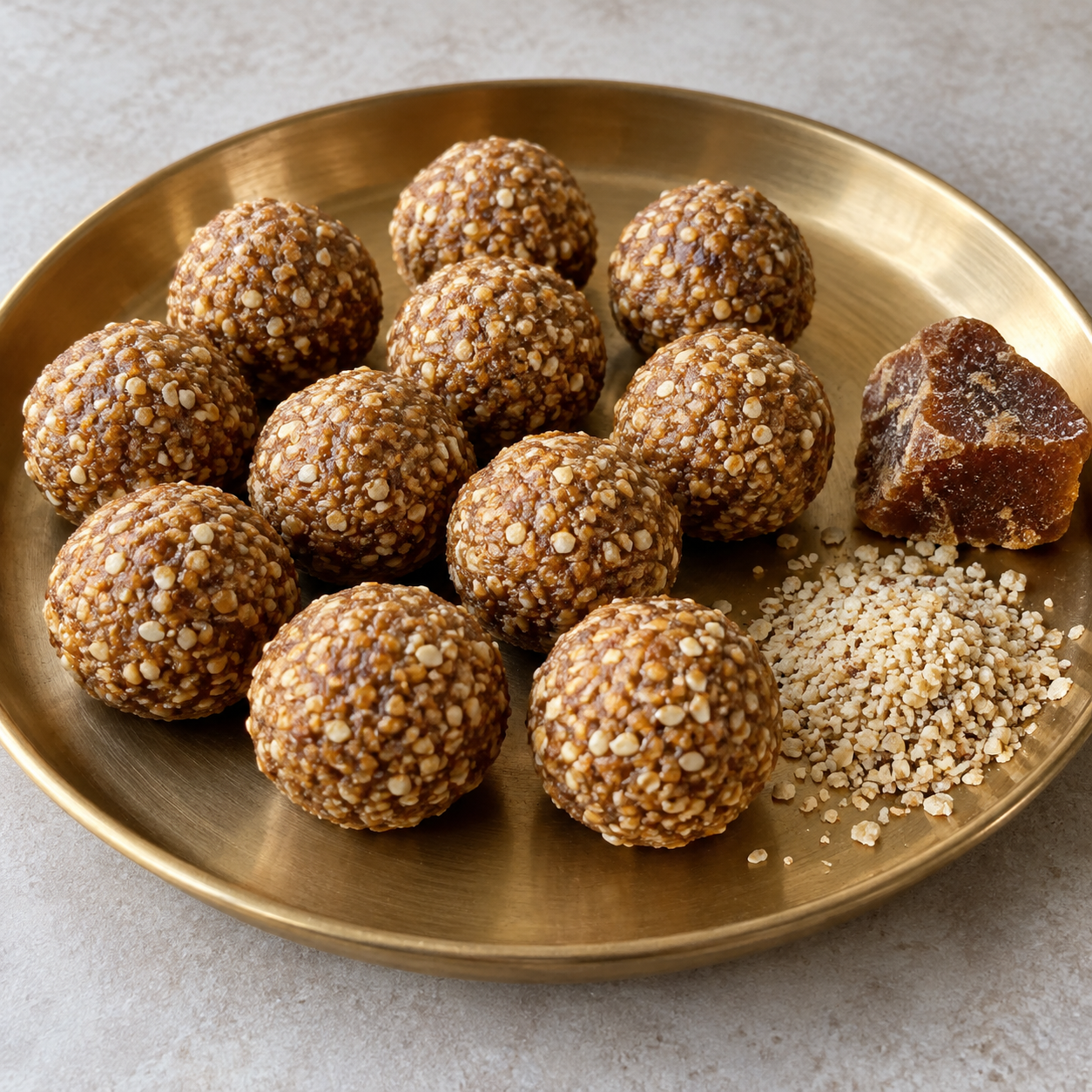
A name is a clue, not a full formula
The ancient Sanskrit vocabulary of food includes ground sesame and sweet preparations associated with it. The lexical entry for palala and pālala, drawing on historical Sanskrit dictionaries, distinguishes pounded sesame from related meanings and notes a sweetmeat of ground sesame and sugar. These definitions establish a food idea; they do not provide a complete dated confectioner's recipe.
We therefore use a deliberately cautious label: sesame-and-jaggery balls inspired by early historic food vocabulary. They are not presented as an unchanged festival laddu, and no claim is made that the exact shape below was described by Pāṇini. A name can survive while meanings and ingredients shift. Paying attention to that difference makes the historical story more useful.
Sweetness could be inventoried
The Arthaśāstra chapter on storehouses lists cane-derived sweet products, sesame oil extraction, grains, fats, spices, and equipment for processing them. The text is a layered work of early historic statecraft, not safely reducible to one Mauryan author and date. Its concern with stocks and transformation reveals sweetness as a managed resource as well as a pleasure.
Jaggery is a practical unrefined cane sweetener for this adaptation. Toasted sesame is ground coarsely so its oil and flavor become available; warm syrup binds it into small portions. These are plausible confectionery actions rather than a recovered ancient sequence. We omit peanuts, which belong to a much later transoceanic history in India, and do not add an assortment of modern aromatic flavorings to create a false impression of precision.
Grinding changes the sweet
Leave the sesame slightly coarse. A paste ground too far behaves differently from a mixture that retains some seed fragments. The little balls should show that grainy surface rather than imitate smooth chocolate truffles. Our mild syrup method aims for a firm but yielding result instead of hard candy; its final handling is described with checkpoints.
Serve two small pieces per person. This modern interpretation gives the lexical evidence a concrete edible companion while keeping the gap between word and recipe visible. Sesame, sugar products, and processing tools have textual support; the ball shape, ratios, syrup concentration, and cooling times are our choices. Historical food knowledge can begin with a dictionary, but the dictionary must never be asked to certify more than it says.
Pounded-sesame and jaggery balls
Serves 6 · Preparation 20 min · Cooking 10 min · 20 minutes chilling
A modern adaptation for home cooking. Times are approximate.
Ingredients
- 180 g hulled sesame seeds
- 110 g food-grade cane jaggery, finely grated
- 25 ml water
- 10 g ghee
- 1 g salt
Method
- Toast sesame in a dry skillet over medium-low heat 4–5 minutes, stirring, until lightly fragrant. Cool briefly.
- Pulse in a food processor to a coarse meal; stop before it becomes a smooth butter.
- Warm jaggery and water in a small saucepan until dissolved. Add ghee and salt; simmer gently 2 minutes.
- Stir in sesame until thick. Let cool just until safe to handle, about 5–8 minutes.
- Shape twelve small balls. If mixture crumbles, add warm water a teaspoon at a time; if too soft, allow further cooling. Chill 20 minutes to firm.
Substitutions and adjustments
- Use dark brown cane sugar instead of jaggery as a modern pantry substitute.
- Use a neutral oil instead of ghee for a modern dairy-free variation.
Historical choices: Ground sesame and sugar-based sweetness are textually supported; this particular ball formula and syrup method are modern.
Kitchen note: Hot syrup can burn; shape only after safe cooling. Sesame is an allergen.
Sources and further reading
- Historical Sanskrit dictionaries: palala/pālala. Lexical support for pounded sesame and a sesame-sugar sweetmeat; does not give a complete ancient recipe.
- Arthaśāstra II.15, Storehouse superintendent. Primary text on cane sweeteners, sesame oil and food processing; the work has layered dating.