ANCIENT MEALS · 077 / 100
Khao Sam Kaeo and Phu Khao Thong trading communities · Thai-Malay peninsula, southern Thailand · c. 400–100 BCE
Evidence: archaeological reconstruction. The historical evidence and modern cooking choices are distinguished below.
Crops travelled with people
A small green bean can be evidence of a very large connection. Archaeobotanical work at Khao Sam Kaeo and Phu Khao Thong found rice alongside pulses of South Asian origin, including mung bean and horsegram. The Antiquity study of these early maritime sites places the plants within Indian Ocean exchanges. It argues that preferred food crops could accompany traders and other mobile communities. A cargo story can therefore also be a kitchen story.
Rice and mung beans in an assemblage do not prove they occupied one cooking vessel together. Our combined pot is explicitly reconstructed. It is not called the first khichdi, nor treated as evidence for an unchanged modern national dish. The interesting fact is the meeting of crop traditions at particular ancient settlements, not the retroactive naming of their meals.
Sharing a pot, keeping different identities
Rice supplies soft grains; mung beans offer a different texture and flavor. Split dehulled beans shorten the practical cooking time in this version. Ancient recovered seeds do not tell us the exact proportion of polished rice to split pulse, so our balance is a modern choice. Water cooking makes a sensible reconstruction using these resources without introducing a long list of unsupported seasonings.
The history of rice itself is geographically complex. A research review of archaeological and genetic evidence discusses multiple regional trajectories and dispersal. That background discourages a simple story in which one civilization invents a complete meal and then exports it unchanged. Plants move; cooks choose; techniques adapt to local vessels, fuel, taste, and labor.
An archaeological lunch
Our saucepan gives the beans a brief head start before the rice enters, then lets the mixture cook to a spoonable but fairly thick consistency. The staggered timing prevents the rice from finishing while the pulse remains hard. It is kitchen guidance, not a recovered instruction. A small amount of ginger is optional and is labeled a flavor addition rather than claimed as part of a sealed ancient recipe.
Serve warm in individual bowls. The evidence anchors the crops, sites, and exchange setting; quantities, grain processing, combination, and cooking schedule belong to a plausible present-day interpretation. The dish encourages us to notice that everyday meals can carry migration histories even when their cooks left no written recipes.
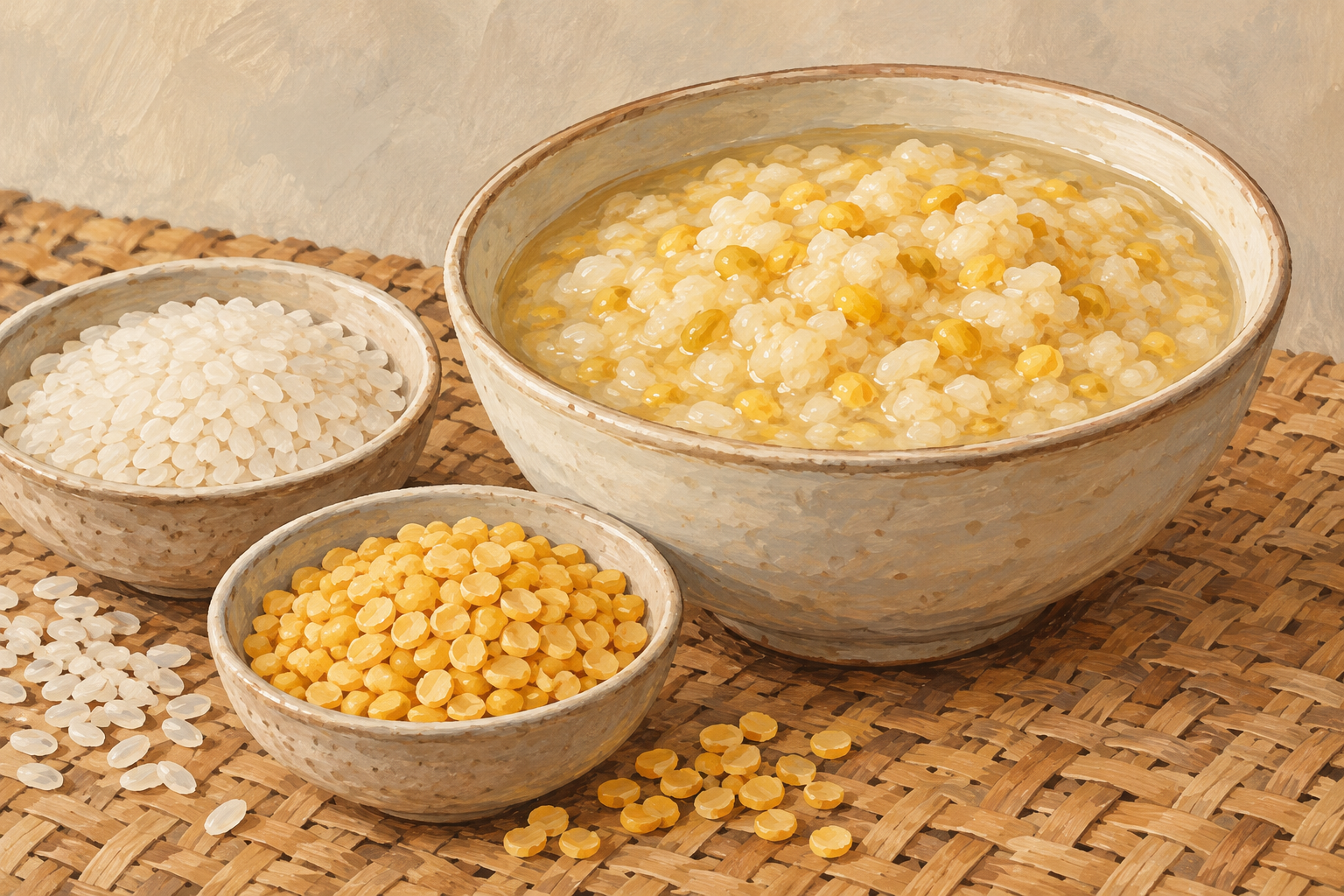
Rice-and-split-mung trading-port pot
Serves 4 · Preparation 10 min · Cooking 35 min · 5 minutes rest
A modern adaptation for home cooking. Times are approximate.
Ingredients
- 160 g short-grain rice
- 140 g split dehulled mung beans
- 1 litre water, plus more if needed
- 4 g salt
- 10 g fresh ginger, finely grated, optional modern flavor addition
Method
- Rinse rice and mung beans separately until the water is mostly clear.
- Put mung beans and water in a saucepan. Bring to a boil, skim foam, and simmer 10 minutes.
- Add rice and optional ginger. Cover loosely and simmer 20–25 minutes, stirring occasionally, until rice and beans are fully tender.
- Add salt and adjust thickness with hot water. Rest covered off heat for 5 minutes and serve.
Substitutions and adjustments
- Use whole mung beans only after soaking and cooking them separately until almost tender; they require longer.
- Long-grain rice can replace short-grain but gives a less cohesive texture.
Historical choices: The crops are attested at the early maritime sites. Their one-pot combination, dehulling and proportions are reconstructed.
Kitchen note: Use food-safe commercial ingredients.
Sources and further reading
- Castillo et al., Rice, beans and trade crops on the early maritime Silk Route. Specific rice/pulse assemblages at Khao Sam Kaeo and Phu Khao Thong and exchange interpretation; no assembled dish.
- Fuller et al., Archaeological and genetic insights into rice. Regional crop history; no claim that the modern recipe was found at these ports.