ANCIENT MEALS · 076 / 100
Later Vedic ritual food tradition · Northern Indian subcontinent · c. 900–500 BCE
Evidence: adapted surviving recipe. The historical evidence and modern cooking choices are distinguished below.
A meal counted by the family
The Śatapatha Brāhmaṇa turns humble barley into a food with social and ritual meaning. In the Varuṇapraghāsa passage, barley is husked and lightly roasted before dishes of karambha are prepared, one for each member of the family and one more. Julius Eggeling's translation notes explain karambha as roasted, coarsely ground barley mixed with sour curds. The count matters as much as the ingredients: provision is imagined for those present and for the family's continuation.
This is evidence from a ritual text, not an ordinary household cookbook. It should not be made into a claim that every person in ancient India ate the same breakfast. The broader ancestor-offering passage also describes parched grain and a milk preparation, showing how grain processing appears repeatedly within ritual instruction. These passages provide particular combinations and actions, with quantities shaped by ceremonial purposes.
Parched grain has a different character
Toasting brings an aroma that plain boiled grain lacks. Grinding changes the surface exposed to liquid. Sour curds bring a contrasting taste and a cool, thick texture. Our adaptation preserves those relationships, but uses rolled barley so a cook can achieve even heating without trying to reproduce ancient milling or hearth equipment.
We fully cook the barley with water after dry toasting it, then cool it before mixing with pasteurized yogurt. That extra cooking stage is a practical food-safety and texture decision. The historical account of parching is not used as a guarantee that lightly heated raw grain is safe to eat. Packaged fully cooked barley flakes are another option, prepared according to their directions.
Food history without a reenacted ceremony
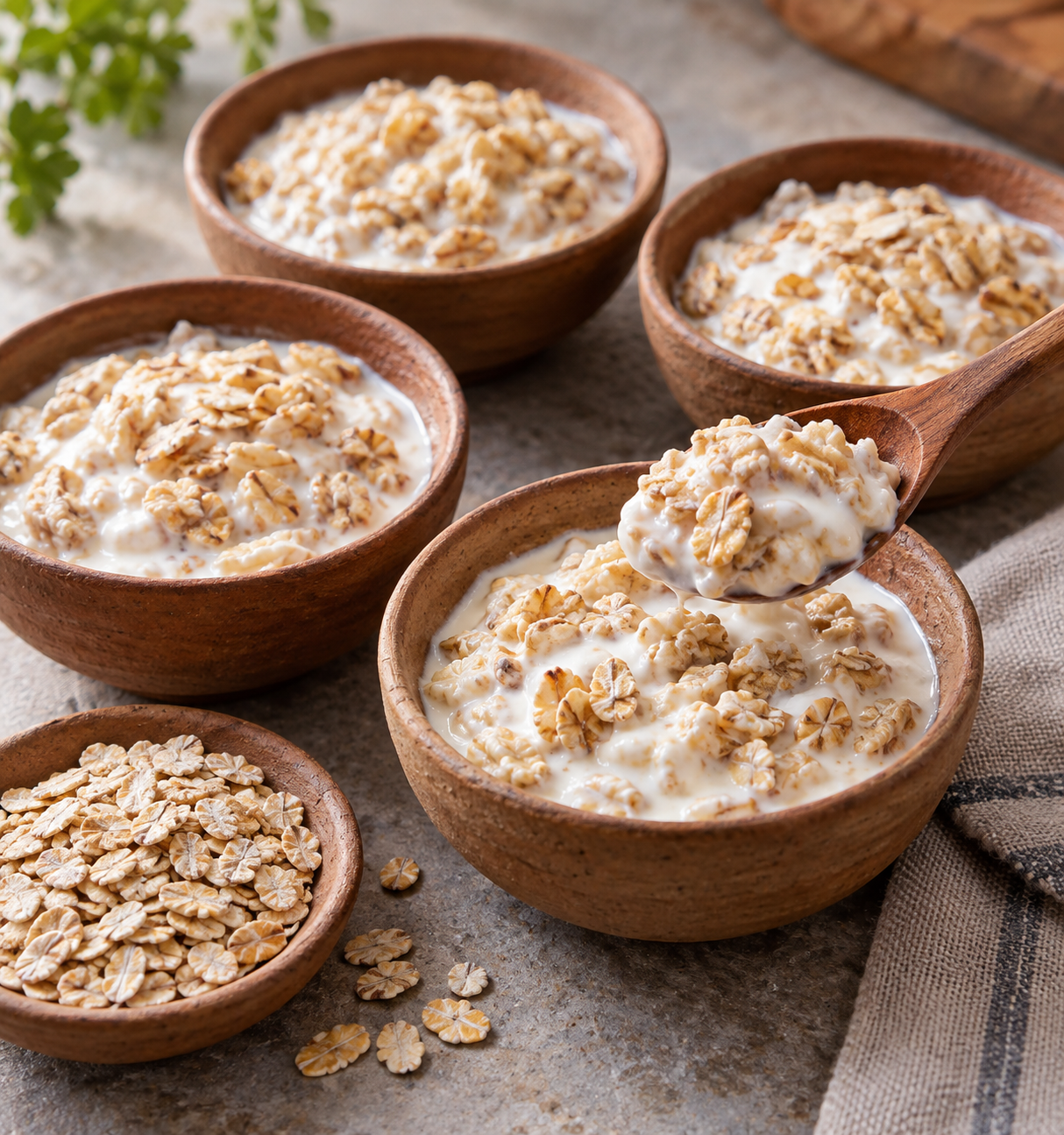
The four bowls below are for eating, not an instruction to conduct a religious rite. The ancient text supplies the food connection; today's kitchen supplies the measured portions. Yogurt's sourness varies, so thinning it with a little water is more useful than assigning an exact ancient taste.
Serve the karambha cool or barely warm, thick enough to hold its shape on a spoon. Keep it simple to notice barley's toasted flavor against the dairy. No honey is needed to make this dish meaningful. Its roasting and curd pairing are text-based, while the rolled grain, full water cooking, proportions, and timing are openly modern.
Toasted barley with sour yogurt
Serves 4 · Preparation 10 min · Cooking 20 min · 30 minutes cooling
A modern adaptation for home cooking. Times are approximate.
Ingredients
- 180 g rolled barley flakes
- 450 ml water
- 350 g plain pasteurized yogurt
- 2 g salt
- up to 60 ml additional water for thinning
Method
- Toast barley flakes in a dry saucepan over medium heat for 3–4 minutes, stirring continuously.
- Add measured water carefully, bring to a simmer, and cook 15–20 minutes or according to package instructions, until fully tender.
- Spread in a shallow bowl and cool to lukewarm within 30 minutes.
- Stir in yogurt and salt, thinning with a little additional water if needed. Serve immediately.
Substitutions and adjustments
- Use packaged precooked barley flakes and follow their directions.
- A plain cultured plant yogurt gives a dairy-free modern version, with a changed historical ingredient.
Historical choices: The roasted-barley and sour-curd pairing follows the primary passage and translator note. Full water cooking and rolled flakes are modern adaptations.
Kitchen note: Use pasteurized yogurt, cook grain fully, and refrigerate leftovers within 2 hours.
Sources and further reading
- Śatapatha Brāhmaṇa II.5.2, Eggeling translation. Primary ritual passage and note on karambha: roasted barley, coarse grinding and sour curds.
- Śatapatha Brāhmaṇa II.6.1. Related primary context for parched grain and milk preparations; not the same recipe.