ANCIENT MEALS · 075 / 100
Qimin yaoshu, citing Shici · China, northern compilation with southern culinary material · c. 530–550 CE
Evidence: adapted surviving recipe. The historical evidence and modern cooking choices are distinguished below.
Fruit inside a wrapper
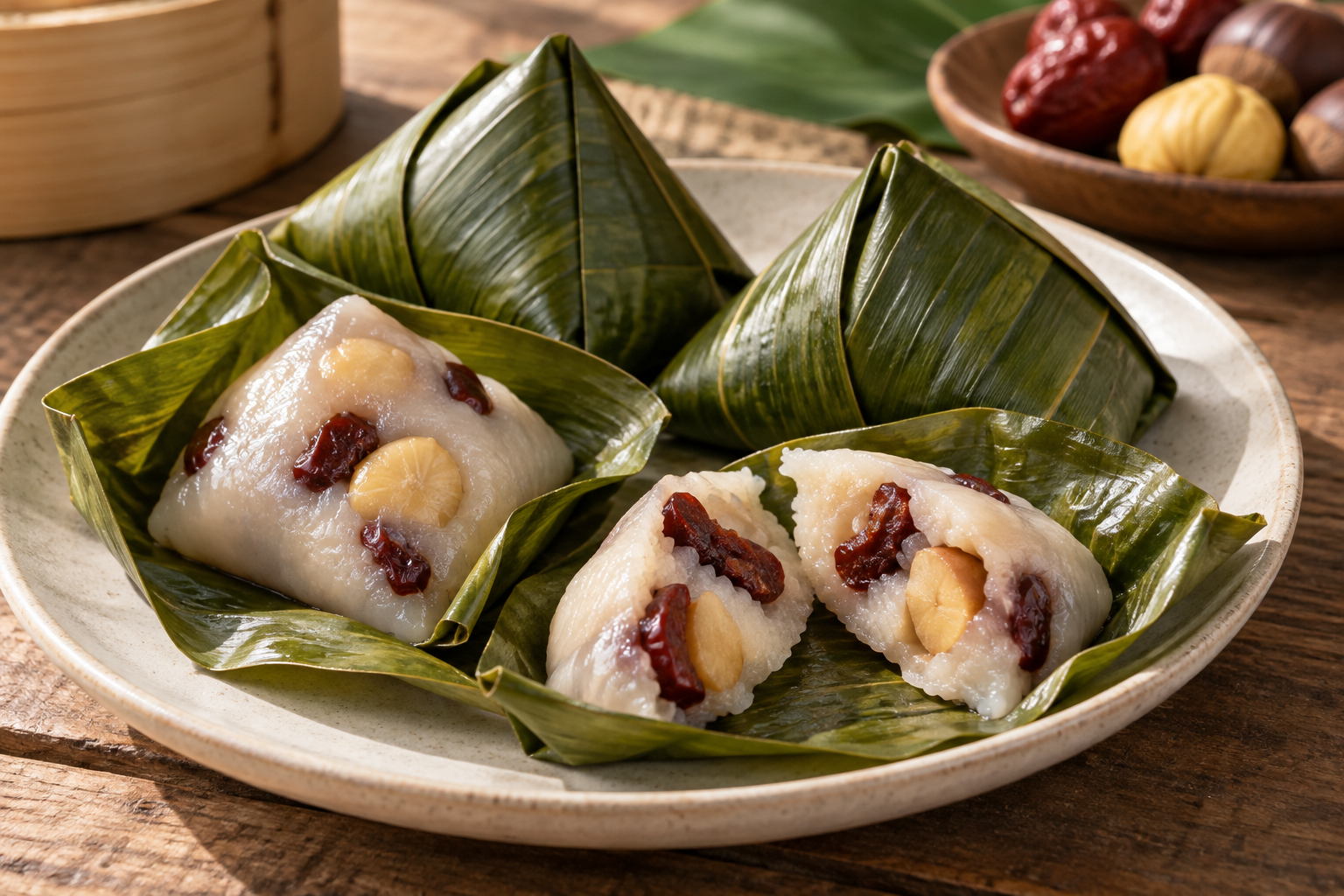
A packet of food can preserve more than heat. Leaves hold a dough together, separate it from a steamer, and carry the scent of their surface into the meal. In the Qimin yaoshu section on wrapped grain foods, an entry attributed to Shici describes glutinous-rice flour mixed with water and honey, arranged with jujube and chestnut, wrapped in oiled bamboo leaves, and steamed thoroughly. Here a surviving recipe gives a recognizable assembly process.
The same section includes other grain parcels, but they should not all be treated as one identical modern festival food. Historical names and ingredients vary. This particular sweet flour preparation is the basis of our recipe, so the article does not borrow a later origin legend to explain an earlier text. The surviving instruction itself is interesting enough.
Rice belongs to a changing agricultural map
Rice history crosses regions and generations. Research reviewing archaeological and genetic evidence shows how cultivation developed and spread through East Asia, with differences in local crop systems. Our sixth-century compilation stands much later in that story, at a time when rice food technology could be described in a northern agricultural work alongside other grains.
Glutinous rice is a starch type, not a reference to wheat gluten. Commercial glutinous-rice flour makes a sticky cooked dough that can hold the fruit pieces. Our rectangular packets are small so a household steamer can heat them evenly. Food-grade banana leaf is offered as a convenient modern wrapper when bamboo leaves are difficult to source; the substitution changes the material and should be named.
The measurements are ours
The text's long formed pieces and cutting directions do not tell us the ideal amount for four diners. We specify eight parcels, modest honey, and cooked chestnuts. The dough should be soft enough to press around the fruit but firm enough to wrap without flowing. That handling checkpoint is more useful than pretending a historical measure maps perfectly to every bag of modern flour.
Unwrap at the table and split a parcel to show the reddish jujube and pale chestnut. Our adaptation keeps the written recipe's flour, sweetener, fruits, wrapper, and steaming method visible. Preparation quantities and timing are modern. It is a small example of a text preserving gestures: mix, arrange, oil, wrap, steam. Those verbs carry a food history that a grain list alone cannot convey.
Prepare eight small packets before steaming
Divide the chopped jujubes into eight portions, about 7.5 g each, and the chestnuts into eight portions, about 12.5 g each. Those small quantities keep the filling from overwhelming the dough. Flatten each dough portion with damp fingers, enclose the fruit, and make a compact packet rather than a thick ball. Patch tears with a little dough before wrapping.
Leave space between the wrapped parcels so steam can circulate. Their appearance alone is an uncertain cooking guide: open one carefully and split it to check for a cohesive cooked centre without dry floury patches. This is a practical check for the modern adaptation, not a claim to reproduce the text’s exact size or timing. Find other steamed and grain dishes through Cooking at Incoprea; the cookbook section lists the Ancient Meals book in preparation.
Jujube-and-chestnut glutinous-rice parcels
Serves 4 · Preparation 40 min · Cooking 30 min · 5 minutes rest; dried-leaf soaking as package directs; extra time if steaming in batches
A modern adaptation for home cooking. Times are approximate.
Ingredients
- 200 g glutinous-rice flour
- 130–150 ml warm water
- 35 g honey
- 60 g pitted dried jujubes, chopped
- 100 g commercial cooked peeled chestnuts, chopped
- 10 ml neutral cooking oil
- 8 pieces, about 20 × 20 cm food-grade banana leaf, or soaked bamboo leaves arranged to wrap
Method
- Prepare the food-grade wrappers first. Soften banana-leaf pieces briefly with hot water, drain and pat dry. For dried bamboo leaves, soak and rinse according to the packet directions, allowing that extra preparation time. Brush the inner wrapping surfaces with the measured oil.
- Check the pitted jujubes for hard pit fragments. Divide the chopped jujubes into eight portions of about 7.5 g and the cooked chopped chestnuts into eight portions of about 12.5 g.
- Mix glutinous-rice flour, honey and 130 ml warm water. Knead briefly, adding more of the listed water by teaspoons only as needed. The dough should hold a shape while yielding to finger pressure, without loose dry flour or a flowing consistency. Divide into eight equal pieces and keep covered.
- With lightly dampened fingers, flatten one piece into an oval about 10 cm long. Put one portion each of jujube and chestnut along the centre. Fold and press the dough around the filling, patching tears. Shape into a compact rectangle about 2 cm thick; repeat for all eight.
- Set each rectangle on an oiled leaf. Fold the sides inward, then fold the ends over to enclose the dough without squeezing it hard. Tie loosely with kitchen string if the wrapper will not stay closed. The leaf is a wrapper, not an ingredient to eat.
- Bring water to a simmer below a steaming rack, keeping the water below the parcels. Arrange packets in one layer with small gaps, cover, and steam for about 25–30 minutes per batch. If the steamer is small, cook in batches rather than packing the parcels tightly. Check the water level and add hot water as needed without pouring it over the food.
- Rest for 5 minutes. Open one parcel carefully away from your face and split it: the dough should be hot throughout and cohesive, without dry, floury patches in the centre. If needed, rewrap and steam longer, checking after another 5 minutes. Discard wrappers before eating.
Substitutions and adjustments
- Use soaked food-grade bamboo leaves for a closer wrapper choice.
- Use cooked chestnuts rather than raw nuts to keep cooking predictable.
- Use commercial glutinous-rice flour for this dough. Ordinary rice flour has different handling and cooking properties and is not a direct replacement.
Historical choices: The source specifies glutinous-rice flour, water, honey, jujube, chestnut, oiled bamboo wrapping and thorough steaming; portions and banana-leaf option are modern.
Kitchen note: Discard wrappers before eating and beware trapped steam. Honey is unsuitable for infants under 12 months.
Sources and further reading
- Qimin yaoshu, volume 9 wrapped grain-food chapter. Public-domain primary recipe attributed to Shici, with rice flour, honey, jujube, chestnut and bamboo-leaf steaming.
- Fuller et al., Archaeological and genetic insights into the origins of domesticated rice. Context for regional rice histories; does not establish this recipe before the sixth-century text.