ANCIENT MEALS · 072 / 100
Qimin yaoshu horticultural and culinary tradition · Northern China · c. 530–550 CE
Evidence: adapted surviving recipe. The historical evidence and modern cooking choices are distinguished below.
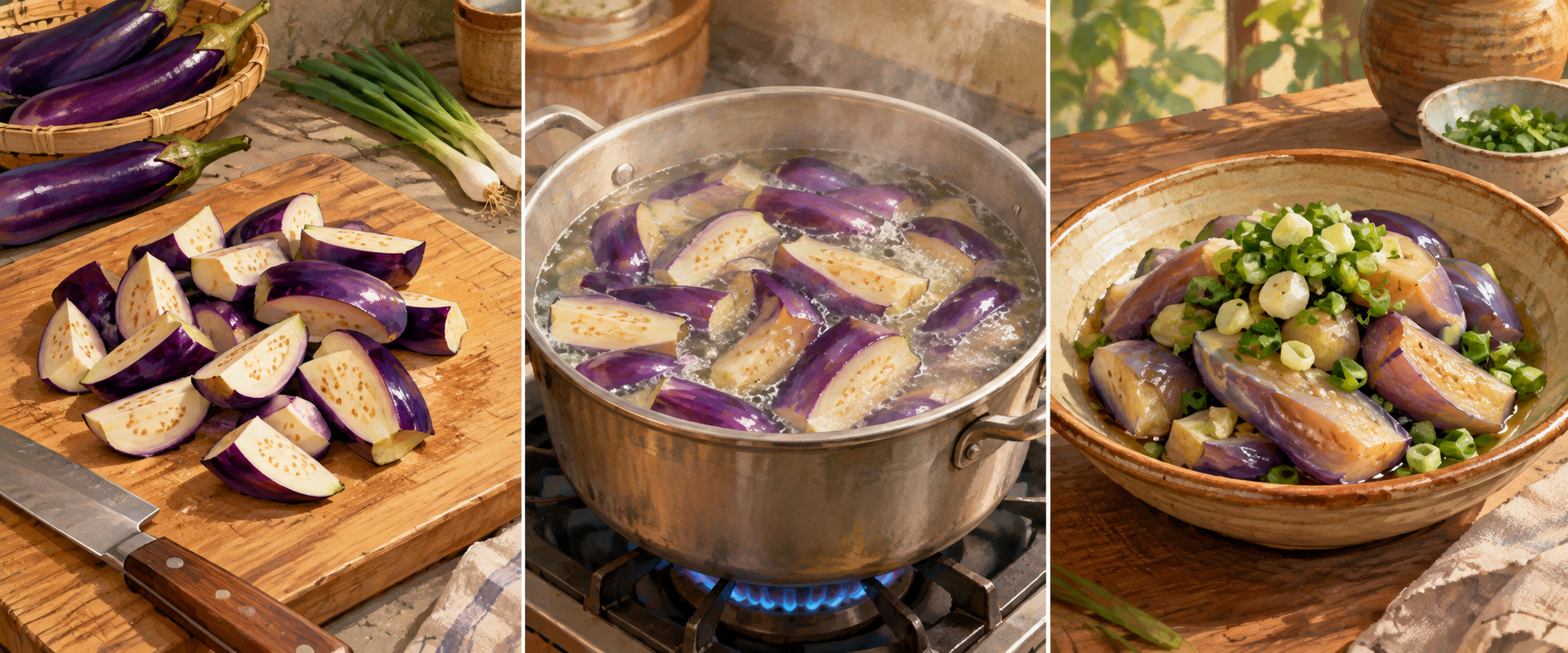
A vegetable still changing
The smooth, mild eggplants in many shops are products of a long history of selection. Ancient written evidence gives glimpses of fruit that did not necessarily look or taste the same. A botanical study of Chinese literature traces descriptions of eggplant cultivation and qualities through historical texts, including the sixth-century Qimin yaoshu. It reminds us that a named vegetable is not a frozen biological object across fifteen centuries.
The manual offers more than advice for a garden. Its braised-eggplant entry calls for young fruit, dividing it, blanching it, heating oil with chopped scallion white, and cooking with a clear savory sauce before adding powdered ginger and pepper. This is unusually useful evidence: an order of operations, not a modern guess constructed solely from ingredients.
Blanch, then braise
Our version quarters small modern eggplants and blanches them briefly. We then build the scallion flavor in oil and finish the pieces in a modest quantity of sauce and water. The result should be soft enough for a spoon. Blanching before braising is retained because it belongs to the source method, even though a modern cook might ordinarily choose to roast the fruit instead.
The source's savory sauce cannot be equated automatically with a particular supermarket bottle. Here, light soy sauce diluted with water gives a practical seasoning. Sesame oil is our specified choice of cooking oil. Powdered ginger follows the entry's finishing instruction, while Sichuan pepper is a cautious interpretation of historical jiao; its measured amount is not recovered from the text. Fresh ginger is an offered variation with a different texture.
A recipe with a visible boundary
Young ancient fruit and today's cultivated varieties have different bitterness, seeds, and skin. For that reason we do not reproduce every ancient judgment about flavor as a promise about the meal. Nor do we claim the modern form is how every sixth-century household ate eggplant. A compilation can preserve a specific practice without establishing its universal popularity.
Place the finished quarters in a shallow bowl, and spoon their scallion-rich juices over them. The dish offers a good example of what an adapted surviving recipe can do: retain a meaningful technique while declaring its substitutions and quantities. The historical instructions are real; our kitchen timings and final balance remain an interpretation.
Blanched and braised eggplant with scallion
Serves 4 · Preparation 15 min · Cooking 20 min · None
A modern adaptation for home cooking. Times are approximate.
Ingredients
- 600 g small young eggplants
- 70 g scallion whites, finely chopped
- 20 ml sesame oil suitable for cooking
- 20 ml commercial light soy sauce
- 150 ml water
- ½ teaspoon ground dried ginger
- ¼ teaspoon ground Sichuan pepper
Method
- Trim eggplants and quarter lengthwise; cut long quarters in half.
- Bring a saucepan of water to a boil. Blanch eggplant for 3 minutes, then drain.
- Heat oil in a wide saucepan over medium heat. Add scallion whites and cook 2 minutes without browning heavily.
- Add eggplant, soy sauce and measured water. Cover and simmer 12–15 minutes until fully tender; turn gently once.
- Add ginger and Sichuan pepper; simmer 1 minute and serve with its juices.
Substitutions and adjustments
- Use 10 g grated fresh ginger in place of dried ginger, adding it with the scallions; this changes the finishing method.
- Use a neutral cooking oil if sesame is unsuitable.
Historical choices: The young fruit, blanching, scallion oil, sauce and powdered seasonings follow the primary entry. Sauce brand, portions and exact spice identification are adaptations.
Kitchen note: Use food-safe commercial ingredients.
Sources and further reading
- Qimin yaoshu, method for braising eggplant. Public-domain primary recipe text; provides the sequence of preparation.
- Wang et al., Ancient Chinese Literature Reveals Pathways of Eggplant Domestication. Peer-reviewed historical botany; explains changing cultivation and descriptions, not this modern cultivar.