ANCIENT MEALS · 071 / 100
Qimin yaoshu culinary compilation · Northern China · c. 530–550 CE
Evidence: adapted surviving recipe. The historical evidence and modern cooking choices are distinguished below.
Flavor carried by steam
Boiling is not the only way a pot can feed a household. Place a vessel above simmering water and steam carries heat to a dish while its own juices remain inside. The Qimin yaoshu preserves a chicken preparation that uses fermented soybeans, scallion white, perilla leaves, bean-derived liquid, and pork alongside the bird. The steaming chapter's chicken entry directs that the assembled ingredients be steamed thoroughly. This gives us a technique and a distinctive seasoning family, not merely a list of possible ancient foods.
Jia Sixie's agricultural compilation belongs to sixth-century northern China, but gathers material from earlier named works and practical knowledge. Its many recipes sit beside instructions for growing crops and keeping livestock. The Chinese Academy of Sciences discussion of the manual highlights the mixture of traditions represented in its food technology. A book with a broad agricultural purpose can preserve details a banquet poem would never need to explain.
Bean seasoning is not interchangeable sauce
The modern ingredient douchi consists of commercially fermented beans with a salty, concentrated taste. It offers a practical counterpart to the text's fragrant fermented soybeans, but commercial styles differ and cannot be assumed identical to a sixth-century product. Our soy sauce similarly replaces a historical seasoning liquid without claiming a perfect match.
We reduce the meat combination to chicken thighs and a little pork belly, both cut small enough for a domestic steamer. Perilla gives the dish an herbal scent. The bowl collects a broth from the meat and seasoning, which can be spooned over the portions. This is a quite different method from roasting a whole bird over a hearth: enclosed steam, a savory bean seasoning, and retained juices define the meal.
Adapting an instruction responsibly
Ancient directions to cook thoroughly are valuable, but they are not a food thermometer. Our temperature check is a modern safety measure. The original quantities use historical measures and are not copied as though they were today's grams; salt is adjusted to the commercial ingredients.
Serve the chicken with plain grain, leaving the dark beans and green perilla visible. This adaptation preserves the source's central technique and combination, while the boneless cuts, measured seasoning, and timetable belong to our kitchen. It invites attention to an ancient cook's ability to make a small amount of powerful seasoning travel through an entire dish.
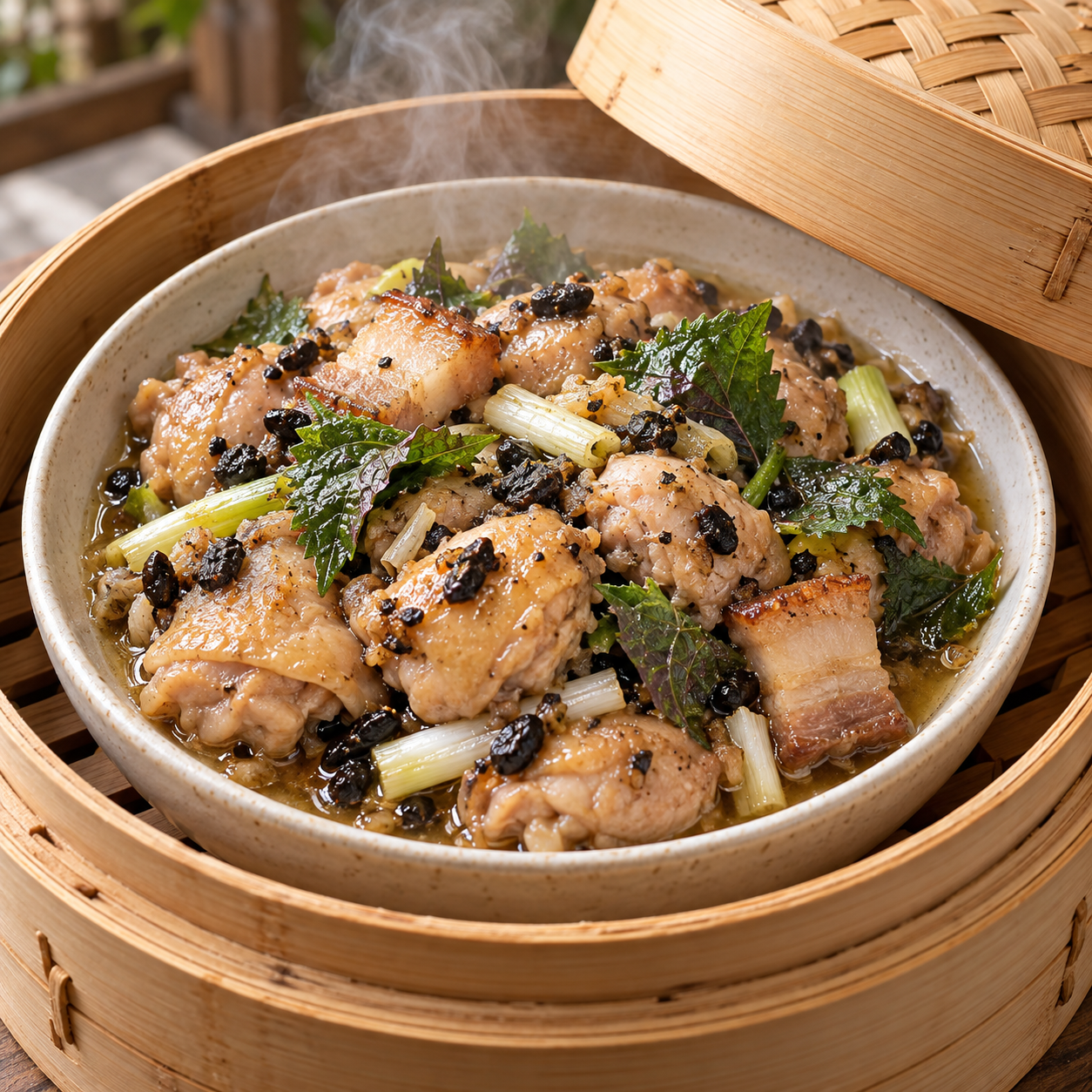
Steamed chicken with douchi and perilla
Serves 4 · Preparation 20 min · Cooking 30 min · None
A modern adaptation for home cooking. Times are approximate.
Ingredients
- 600 g boneless chicken thighs, cut into 4 cm pieces
- 80 g pork belly, diced small
- 20 g commercial douchi, briefly rinsed and chopped
- 60 g scallion whites, cut into 3 cm lengths
- 8 perilla leaves, torn
- 15 ml light soy sauce
- 60 ml water
Method
- Mix chicken, pork, douchi, scallion, soy sauce and water in a shallow heatproof bowl that fits your steamer.
- Scatter perilla leaves over the surface. Set the bowl on a steaming rack above simmering water; the bowl must not touch water.
- Cover and steam 25–30 minutes. Check the thickest chicken pieces reach 74°C; continue steaming if needed. Keep the lower pot supplied with hot water.
- Let rest 3 minutes. Divide meat and spoon collected juices over each serving.
Substitutions and adjustments
- Shiso is a form of perilla and works here. If unavailable omit it rather than invent an equivalent ancient herb.
- Omit pork belly and add another 80 g chicken for a simpler modern adaptation.
Historical choices: Fermented beans, scallion, perilla, pork and steaming derive from the surviving entry; cuts, sauce choice and quantities are modern.
Kitchen note: Cook chicken to 74°C; use a stable heatproof bowl and beware steam when lifting the lid. No home fermentation.
Sources and further reading
- Qimin yaoshu, chapter 77 steaming methods. Primary recipe reproduced with modern Chinese explanation; chicken, pork, fragrant fermented beans, scallion and perilla.
- Chinese Academy of Sciences study of Qimin yaoshu. Scholarly context for the agricultural compilation and mixed food traditions.