ANCIENT MEALS · 070 / 100
Northern and Eastern Wei culinary compilation · Northern China · c. 530–550 CE
Evidence: adapted surviving recipe. The historical evidence and modern cooking choices are distinguished below.
A familiar name with a different filling
The word shaobing can bring to mind a flaky or sesame-topped bread sold from a modern stall. The sixth-century Qimin yaoshu gives a preparation under that name whose center of attention is lamb and scallion. In its chapter on bing, the directions combine flour with lamb, scallion white, seasoned liquid, and salt, and require the dough to rise. The ancient category bing covered several flour foods rather than only the flat cakes that English readers might expect.
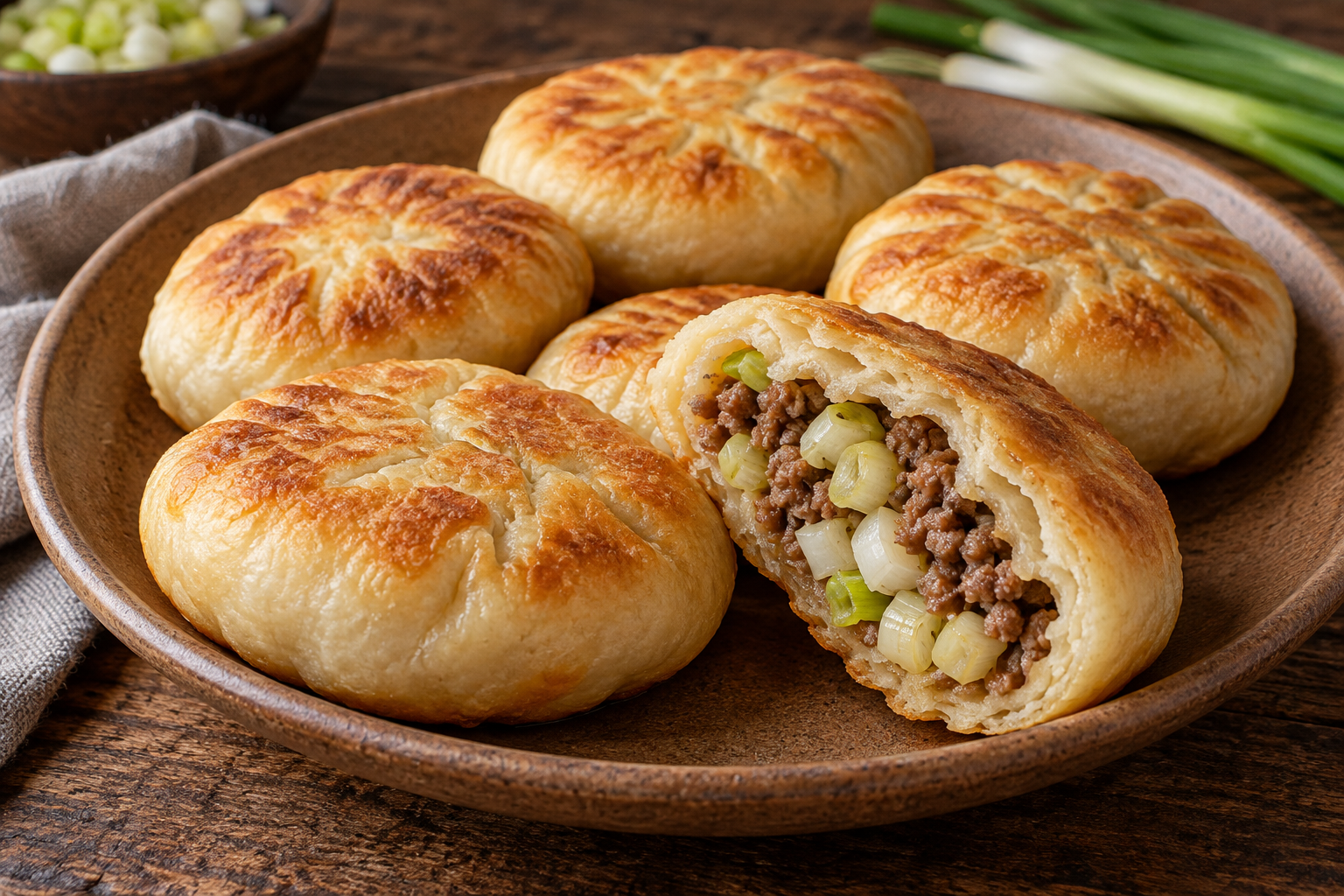
This is an adaptation of a surviving instruction, with an important limitation: a short ancient entry is not a standardized bakery formula. It does not give our bun size, oven thermostat, yeast packet, or a fully explicit modern assembly sequence. Those decisions remain reconstruction even when a written recipe supplies the essential combination.
A bakery at a cultural crossroads
The Chinese Academy of Sciences study of minority contributions in the manual discusses northern food traditions and the relation between named breads, specialized ovens, and wider culinary exchange. It helps explain why this agricultural book matters to a food historian: crops and livestock become techniques, equipment, and finished foods. Labels that sound timeless can conceal considerable change.
Our version uses a yeasted wheat dough and a cooked lamb filling, pinched into six flattened rounds and baked. Cooking the filling first follows the entry's emphasis on cooking the seasoned meat, while also making the home method more controllable. We drain excess liquid so the center does not soak the dough. Modern yeast replaces an unspecified historical leaven; light soy sauce stands in for a savory bean-derived seasoning rather than claiming equivalence to an ancient sauce.
The useful boundary of a translation
A translation can tell us what a recipe says. It cannot recover every gesture that a trained baker once supplied without explanation. How firmly was the dough kneaded? How hot was the oven wall? How thick was each portion? Those were embodied skills. Here they become measurements and checkpoints for a modern cook.
The result is intentionally a filled bread, not a claim that all present-day shaobing descend unchanged from this entry. Serve a round split open so the lamb and scallion are visible. The written source anchors the dish's identity; our quantities and equipment make a workable interpretation. Its practical adjustments are part of the story rather than evidence to hide.
Keep the filling out of the seam
The filling should be moist enough to eat but dry enough that no liquid pools when the pan is tilted. Let it lose its heat before it touches the dough, then divide both dough and filling into six portions. Keep the middle of each dough disc a little thicker than the edge. A clean dough rim is easier to pinch closed than one coated with lamb juices.
Flatten with your palm rather than the rolling pin once the filling is enclosed. If a seam opens, pinch it closed before the second rest. This modern assembly guidance supplements the ancient entry; it is not a translated historical instruction. Browse more bread and grain recipes on Incoprea’s cooking page, where the cookbook section follows the Ancient Meals book in preparation.
Lamb-and-scallion filled baked rounds
Serves 6 · Preparation 35 min · Cooking 35 min · 60 minutes first rise; 15 minutes second rise
A modern adaptation for home cooking. Times are approximate.
Ingredients
- 300 g plain wheat flour
- 4 g instant yeast
- 180 ml lukewarm water
- 4 g salt, divided
- 250 g ground lamb
- 80 g scallion whites, finely chopped
- 15 ml commercial light soy sauce
- 30 ml water for filling
- 10 ml sesame oil
Method
- Mix flour, instant yeast and 2 g salt. Add the 180 ml lukewarm water and knead for about 8 minutes into a soft dough. Cover and let rise about 60 minutes, until noticeably puffy; room temperature may change the time.
- While the dough rises, cook the ground lamb in a skillet for 6–8 minutes, breaking up large clumps. Add scallion, soy sauce, the 30 ml filling water and remaining 2 g salt. Continue until the ground meat reaches 71°C/160°F and the liquid has mostly evaporated. Tilt the pan to check: there should be no puddle of liquid.
- Spread the filling in a shallow clean dish so it loses its heat promptly. Fill the dough when the mixture is no longer hot. Divide the filling into six equal portions; keep any excess pan liquid out of the portions.
- Gently press the risen dough to release large bubbles and divide into six equal pieces. Keep the waiting pieces covered. Roll each to a disc about 12 cm across, keeping the middle slightly thicker than the rim.
- Place one portion of filling in the centre, leaving a clean border. Bring the edges together over it and pinch firmly closed without trapping filling in the seam. Set seam-side down and gently flatten by hand to a round about 2–2.5 cm thick. Do not roll hard enough to split the dough.
- Place the six rounds with space between them on a lined baking tray. Brush with sesame oil, cover loosely, and rest 15 minutes while heating the oven to 220°C/425°F.
- Bake for about 18–22 minutes, until browned. Check one round by splitting it: the dough around the filling should be cooked through, without a wet, gummy band. Return underdone rounds to the oven and check again after a few minutes. Serve warm.
Substitutions and adjustments
- Ground beef can replace lamb but changes the source ingredient.
- Use 10 ml soy sauce plus 5 ml water if reducing salt.
- If the filling is wetter than expected, cook off the extra liquid before cooling it; adding a wet filling makes sealing and baking harder.
Historical choices: The lamb, scallion, risen dough and baking identity follow the sixth-century entry; yeast, portions and oven settings are modern.
Kitchen note: Cook ground lamb to 71°C. Cool the filling promptly and refrigerate leftovers within 2 hours.
Sources and further reading
- Qimin yaoshu, volume 9, bing chapter. Public-domain primary text; shaobing entry and the broad use of bing.
- Chinese Academy of Sciences: contributions of minority peoples in Qimin yaoshu. Scholarly discussion of northern breads and cultural exchange; not authority for modern oven settings.