ANCIENT MEALS · 069 / 100
Qijia-period Lajia · Qinghai, northwestern China · c. 2000 BCE
Evidence: historically informed adaptation. The historical evidence and modern cooking choices are distinguished below.
A bowl and an argument
A discovery at Lajia brought ancient cooking into a very modern dispute. In 2005, researchers described thin strands preserved beneath an earthenware bowl and identified millet microremains associated with them. Their Nature report interpreted the material as approximately four-thousand-year-old millet noodles. It was a memorable image: a familiar meal apparently caught across an enormous span of time.
Recognition is not the same as a settled recipe. Experimental work published in Archaeometry found that pure millet dough could not be stretched in the proposed fashion and questioned whether the identified microremains belonged to the strands themselves. The disagreement concerns material identification and manufacturing technique, not simply which modern nation can claim a favorite food. Headlines about the world's first noodles flatten a much more interesting research problem.
Making the uncertainty edible
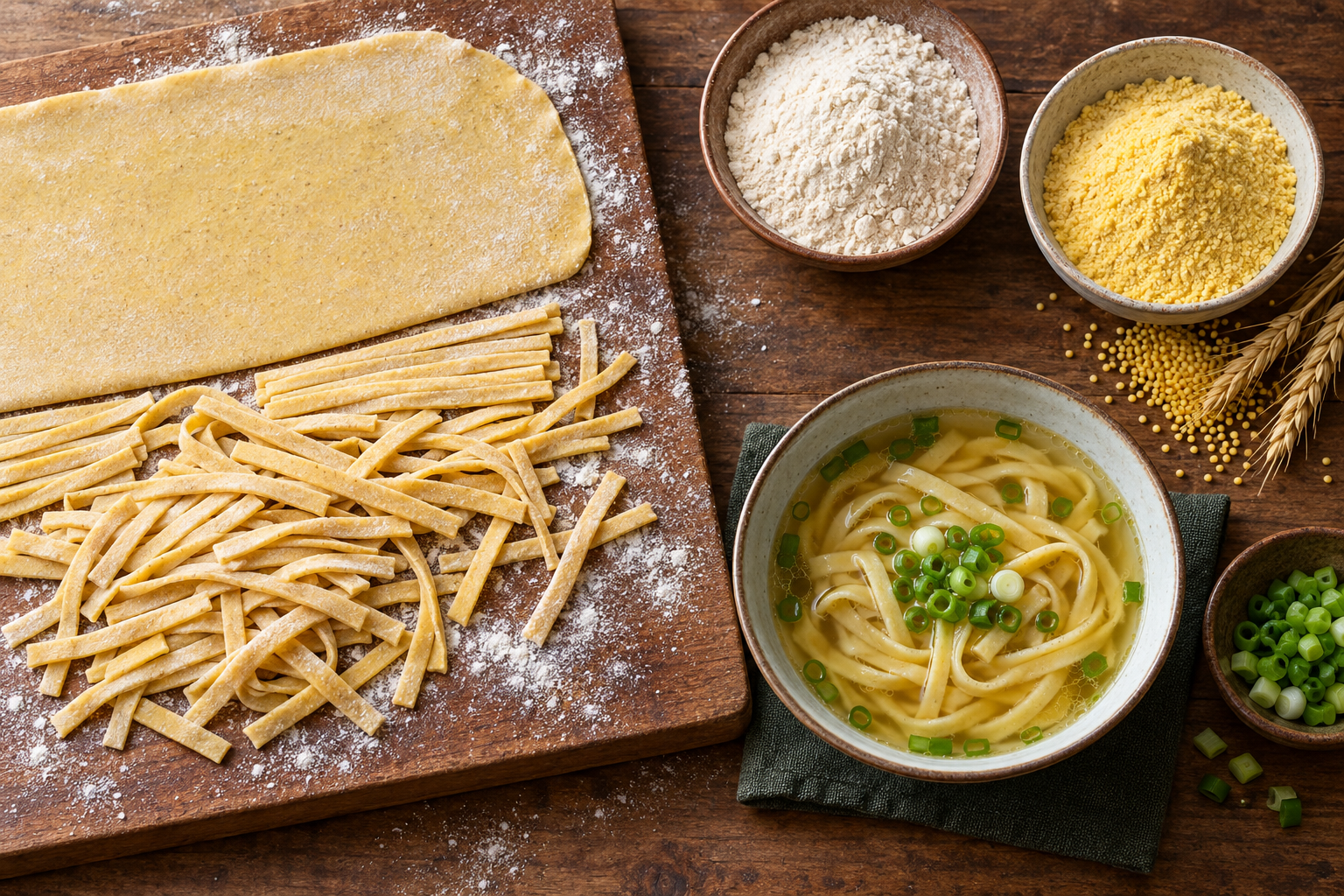
Our dough mixes millet flour with wheat flour, and we roll and cut it rather than hand-pull it. Wheat supplies an elastic structure that millet alone lacks. That makes a manageable modern recipe; it does not resolve the dispute or prove the Lajia cooks used this mixture. The wheat is explicitly a technical adaptation, not a newly discovered ingredient of the ancient bowl.
The noodles are served with a clear scallion broth so their grain flavor remains noticeable. No ancient broth was recovered with them. Broth, seasoning, strand thickness, and all quantities are culinary decisions made here. A home cook can also observe how a flour changes when water is added: a dry meal becomes a dough, rest changes its handling, and boiling changes both firmness and flavor. Such observations belong to cooking, while evidence for a vanished recipe belongs to archaeology.
Keeping two questions separate
Would this recipe make a satisfying meal? Could it reproduce the excavated food? The first is a practical question for a modern kitchen; the second still requires investigation. Our recipe makes no claim to answer either with certainty. Its purpose is to accompany the historical story with an intelligible experiment in ingredients and technique.
Serve short flat strands in small bowls and tell guests why the wheat is there. A mixed-flour noodle can be useful without becoming a claim of authenticity. Lajia remains compelling precisely because an everyday-looking object invites difficult questions about identification, preservation, and the skills that leave few written records.
Short strands are easier to handle
Make four small sheets rather than one large sheet. Keep the waiting dough covered, dust the surface lightly, and cut short strips that can be lifted without stretching. The extra flour is for the board and cut surfaces; it is not an instruction to knead another 20 g into the dough. If the dough keeps springing back, cover it and allow another short rest before rolling again.
A cut strip should hold together when lifted. During boiling, use a cut-open noodle to check for a dry, floury centre rather than treating floating as proof it is done. These are modern cooking checkpoints for this mixture. For other grain-based meals, visit Cooking at Incoprea, and see the Ancient Meals cookbook in preparation for the wider book project.
Millet-and-wheat cut noodles in scallion broth
Serves 4 · Preparation 35 min · Cooking 12 min · 20 minutes dough rest; additional short rest if needed
A modern adaptation for home cooking. Times are approximate.
Ingredients
- 120 g millet flour
- 180 g plain wheat flour, plus 20 g for dusting
- 155–175 ml warm water for dough
- 1 litre water for broth
- 4 scallions, sliced
- 4 g salt
- 15 ml (1 tablespoon) commercial light soy sauce, optional modern seasoning
Method
- Mix the 120 g millet flour and 180 g wheat flour in a bowl. Add 155 ml warm water and bring together with your hands. Knead for about 5 minutes, adding the remaining water a teaspoon at a time only if dry flour remains or the dough cracks badly. Aim for a firm, pliable dough. Keep the separate 20 g flour for dusting.
- Cover the dough and rest for 20 minutes. Divide into four pieces. Keep three covered while working with the first so the surface does not dry out.
- Dust the board and rolling pin lightly. Roll one piece to about 2 mm thick, then cut into strips about 5 mm wide and 8–10 cm long. Dust the cut surfaces sparingly and separate the strips on a lightly floured tray. Repeat with the remaining dough; avoid piling damp strips into a compact heap.
- In a separate saucepan, bring the 1 litre broth water, scallions and salt to a simmer for 5 minutes. Add the optional light soy sauce if using. Keep the broth hot while the noodles cook.
- Bring a large pan of water to a boil. Add noodles in two batches if necessary to keep them moving freely, and stir gently at the start to separate them. Boil for about 4–6 minutes, beginning the check at 4 minutes.
- Lift out a strip and cut through it. Continue cooking if a dry, floury centre remains; thickness and flour brands can change the time. Floating alone is not the doneness check. Drain each batch well.
- Divide noodles among four bowls and pour the hot scallion broth over them. Serve promptly. The dough, cutting method and broth are modern choices.
Substitutions and adjustments
- A purchased millet-and-wheat noodle may replace the dough; cook by its package instructions.
- Do not replace all wheat with millet and expect the same dough behavior.
- If a rolled piece tears, gather that piece together, cover and rest briefly before trying again. Do not try to hand-pull this mixture or substitute millet for all the wheat.
Historical choices: Inspired by the disputed Lajia find. Wheat binding, cut-noodle method and scallion broth are explicit modern adaptations.
Kitchen note: Use food-safe commercial ingredients.
Sources and further reading
- Lu et al., Millet noodles in Late Neolithic China. Original report and interpretation of Lajia remains.
- Ge et al., Can noodles be made from millet?. Experimental challenge to the proposed millet stretching method and residue attribution.