ANCIENT MEALS · 067 / 100
Eastern Alpine Early Iron Age · Hallstatt salt mine, present-day Austria · Approximately 800–450 BCE
Evidence: archaeological reconstruction. The historical evidence and modern cooking choices are distinguished below.
Salt preserved more than wealth
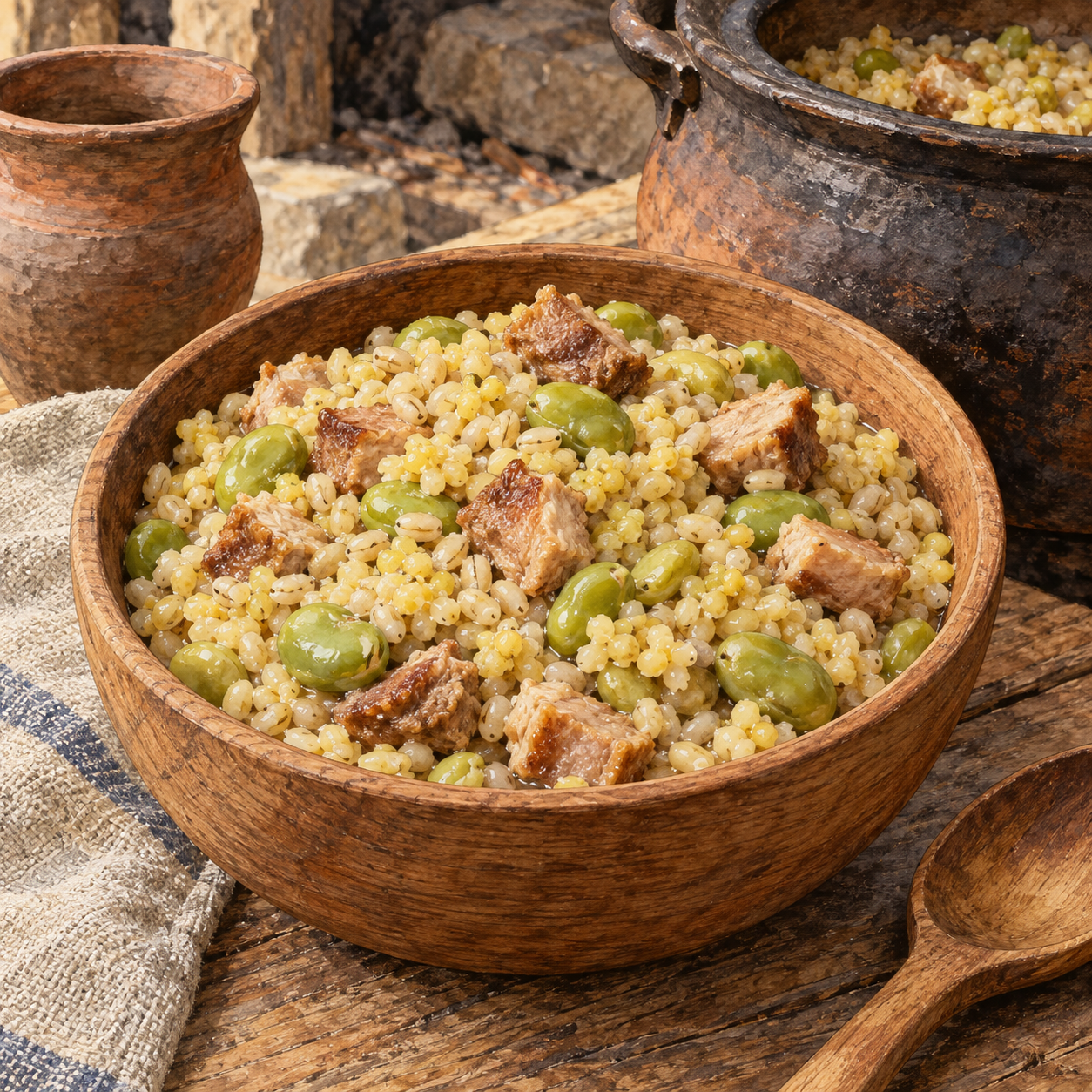
Hallstatt's salt mine preserved organic materials that often vanish at archaeological sites. Food traces, vessels, utensils, and human waste give researchers a view of meals alongside mining work. The Natural History Museum Vienna's account describes a reconstructed grain, bean, and meat preparation comparable to the Eastern Alpine dish now called Ritschert. Barley, millet, broad beans, and rind-rich meat form its proposed framework, while exact prehistoric ingredients and consistency remain uncertain.
A 2021 Current Biology study of Hallstatt palaeofeces adds microscopic and molecular dietary evidence across samples from different periods. Those periods must not be merged into one menu. This page concerns the Early Iron Age, approximately 800–450 BCE. The modern name Ritschert is a comparison used to explain a plausible pot, not a word recovered from a prehistoric recipe manuscript.
One pot as an archaeological inference
The combination makes culinary sense as a thick cooked dish, but residues are not a full recipe. They cannot give this pot's exact ratios, simmering time, or seasoning. The adaptation uses pearl barley, a little millet, shelled green broad beans, and commercially supplied pork shoulder. Modern shoulder replaces the uncertain range of ancient meat parts and simplifies handling. Water is the cooking liquid; salt is added lightly as a modern taste choice.
Different ingredients require different times. Pork is first simmered until beginning to tenderise, then barley cooks in its liquid. Millet and beans join later so the pot remains textured. That sequence is our practical decision, not an excavated instruction. It keeps the dish distinct from plain porridge: grains, legumes, meat, and their cooking liquid form a substantial savoury meal.
A present safety boundary
Broad beans need a specific modern caution. UCLH guidance on G6PD deficiency advises avoiding them because of favism. The canned-chickpea substitute below offers a usable alternative and is clearly identified as changing the bean ingredient. Historical interest does not remove that boundary.
No mine material, untreated rind, contaminated water, or historical preservation experiment belongs in the recipe. Use ordinary food-safe ingredients and a modern saucepan. A long enough simmer makes the pork tender and the grains fully cooked; add water as needed rather than letting the thick pot burn. The finished dish is a reasoned reconstruction built around an archaeological ingredient pattern, while the exact miner's meal and its proportions remain beyond recovery.
Hallstatt-inspired barley, millet, broad-bean, and pork pot
Serves 4 portions · Preparation 20 min · Cooking 85 min · None with shelled fresh or frozen beans.
A modern adaptation for home cooking. Times are approximate.
Ingredients
- 250 g boneless pork shoulder, diced into 1.5 cm pieces
- 120 g pearl barley, rinsed
- 40 g millet, rinsed
- 200 g shelled green broad/fava beans, fresh or frozen
- 1.2 litres drinking water, plus extra as needed
- ½ tsp salt, optional modern seasoning
Method
- Combine pork and water in a saucepan, bring to a boil, skim, and simmer covered for 35–45 minutes.
- Add barley and simmer 25 minutes, stirring occasionally.
- Add millet and continue simmering for 15 minutes, adding water if the pot becomes too thick.
- Add broad beans and optional salt; simmer another 8–12 minutes until pork is fully cooked and tender and all grains and beans are soft.
- Mash a few grains into the liquid if desired, leaving meat and beans visible. Serve hot.
Substitutions and adjustments
- People with G6PD deficiency/favism must avoid broad beans; use 200 g canned chickpeas, drained and rinsed, added for the final 5 minutes. This changes the historical legume.
- Use cooked commercial pork pieces and shorten the initial stage, reheating thoroughly.
Historical choices: Museum and palaeofecal evidence support a grain/bean/meat framework and a Ritschert comparison. Ratios, modern pork cut, pearl processing, sequence, salt, and exact texture are reconstructed.
Kitchen note: People with G6PD deficiency or favism should avoid fava/broad beans even when cooked. Cook pork, grains, and legumes fully; use drinking water and refrigerate leftovers promptly.
Sources and further reading
- Natural History Museum Vienna: Hallstatt Period. Museum archaeological account of food in the mine and the Ritschert comparison; exact ingredients and consistency are not fully known.
- Maixner et al., Hallstatt miners consumed blue cheese and beer, Current Biology 2021. Peer-reviewed dietary analysis across multiple dated samples; the recipe does not combine all periods into one meal.
- UCLH: Glucose-6-phosphate dehydrogenase deficiency. Official hospital advice to avoid broad beans with G6PD deficiency; supports the modern safety warning and chickpea alternative.