ANCIENT MEALS · 065 / 100
Early Iron Age northern Europe · Bjældskovdal, Jutland, present-day Denmark · Approximately 400 BCE
Evidence: archaeological reconstruction. The historical evidence and modern cooking choices are distinguished below.
A meal preserved inside a person
Tollund Man's preserved remains offer a rare kind of food evidence: material from a meal rather than an ingredient list imagined from crops grown nearby. A 2021 peer-reviewed reanalysis recorded by Aarhus University identified a porridge containing barley, flax, and pale persicaria, with probable fish consumption as well. The work combined several analytical methods and considered what the findings can, and cannot, reveal about Early Iron Age life.
Museum Silkeborg's account of food places the grain and seed evidence beside other finds from Iron Age settlements. The recipe below selects the familiar edible barley and flax components for a modern bowl. It omits the wild seed mixture and fish, so it does not claim to reproduce the complete last meal. Omission is a stated limit, not an attempt to turn the archaeological evidence into a tidier story than it supports.
A human story without a ritual recipe
Tollund Man died violently around the beginning of the Scandinavian Iron Age, but the food should not automatically be called a prescribed sacrificial menu. The reanalysis discusses both ordinary fare and possible significance of threshing waste. Those possibilities remain different kinds of inference. Nothing in our kitchen recipe can settle why the ancient meal contained particular wild seeds or what its diner expected to happen afterward.
A simple savoury porridge allows the direct ingredient evidence to remain visible. Cracked barley gives a substantial grain body, while a small amount of food-grade ground flax thickens the liquid. Their measured ratio is modern. Archaeological residues do not provide a reliable household pot volume or a present serving size. Salt is optional and explicitly a taste choice rather than an established amount.
Cooking the safe adaptation
The modern bowl contains no foraged seeds, grit, or chaff. Those materials may be historically meaningful in a sample, but they are not instructions for what to add to dinner. Cook the barley until soft before stirring in the ground flax, then simmer that addition fully. Water, rather than milk or butter, keeps the adaptation close to its declared grain-and-seed focus without inventing dairy evidence for this meal.
The cooking time depends on how coarsely the barley is cracked, so judge tenderness and add hot water if the pot becomes too thick. Serve the porridge warm in small bowls. Its value is a respectful encounter with directly analysed food remains, while recognising that a complete ancient meal and its social meaning remain beyond a modern measured reconstruction.
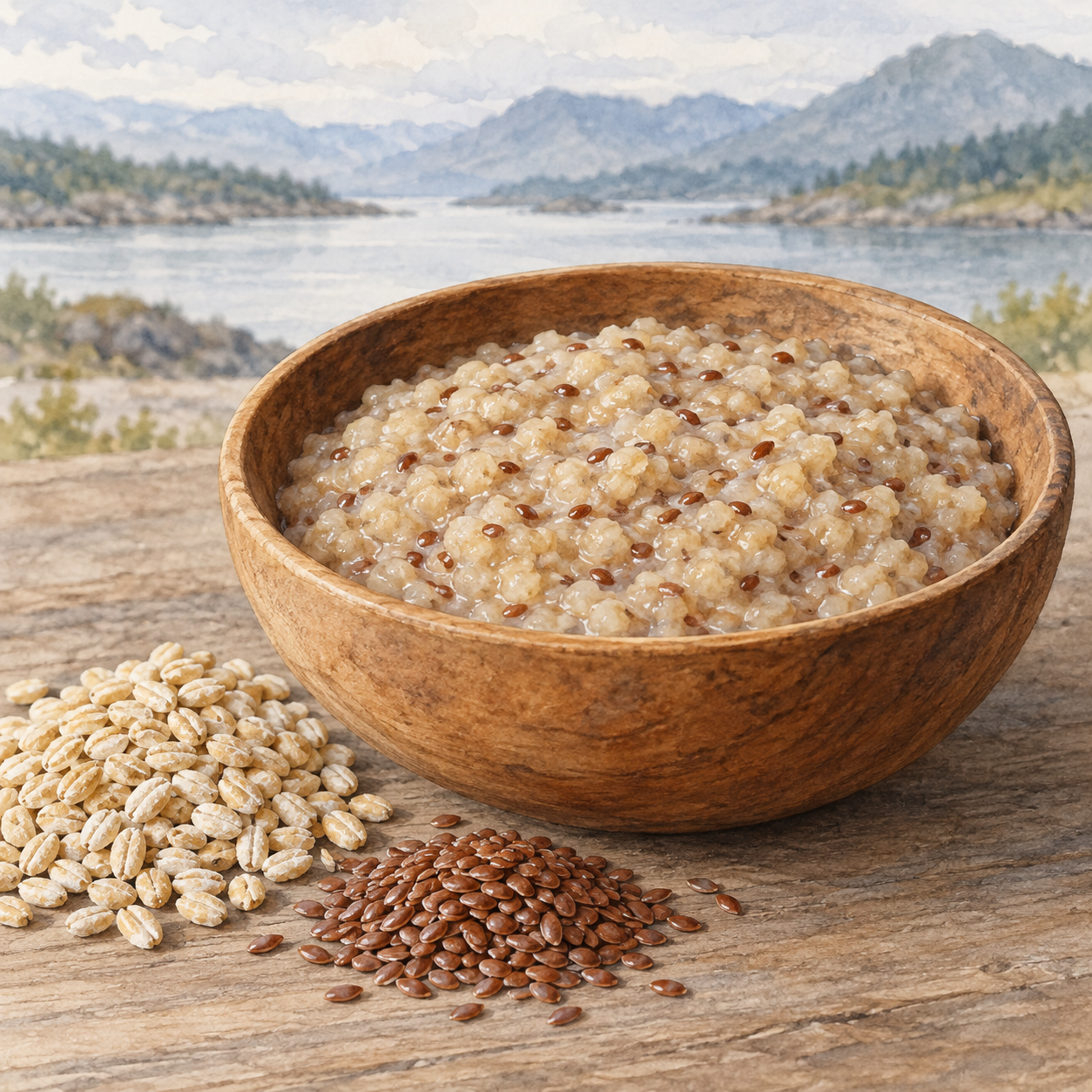
Savoury cracked-barley and flax porridge
Serves 4 small bowls · Preparation 10 min · Cooking 45 min · None.
A modern adaptation for home cooking. Times are approximate.
Ingredients
- 160 g commercial cracked barley or barley grits
- 900 ml drinking water, plus extra as needed
- 10 g (about 1 tbsp) food-grade ground flaxseed
- ¼ tsp salt, optional modern seasoning
Method
- Rinse cracked barley briefly and combine with water in a saucepan.
- Bring to a boil, reduce heat, and simmer 30–40 minutes, stirring often, until the grain is soft.
- Stir in ground flaxseed and optional salt. Simmer another 5–8 minutes, stirring continuously.
- Add hot water if too stiff; aim for a thick but spoonable porridge.
- Serve warm. Cool and refrigerate any leftovers promptly.
Substitutions and adjustments
- Pearl barley can replace cracked barley, with a longer simmer and a different grain texture.
- Do not add foraged weed seeds, chaff, or unknown plants to imitate archaeological residues.
Historical choices: The analysed meal contained barley, flax, pale persicaria, and probable fish. This recipe reconstructs only a safe grain-and-flax component; proportions, texture, salt, and timing are modern.
Kitchen note: Use commercial food-grade grain and a modest amount of flaxseed, cooking both fully. Omit archaeological contaminants and unidentified wild seeds.
Sources and further reading
- Nielsen et al., The last meal of Tollund Man: Aarhus research record. Peer-reviewed Antiquity 2021 analysis identifies barley, flax, wild seeds, and probable fish; ritual interpretation remains qualified.
- Museum Silkeborg: What people ate. Museum context for Iron Age grains and seeds, including the Tollund meal; not proof of exact modern proportions.