ANCIENT MEALS · 064 / 100
Late Neolithic lakeshore settlement · Lake Zürich, present-day Switzerland · Approximately 3176–3153 BCE
Evidence: archaeological reconstruction. The historical evidence and modern cooking choices are distinguished below.
Two small finds, a large question
At the Neolithic lakeshore settlement of Parkhaus Opéra in Zürich, two charred bread-like objects survived long enough for researchers to examine their internal structure. A 2017 PLOS ONE study by Heiss and colleagues identified cereal tissues and investigated grain particles, pores, and the effects of preparation. The finds came from a settlement layer dated approximately 3176–3153 BCE. Their importance lies in direct food evidence rather than a later story about what prehistoric people ought to have eaten.
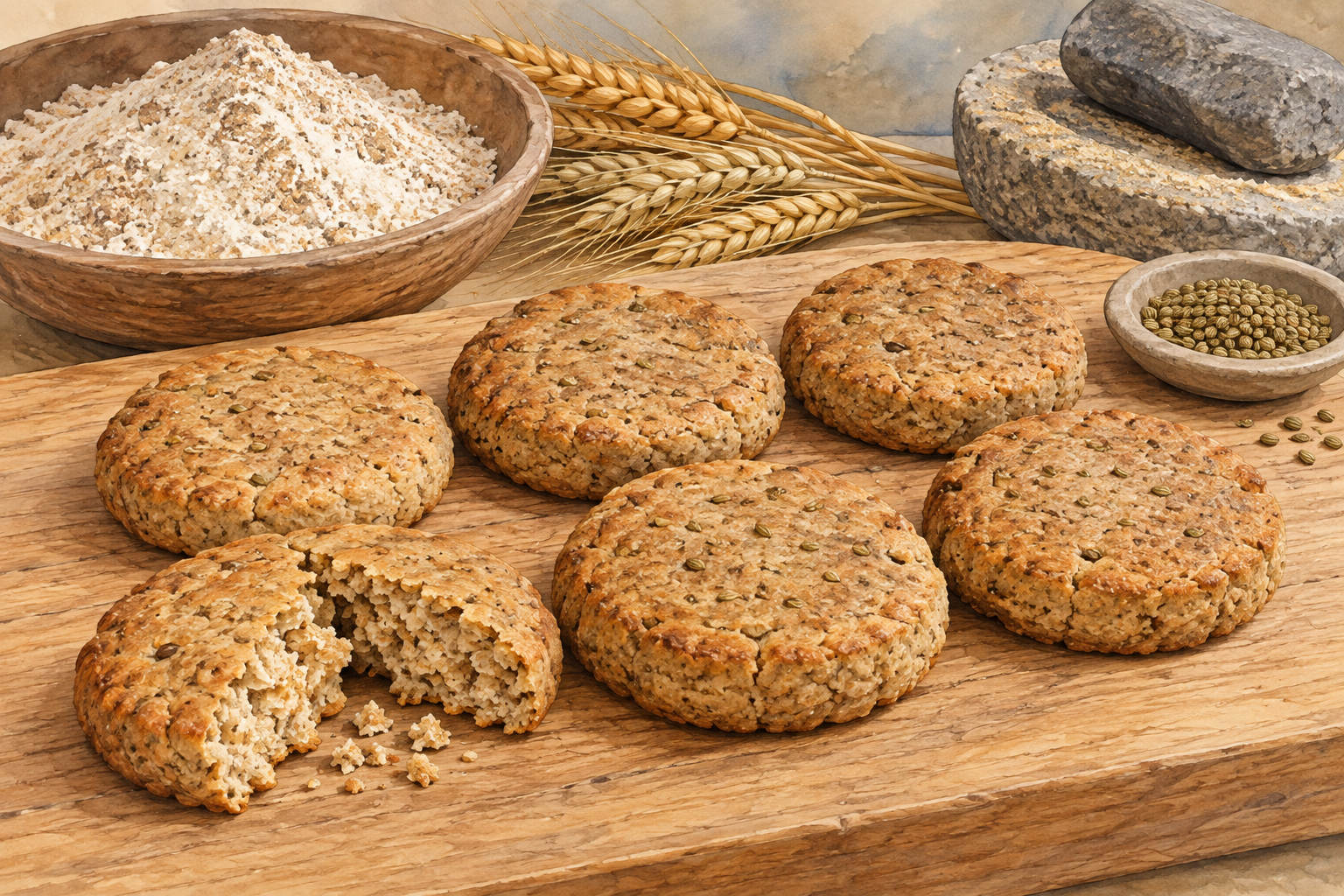
One object contained barley evidence; the other included wheat and probable barley, together with a small fruit identified as probably celery. The study treats that celery clue as evidence for a condiment, while stressing the limited ability to infer quantities. The City of Zürich's archaeological publication record places the analysis within the documented Parkhaus Opéra research programme. It is not a surviving recipe card.
A reconstruction with measured uncertainty
This modern galette uses barley flour and whole-wheat flour, with a little food-grade celery seed. The proportions are invented for practical baking and clearly labelled as such. The study cannot tell us that ancient cooks used an equal flour blend or half a teaspoon of seed. It also cannot resolve the wheat to a single species, so this page does not call the loaf certainly einkorn or emmer.
The compact texture and small pores support an unleavened preparation. Modern yeast and baking powder are therefore omitted. The researchers also found evidence consistent with wet dough preparation and heating before the final charring. Our oven supplies a controlled modern bake, not a claim about the precise ancient hearth or appliance. Nor do we imitate the charring that happened to preserve the archaeological objects.
Grain processing is part of the story
Grinding changes how cereals behave as food. The study records differences in particle size and discusses what they may imply about processing. Modern flour cannot fully reproduce the ancient meal, but choosing whole-wheat flour alongside barley makes that difference easier to explain than using an airy white sandwich loaf. The goal is a dense cooked disc with a modest aromatic hint.
Keep the galettes low enough for the flour centres to cook, and add water gradually because milling and bran affect absorption. Optional salt is a modern taste decision rather than an attested amount. Serve the breads warm or cooled, while recognising that an archaeological ingredient clue can support a thoughtful reconstruction without revealing the exact taste of a Neolithic meal.
Mixed-grain celery galettes
Serves 6 small breads · Preparation 20 min · Cooking 30 min · Rest dough 15 minutes.
A modern adaptation for home cooking. Times are approximate.
Ingredients
- 150 g barley flour
- 150 g whole-wheat flour
- 180–210 ml water
- ½ tsp food-grade celery seed, lightly crushed
- ¼ tsp salt, optional modern seasoning
Method
- Heat oven to 200°C/400°F. Line a baking tray.
- Mix flours, celery seed, and optional salt. Add 180 ml water, mixing, then add more by teaspoons to make a soft shapeable dough.
- Knead gently for 2–3 minutes, cover, and rest 15 minutes.
- Divide into six pieces and pat into discs about 9 cm wide and 1 cm thick.
- Bake 25–35 minutes, turning once, until lightly browned and the centres are fully cooked with no damp flour dough. Break one open to check.
- Cool 5 minutes and serve.
Substitutions and adjustments
- Emmer flour can replace the whole-wheat flour as a plausible grain choice, but the find does not identify the exact wheat species.
- Do not replace the measured modern blend with a claim about recovered ancient proportions.
Historical choices: Based on Parkhaus Opéra bread-like finds studied by Heiss et al. Probable cereal and celery identifications support the framework; ratios, seed amount, water, shaping, salt, and oven are modern reconstruction.
Kitchen note: Use food-grade flour and celery seed. Bake every centre fully; do not taste raw dough. Celery can be an allergen.
Sources and further reading
- Heiss et al., State of the (t)art, PLOS ONE 2017. Peer-reviewed direct analysis of the two Zürich bread-like finds; ingredient quantities and exact wheat species cannot be recovered.
- City of Zürich: Underwater archaeology publication list. Municipal archaeological research record listing the Parkhaus Opéra analyses and their published context.