ANCIENT MEALS · 063 / 100
Greek gastronomic poetry · Greek Mediterranean, including Sicily · Approximately fourth century BCE, preserved by Athenaeus around 200 CE
Evidence: historically informed adaptation. The historical evidence and modern cooking choices are distinguished below.
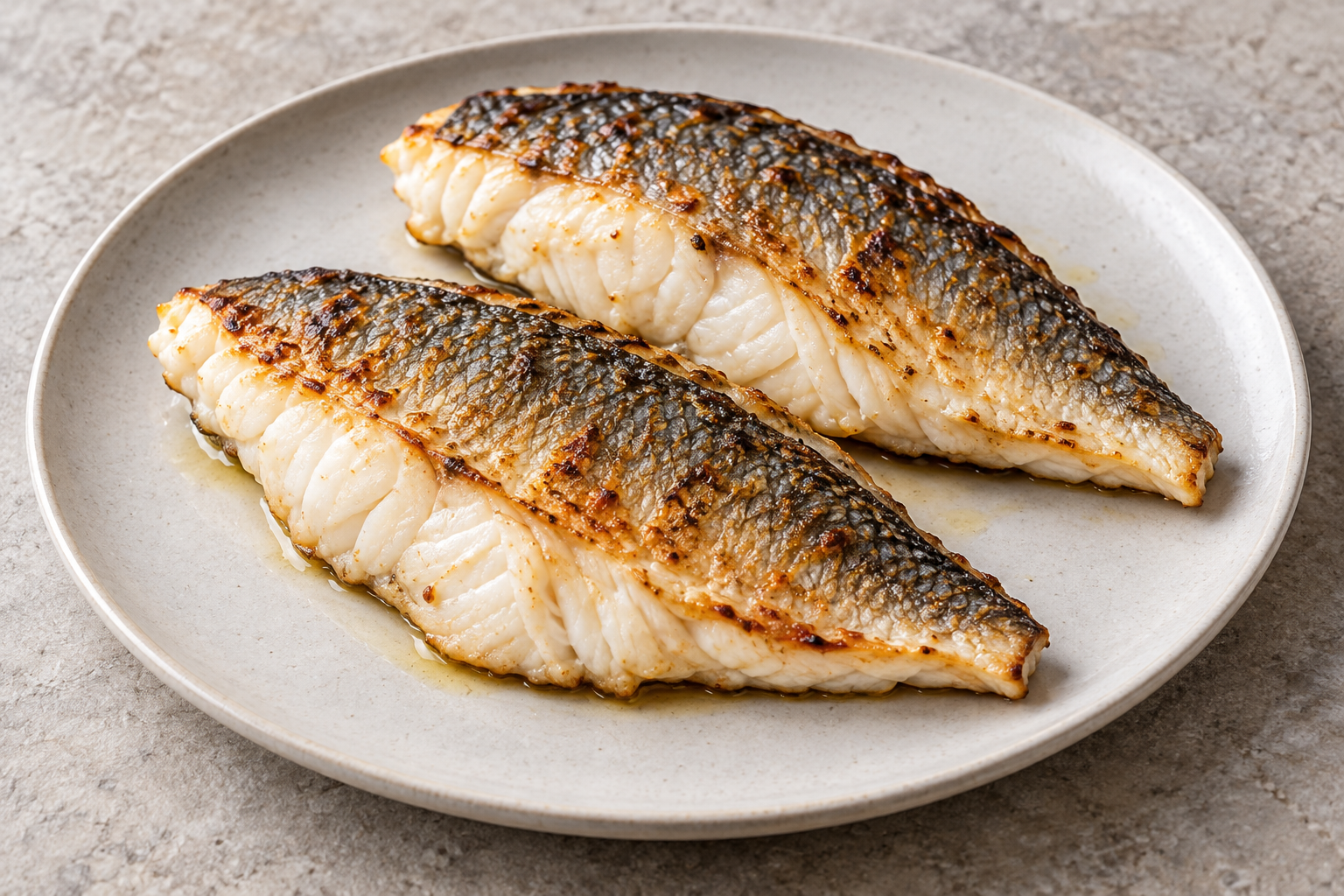
Let the fish carry the flavour
Archestratus's food poetry survives in quotations rather than a complete cookbook. In Athenaeus, Book VII, 321d, his advice distinguishes tougher fish from naturally tender, fatty fish. The latter need only salt and oil in the selected passage. That preference is the historical anchor for this modern grilled fish. It is a principle of seasoning, not a fully measured recipe for a named contemporary fillet.
The University of Chicago's discussion of ancient cookery draws attention to the simplicity of this fragment and explains how Archestratus's fourth-century-BCE poetry reaches us through Athenaeus. Those dates should remain separate. A Greek poet's instruction is preserved by a later imperial writer; the surviving quotation does not mean both sat at the same historical table.
A deliberate adaptation of a fragment
Modern sea bream or sea bass fillets are selected for availability and manageable cooking. They are not asserted to be the precise ancient species behind every fish term in the passage. Grilling is our chosen present method, while the fragment supplies the restrained salt-and-oil treatment. That is why the evidence label is a historically informed adaptation rather than an intact surviving recipe.
There is no wine, honey, vinegar, cheese, herb stuffing, or complicated sauce. This keeps the dish distinct from the stuffed sardines and shellfish broth in this collection. A little oil prevents sticking and carries the heat across the surface; salt seasons the fish without giving it a crust of seasoning. No claim about a direct ancestry for a modern regional dish is necessary.
Freshness does not replace a thermometer
The appeal of simple seasoning depends partly on sound ingredients, but an ancient writer's praise cannot supply modern safety assurance. Buy fish from a reputable supplier, refrigerate it, and check carefully for bones. A preheated grill pan gives the home cook controlled contact heat. The cooking time will change with thickness, so a measured centre temperature is more reliable than counting minutes alone.
Archestratus's fragment concerns a gastronomic preference and should not be taken as a survey of what everyone in the Greek Mediterranean ate. It also does not forbid other seasonings in all of his writings. This recipe follows one selected idea on purpose. Serve the fish hot with its own juices, allowing the lightly browned surface and tender cooked flesh to provide the interest. The portion size, pan method, and safety endpoint are transparent modern decisions.
Simply grilled fish with salt and olive oil
Serves 4 portions · Preparation 10 min · Cooking 12 min · None.
A modern adaptation for home cooking. Times are approximate.
Ingredients
- 4 fillets (about 150 g each) sea bream or sea bass, scaled if skin-on and checked for bones
- 2 tbsp olive oil
- ½ tsp salt
Method
- Keep fish refrigerated until preparation. Check for pin bones and pat dry.
- Heat a grill pan over medium-high heat. Brush fish with oil and season lightly with salt.
- Lay fillets skin-side down if skin-on. Cook 4–6 minutes, adjusting heat to avoid scorching.
- Turn carefully and cook 3–5 minutes more until the thickest centre reaches 63°C/145°F and the flesh is opaque.
- Serve promptly with the cooking juices and no additional sauce.
Substitutions and adjustments
- Use another responsibly sourced mild fish fillet of similar thickness; this is a species adaptation.
- A hot oven at 200°C/400°F can replace the grill pan, with cooking time guided by the same centre temperature.
Historical choices: Archestratus, quoted by Athenaeus VII.321d, supplies the salt-and-oil principle for tender fatty fish. Modern fillets, species, grilling, quantities, and temperature are adaptations.
Kitchen note: Buy and handle fish safely, inspect for bones, and cook to 63°C/145°F.
Sources and further reading
- Athenaeus, Deipnosophistae VII.319c–330c: Loeb translation. Public-domain primary text preserving Archestratus's distinction between tough fish and tender fish seasoned simply.
- Encyclopaedia Romana: Apicius and ancient cookery. University-hosted discussion of Archestratus's fragmentary survival and restrained fish advice; contextual secondary source.