ANCIENT MEALS · 062 / 100
Archaic Greek hymn tradition · Eleusis and Greek literary tradition · Approximately seventh–sixth century BCE text
Evidence: historically informed adaptation. The historical evidence and modern cooking choices are distinguished below.
A drink at the centre of a story
In the Homeric Hymn to Demeter, the grieving goddess refuses wine and asks for a mixture of barley, water, and an aromatic herb translated as pennyroyal. The passage calls the mixture kykeon. It gives a powerful literary setting and a short ingredient framework, not a measured home-kitchen recipe. This adaptation is a cooked barley-and-spearmint drink inspired by that framework.
The distinction between poem and procedure matters. The hymn does not settle the exact grain grind, proportions, temperature, or final thickness. Nor can a modern drink recreate the experience or significance of a historical rite simply by using similar ingredients. This page presents a food-history adaptation, leaving ritual claims and undocumented additions outside its recipe.
A clear herb substitution
Pennyroyal is omitted. The National Library of Medicine's LiverTox account of pennyroyal records serious toxicity, particularly from its oil. Ordinary food-grade spearmint provides an accessible aromatic substitute without pretending it is the same ancient plant. No essential oils, unidentified wild herbs, or contaminated grain are used. The substitution changes the flavour and is identified openly.
Barley flour is simmered fully so that the drink does not ask a reader to consume raw flour. The heating step is a modern safety and texture decision. It produces a pourable, lightly thickened mixture with a modest grain flavour. Spearmint is added after simmering to keep its aroma clear, then removed. Honey is not added to the basic recipe because the selected hymn passage names barley, water, and the herb rather than a sweetened drink.
Mixing is a practical act
Fine grain particles can settle as a drink stands. Stirring before each serving makes the texture more even and connects the present experience to the idea of a mixed preparation. That is a culinary observation, not proof of a precise ancient drinking habit. A broad cup or small bowl is useful, but the vessel shown in a generated image cannot be treated as an excavated example of this recipe.
The historical scope here is the Archaic Greek hymn tradition, commonly situated around the seventh to sixth centuries BCE, and its Eleusinian narrative. Adjust with hot water if it thickens too far, and let it cool to a comfortable drinking temperature. Its measured quantities, simmering, and spearmint replacement make the literary mixture usable while keeping the gap between attestation and modern reconstruction explicit.
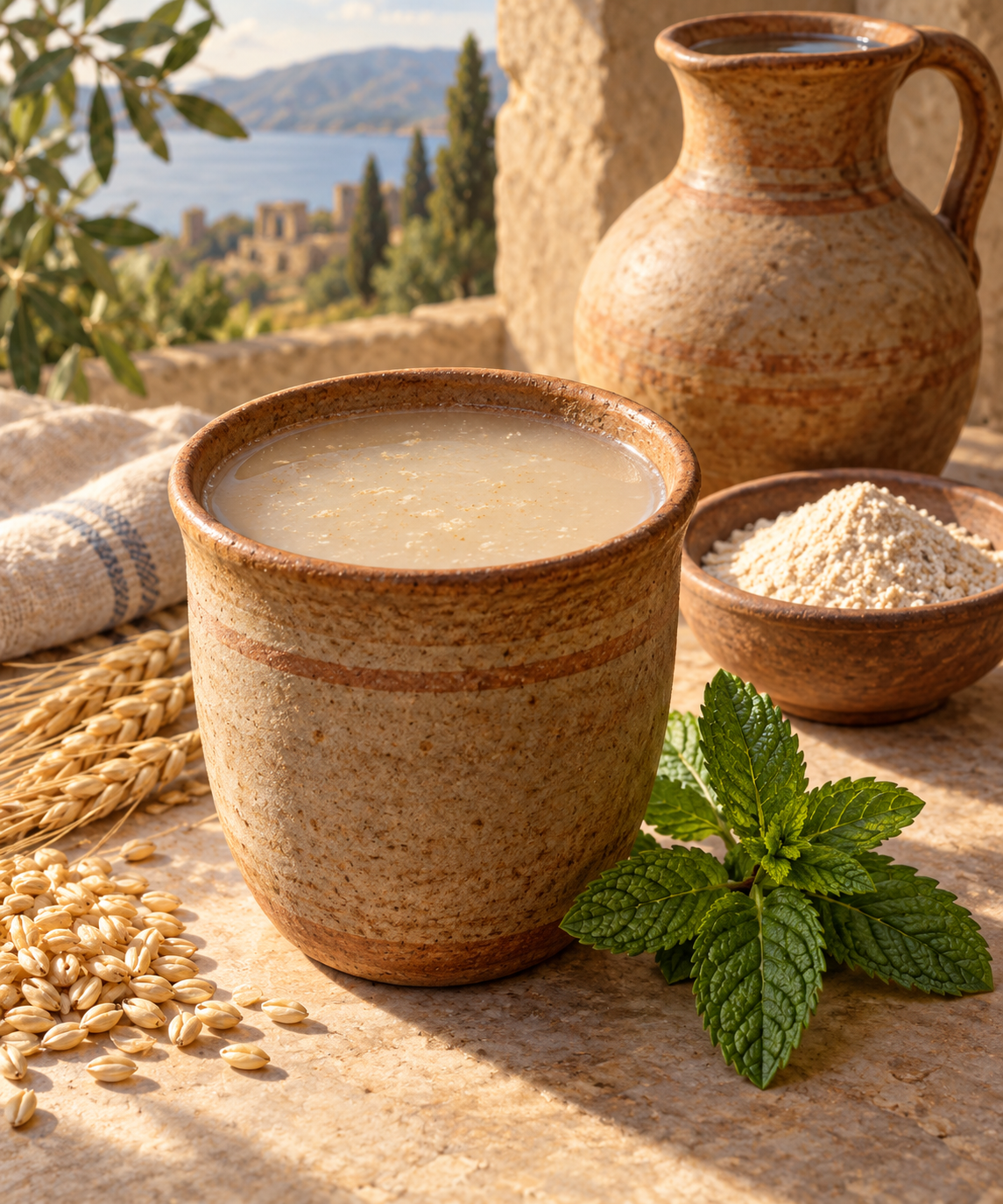
Cooked barley-and-spearmint kykeon adaptation
Serves 4 small cups · Preparation 5 min · Cooking 15 min · Infuse mint 5 minutes; cool to comfortable drinking temperature.
A modern adaptation for home cooking. Times are approximate.
Ingredients
- 30 g barley flour
- 800 ml drinking water, plus extra if needed
- 4 sprigs washed food-grade fresh spearmint
Method
- Whisk barley flour with 100 ml cold water to make a smooth slurry.
- Bring the remaining 700 ml water to a simmer. Whisk in the slurry.
- Simmer gently 12–15 minutes, stirring frequently, until the flour is fully cooked and the mixture remains pourable.
- Remove from heat, add spearmint sprigs, and infuse for 5 minutes. Remove the sprigs.
- Add hot water if too thick, stir before dividing, and let cool to a comfortable drinking temperature.
Substitutions and adjustments
- Use ordinary food-grade peppermint leaf if spearmint is unavailable; its aroma differs.
- Never replace spearmint with pennyroyal or any essential oil.
Historical choices: The Hymn to Demeter attests barley, water, and pennyroyal in kykeon. Fully cooked flour, proportions, infusion order, and spearmint are modern adaptations.
Kitchen note: Cook flour fully. Use ordinary culinary mint only; omit pennyroyal and essential oils. Cool before drinking.
Sources and further reading
- Harvard Center for Hellenic Studies: Homeric Hymn to Demeter. Primary-text translation, lines 206–211, gives the literary mixture and its narrative context, not a measured recipe.
- LiverTox: Pennyroyal, National Library of Medicine. Official medical reference for the modern decision to omit pennyroyal; ordinary spearmint is a distinct culinary substitute.