ANCIENT MEALS · 061 / 100
Galen's Greek food writing · Greek-speaking Roman Mediterranean · Approximately second century CE
Evidence: adapted surviving recipe. The historical evidence and modern cooking choices are distinguished below.
A physician describes a frying pan
Galen's On the Properties of Foodstuffs describes wheat flour mixed with water and poured into hot olive oil. He observes the batter setting and the cook turning it until both surfaces and the interior are done. His Greek terminology distinguishes Athenian and Asian Greek pronunciations of the pancake's name. These are unusually useful details for a text concerned with food and its effects on the body.
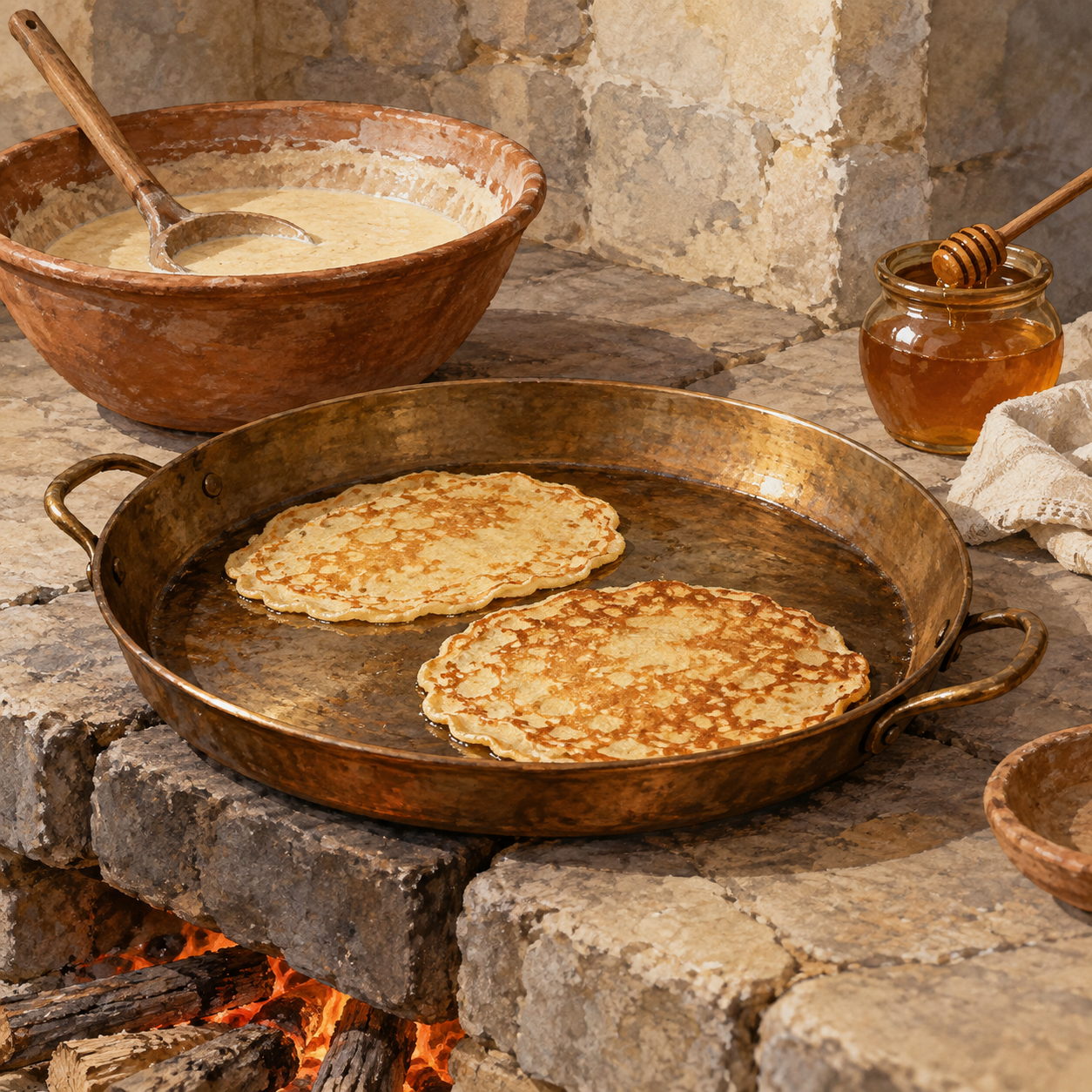
A University of Łódź study of cereals in ancient and early Byzantine medical sources discusses the same preparation and its place among flat cakes. Neither source supplies the exact modern bowl of batter below. The adaptation uses a small household quantity and honey as a selected flavouring, keeping the flour-water-oil framework visible. No egg, milk, baking powder, or yeast is needed.
From poured batter to a cooked cake
Unlike a kneaded flatbread, this mixture flows into the pan. Its structure forms during cooking. That distinction gives the dish its own place in the collection: it is not another loaf or a bread slice fried after baking. A small amount of honey in the batter supplies sweetness, with a little more at serving. Salt balances the mixture but does not create a savoury filling.
The modern cook must decide what Galen leaves unmeasured. Batter thickness affects spreading, pan size determines the batch, and a steady moderate heat lets the interior cook before the surface becomes too dark. A thin small cake is easier to turn than a large deep one. Those observations concern the practical adaptation; they are not additional recovered ancient instructions.
Reading medicine as food history
Galen's medical explanations belong to the intellectual world of the second century CE. They can preserve valuable kitchen observations without serving as present nutritional advice. This recipe makes no claim that honey remedies the digestive or humoral effects he discusses. The reason to read the passage is its concrete account of a cook watching batter change, not to reproduce an obsolete medical theory.
Pour modest rounds, turn when the surface begins to set, and check that no wet flour mixture remains in the middle. A thin oil coating is used here in place of an unmeasured amount in the ancient pan. Water may need a slight adjustment for different flours. Serve warm, allowing the pancakes' simple wheat flavour and honey finish to carry the dish without imported modern toppings.
Egg-free wheat tagenitai with honey
Serves 4 snack portions, about 8 small pancakes · Preparation 10 min · Cooking 25 min · Rest batter 10 minutes.
A modern adaptation for home cooking. Times are approximate.
Ingredients
- 150 g plain wheat flour
- 200–220 ml water
- 1 tbsp honey, plus 1 tbsp to finish
- ¼ tsp salt
- 3 tbsp olive oil for frying, used gradually
Method
- Whisk flour, 200 ml water, 1 tbsp honey, and salt to a smooth pourable batter. Rest 10 minutes; add up to 20 ml more water if very thick.
- Heat a little oil in a frying pan over medium heat.
- Pour about 3 tbsp batter per cake, making small thin rounds. Cook 2–3 minutes until edges set and the underside is golden.
- Turn carefully and cook the other side 2–3 minutes; turn once more if needed to ensure the centre is fully cooked and no wet batter remains.
- Repeat with remaining batter, adding oil as necessary. Drizzle with the remaining honey and serve warm.
Substitutions and adjustments
- Use a little whole-wheat flour mixed with plain flour for a coarser modern flour interpretation.
- Maple syrup changes the historical sweetener and is not an ancient Greek ingredient.
Historical choices: Galen attests wheat-water batter cooked in olive oil, turning, and honey/salt flavouring options. Exact proportions, small rounds, and oil quantity are adaptations.
Kitchen note: Cook flour batter fully and keep oil at moderate heat. Honey is unsuitable for infants.
Sources and further reading
- Galen, On the Properties of Foodstuffs: Cambridge translation sample. Scholarly primary-text translation, On pastries section, gives the flour-water-oil and turning method; no modern measured recipe.
- Cereals of Antiquity and Early Byzantine Times, University of Łódź. Scholarly analysis of Galen's pancake terminology and preparation in its medical-literary context.