ANCIENT MEALS · 060 / 100
Greek literary foodways · Greek Mediterranean · Earlier Greek references preserved by Athenaeus, approximately 200 CE
Evidence: historically informed adaptation. The historical evidence and modern cooking choices are distinguished below.
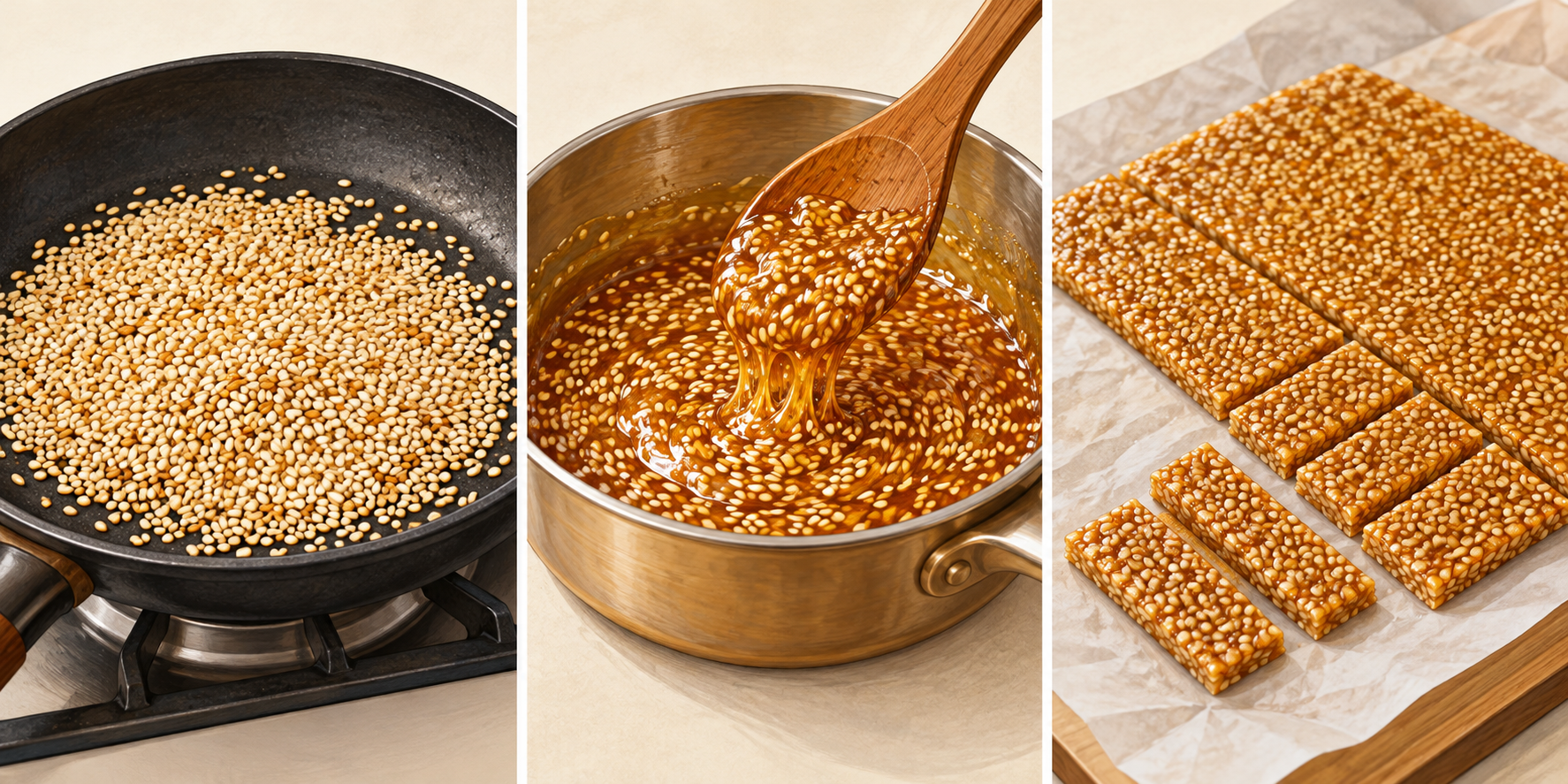
A name preserved at a literary table
Athenaeus's discussion of sweets in The Deipnosophists, Book XIV describes itrion as a thin cake made from sesame and honey. He also quotes earlier poets who mention the food. The passage provides a name, a basic ingredient combination, and a clue about thinness. It does not provide a confectioner's temperature, a seed-to-honey ratio, or instructions for cutting rectangular bars.
That distinction is the foundation of this article. The measured recipe below is a historically informed modern adaptation of an ancient description, rather than a complete surviving recipe translated word for word. Sesame and honey are secure anchors. Toasting, boiling, pressing, chilling, and cutting are practical decisions made to turn them into a manageable sweet. Thin bars give a useful present interpretation of the recorded form without claiming an exact ancient shape.
What the seed contributes
Sesame seeds supply most of the substance. Honey binds them and brings sweetness, while brief toasting gives a stronger aroma. The ratio deliberately leaves the seeds visible, rather than making a honey candy containing a token sprinkle. A small amount of oil is used only on the working surface; it is not silently attributed to the short itrion description. No flour, refined sugar, nuts, chocolate, or dried fruit is added.
The British Museum's classical food overview shows how texts and material evidence can inform modern adaptations. For this particular sweet, the text does the principal evidentiary work. A generated illustration is not an excavated confection, and an appealing modern result cannot fill the gaps in an ancient source. The kitchen process therefore remains labelled as interpretation.
Thin does not mean brittle
Honey can produce a softer texture than a modern sugar brittle, especially in humid conditions. The adaptation aims for chewy pieces that hold together, not a guaranteed crisp snap. Pressing the hot mixture into a thin even sheet improves handling, and cutting while it is still warm avoids breaking an already firm slab. A lightly oiled spoon keeps the mixture from sticking to the tool.
Athenaeus wrote in the Roman imperial period, approximately 200 CE, preserving much earlier Greek voices; those periods should not be collapsed into one simultaneous table. Expect honey type and room humidity to affect the final firmness. Let the sweet cool before eating, and treat the quantities and thermometer target as modern aids rather than recovered ancient knowledge.
Thin sesame-and-honey itrion bars
Serves 5 portions, about 20 small bars · Preparation 15 min · Cooking 15 min · Cool 45–60 minutes.
A modern adaptation for home cooking. Times are approximate.
Ingredients
- 180 g food-grade sesame seeds
- 100 g honey
- 1 tsp olive oil for parchment and spoon
Method
- Line a small tray with parchment and rub it lightly with oil. Lightly oil a spoon.
- Toast sesame in a dry pan over medium-low heat for 4–6 minutes, stirring, until fragrant and pale golden; remove from heat.
- Heat honey in a small heavy pan at a gentle boil for 5–8 minutes, aiming for about 115°C/240°F if using a thermometer. Avoid scorching.
- Stir in sesame, cook over low heat for 1 minute, then scrape onto the prepared tray.
- Press with the oiled spoon into a sheet about 5 mm thick. Score into 20 bars while warm.
- Cool fully for 45–60 minutes, then separate. Chill briefly if the mixture remains very soft.
Substitutions and adjustments
- Use hulled sesame for a mild flavour; unhulled seeds produce a more bitter, coarse texture.
- Do not assume a different syrup recreates the ancient honey ingredient.
Historical choices: Athenaeus XIV attests a thin sesame-honey itrion, but not this measured process. The recipe is a modern confectionery reconstruction.
Kitchen note: Hot honey can cause serious burns; handle with care and cool fully. Sesame is an allergen and honey is unsuitable for infants.
Sources and further reading
- Athenaeus, Deipnosophists XIV: sweets. Public-domain translation describing itrion and citing earlier Greek poets; it does not give proportions or cooking temperature.
- British Museum: Cook a classical feast. Museum overview of using ancient texts and objects in modern classical cooking; contextual support, not the source of this exact confection recipe.