ANCIENT MEALS · 058 / 100
Late Roman cookbook tradition · Roman Mediterranean · Approximately 390–450 CE compilation, with earlier material
Evidence: adapted surviving recipe. The historical evidence and modern cooking choices are distinguished below.
A fruit becomes a container
Dates have a natural cavity once their stones are removed, and a recipe in Apicius, Book VII uses that space. The fruit is filled with nuts and pepper, salted outside, and treated with honey. The Latin heading calls these domestic sweets. That name is part of the surviving text; it should not be expanded into proof that every Roman family made them at home.
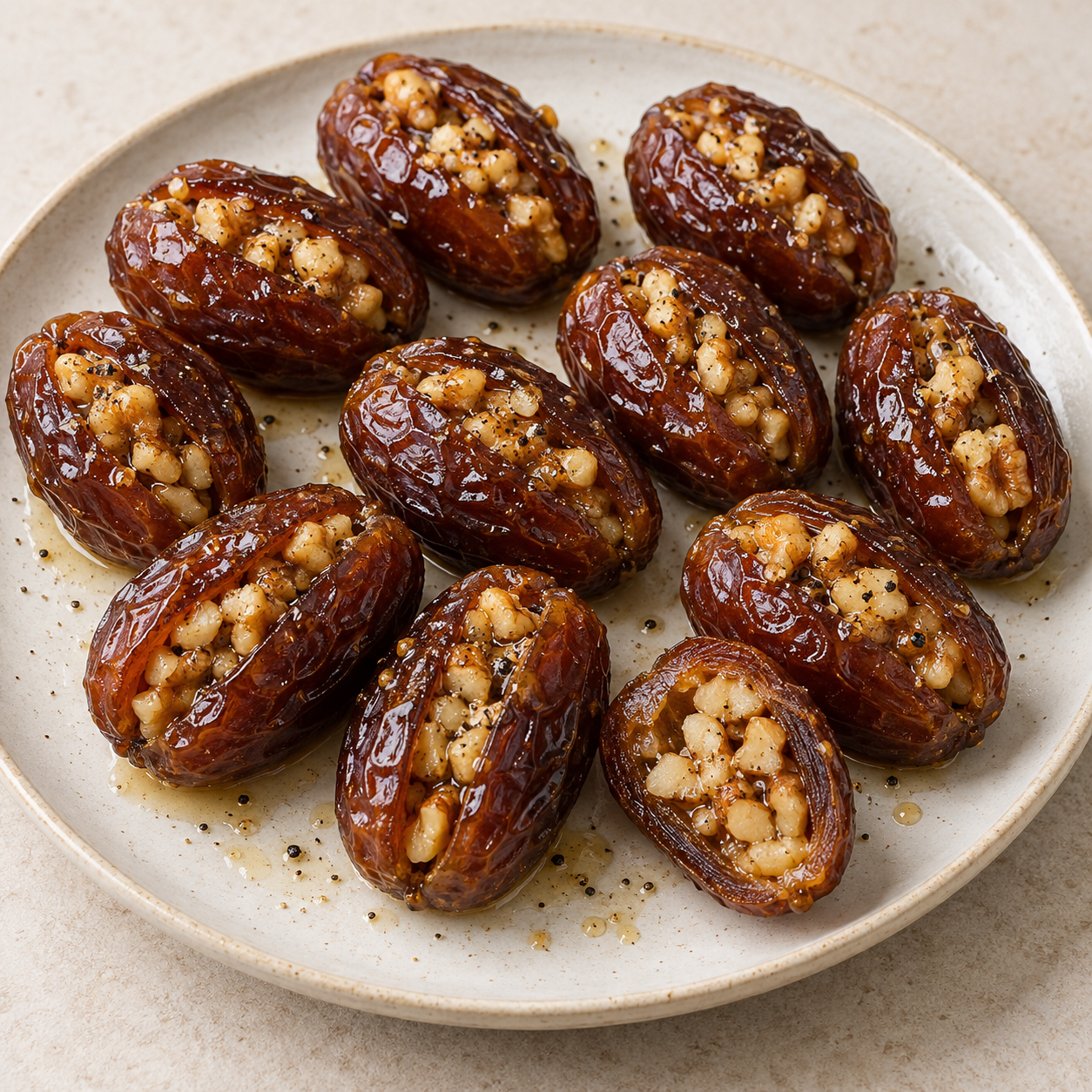
The Latin dulcia domestica supplies the filling and finish while leaving quantities and heat handling unstated in modern terms. Our recipe uses large, soft commercial dates and chopped walnuts. Smaller dates would yield a different serving size and may hold only one small nut piece. The modern choice is practical rather than an identification of a particular ancient cultivar.
Pepper and salt in a sweet
Pepper is not an accidental intrusion. It belongs to the recorded filling, and a small amount gives the confection a warmer flavour than fruit and nuts alone. Salt on the surface provides another contrast. The adaptation measures both sparingly, since modern nuts and dates vary and a strong salt crust would obscure the fruit. Honey adds a sticky finish rather than replacing the date's own sweetness.
The nuts are chopped so that the filling sits securely inside the slit. Whole nuts can also be used, but very large pieces make the dates harder to eat. A brief gentle heating in honey binds the exterior without attempting a historical preservation process. The finished fruit is intended for immediate serving after cooling, not for keeping at room temperature in a jar because an ancient text calls it a sweet.
The small scale tells its own story
The late Roman Apicius compilation, approximately fourth to fifth century CE, includes foods ranging from large meat preparations to these small confections. The contrast is useful. A recipe need not have an exotic animal or elaborate mould to reveal a distinctive culinary idea. Here the form comes from the fruit itself: a little opening is filled, closed, and coated, requiring care but no dough.
This makes the dish distinct from the sesame-honey bars elsewhere in the collection. Dates remain whole pieces with a nut-filled centre; they are not a seed mass cut into a sheet. Serve two or three per person on a small plate and let the glaze cool before tasting. Heating times and filling quantity are modern decisions, while fruit, nuts, pepper, salt, and honey are the secure historical anchors.
Nut-stuffed honey dates with pepper
Serves 4 portions, 12 dates · Preparation 15 min · Cooking 5 min · Cool 10 minutes.
A modern adaptation for home cooking. Times are approximate.
Ingredients
- 12 large soft dates
- 40 g walnuts, finely chopped
- 1 small pinch ground black pepper
- 1 small pinch salt
- 2 tbsp honey
- 1 tsp water
Method
- Slit each date lengthwise and remove the stone, checking carefully for fragments.
- Mix chopped walnuts with pepper. Fill the dates and press them gently closed.
- Sprinkle the surface with a very small pinch of salt.
- Warm honey and water in a small pan over low heat. Add dates and turn gently for 3–4 minutes to coat; do not boil hard.
- Transfer to a lightly oiled or parchment-lined plate and cool 10 minutes before serving.
Substitutions and adjustments
- Use almonds or pine nuts rather than walnuts, changing the texture.
- Small dates can hold single nut pieces; reduce the filling rather than forcing them apart.
Historical choices: Apicius VII records dates stuffed with nuts and pepper, salted, and treated with honey. Nut choice, gentle heating, and portions are adaptations.
Kitchen note: Remove every date stone and fragment. Hot honey can burn; cool before eating. Nuts are allergens and honey is unsuitable under one year.
Sources and further reading
- Apicius, Book 7: English translation. Public-domain Vehling translation; differences from the primary Latin are discussed where relevant.
- Bibliotheca Augustana: Apicius, Latin Book 7. University-hosted primary Latin text used to check the selected recipe's framework.