ANCIENT MEALS · 052 / 100
Late Roman cookbook tradition · Roman Mediterranean · Approximately 390–450 CE compilation, with earlier material
Evidence: adapted surviving recipe. The historical evidence and modern cooking choices are distinguished below.
Small pieces make the pattern
A minutal is a preparation of small pieces, and the apricot version in Apicius, Book IV makes that structure explicit. Cooked pork shoulder is diced and combined with shallot, liquids, and a seasoning of pepper, cumin, mint, dill, honey, and vinegar. Pitted apricots are added and cooked before a grain preparation thickens the dish. The fruit belongs in the recorded framework; it is not a modern flourish added merely to make an ancient stew seem exotic.
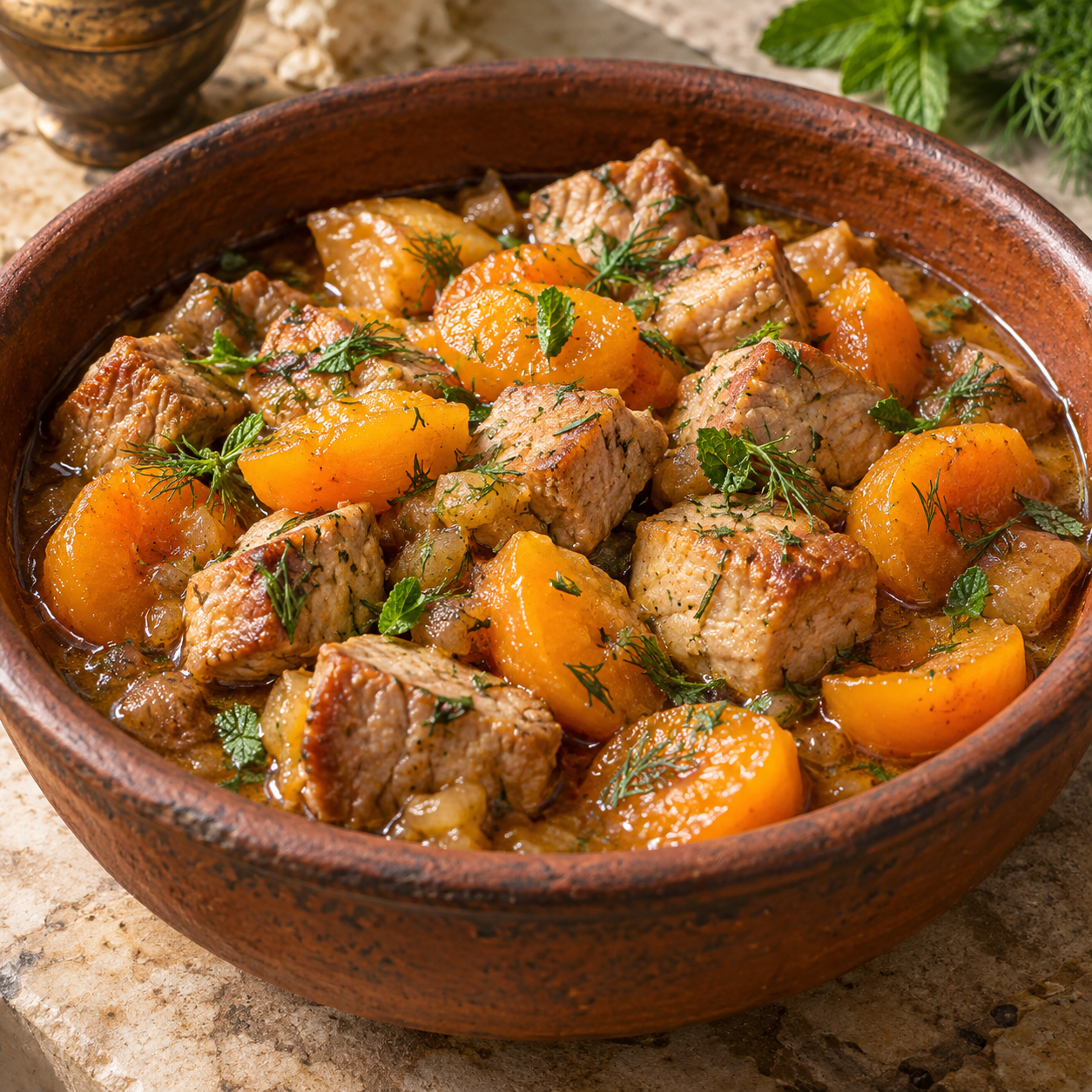
The Latin minutal ex praecoquis records the sequence and the use of already cooked pork. Our recipe begins with raw diced pork shoulder and first braises it fully, making the dish self-contained for a present kitchen. That is a clear procedural adaptation. A cook with appropriately stored cooked shoulder could shorten the first stage, but this page does not assume another uncounted recipe has already been made.
Fruit changes the timing
Apricots soften much more quickly than shoulder meat. Adding them near the end preserves identifiable pieces rather than dissolving the fruit throughout a long braise. Ripe fruit will break down faster than firm fruit, so the final cooking time is approximate. Mint and dill add a different aromatic dimension from the seeds, and vinegar keeps the honey and apricot from turning the dish into a sweet compote.
The ancient thickener, tracta, is not identical to modern starch. This version uses a little wheat flour stirred with water and simmered through, a transparent convenience choice. Commercial fish sauce approximates the salty Roman liquid, while ordinary wine and a small amount of honey stand in for a more complicated combination of grape products. Their precise proportions cannot be recovered from the short ancient passage.
A ragout without a false pedigree
This dish is situated within the late Roman cookbook compilation, approximately fourth to fifth century CE, with older material incorporated. Its presence shows a written combination of pork and fruit; it does not identify a particular emperor, feast day, or uniform empire-wide dinner. Nor is it offered as an ancestral version of a named modern national stew.
Serve the meat and fruit in a shallow bowl so both remain visible, with bread to collect the sauce. The pork must become tender before the apricots are added, even if that takes longer than the stated interval. Adjust acid and sweetness gently at the end, remembering that those measurements are modern interpretation rather than a recovered ancient formula.
Pork and apricot minutal
Serves 4 portions · Preparation 20 min · Cooking 95 min · None.
A modern adaptation for home cooking. Times are approximate.
Ingredients
- 600 g boneless pork shoulder, diced into 2 cm pieces
- 6 fresh (about 300 g) apricots, pitted and quartered
- 2 shallots, finely chopped
- 1 tbsp olive oil
- 150 ml wine
- 350 ml unsalted broth
- 1 tsp commercial fish sauce
- 1 tsp ground cumin
- 1 tbsp wine vinegar
- 2 tsp honey
- 1 tsp each dried mint and chopped fresh dill
- ¼ tsp black pepper
- 1 tbsp wheat flour mixed with 2 tbsp cold water
Method
- Heat oil in a heavy saucepan. Brown pork in batches for 6–8 minutes; add shallots and cook 3 minutes.
- Add wine, broth, and fish sauce. Cover and simmer gently for 70–90 minutes until pork is fully cooked and tender; add water if needed.
- Stir in cumin, vinegar, honey, mint, dill, and pepper.
- Add apricots and simmer uncovered 8–12 minutes until soft but still recognisable.
- Stir in the flour-water mixture and simmer 3–5 minutes until the sauce thickens and flour is cooked. Serve hot.
Substitutions and adjustments
- Use 120 g unsulphured dried apricots, soaked in hot water 20 minutes, for a different texture.
- Replace fish sauce with salt to taste; modern flour slurry replaces ancient tracta.
Historical choices: Apicius IV attests cooked diced pork, apricots, aromatics, and thickening. Starting from raw shoulder and using a flour slurry are adaptations.
Kitchen note: Cook pork fully and until tender; remove every apricot stone. Refrigerate leftovers promptly.
Sources and further reading
- Apicius, Book 4: English translation. Public-domain Vehling primary-text translation; editorial additions and species identifications need caution.
- Bibliotheca Augustana: Apicius, Latin Book 4. University-hosted primary Latin text for the dish's recorded method and ingredients.