ANCIENT MEALS · 050 / 100
Late Roman cookbook tradition · Roman Mediterranean · Approximately 390–450 CE compilation, with earlier material
Evidence: adapted surviving recipe. The historical evidence and modern cooking choices are distinguished below.
What an eastern name can tell us
Pullum Parthicum appears in Apicius, Book VI. The title links chicken with Parthia, a major eastern power and a familiar name in Roman political geography. It does not prove that the recipe was copied directly from a Parthian household. The surviving instruction belongs to a Roman cookbook tradition and combines a bird with pepper, lovage, caraway, wine, salty liquid, and laser. Geographic names can signal associations without establishing a dish's exact birthplace.
The Latin primary text is especially useful because old English commentary speculates about the type of chicken and translates parts of the preparation expansively. Our recipe keeps a simple braise, using chicken portions and a modest aromatic sauce. It avoids turning later editorial guesses into historical facts. The measured portions and cooking times below are modern decisions.
The aromatic question
Laser is one of the most interesting and difficult ingredients in Roman food history. Ancient texts refer to aromatic plant products whose precise relationships and trade histories are debated. Commercial food-grade asafoetida is a practical approximation often used in modern adaptations, not a recovered sample of the famous Cyrenaican silphium. A small pinch is enough; its purpose is to suggest a pungent aromatic layer rather than overwhelm the bird.
Lovage can be replaced with celery leaf, again as a declared substitution. Caraway supplies a distinct seed aroma, while pepper remains prominent. No honey or dried fruit is added to this selected chicken preparation. That restraint distinguishes it from the cookbook's many sweet-sour meat sauces. The wine and commercial fish sauce provide liquid, acidity, and salt, though neither bottle should be treated as an exact match for all Roman products.
Translating a braise
Modern chicken thighs tolerate gentle cooking well. Browning first is a convenient adaptation that develops colour; the covered simmer then cooks the meat through. The ancient text does not supply a modern thermometer endpoint, so the stated poultry temperature is current safety guidance. If the pan dries before the chicken is tender, add a little hot water rather than letting the spices scorch.
The historical frame is the late Roman compilation, approximately 390–450 CE, incorporating older culinary material. Serve chicken with its reduced cooking liquid and simple bread or grains. Its historical interest is the Roman handling of an eastern label and an aromatic seasoning combination, without claiming an unbroken national recipe lineage.
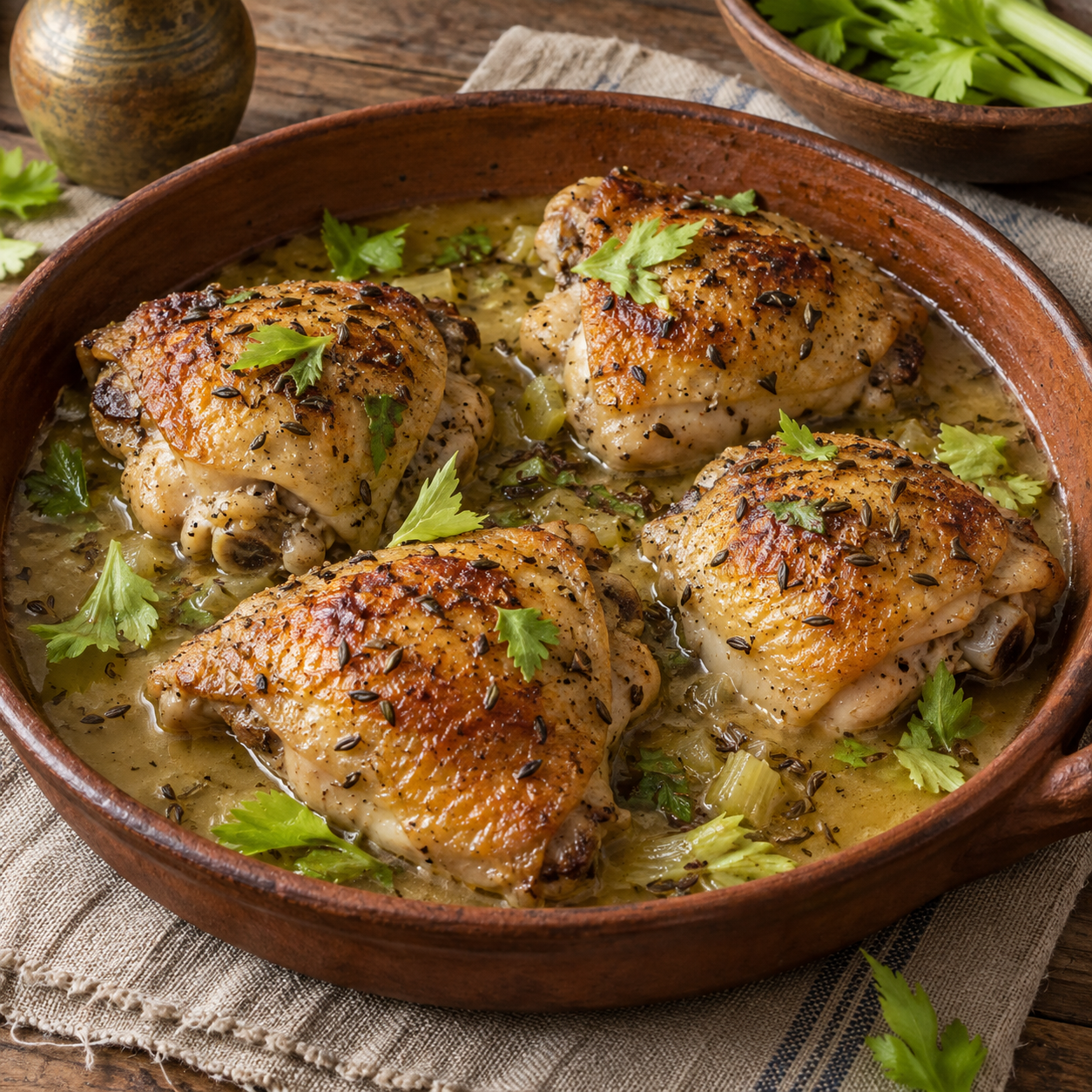
Wine-braised Parthian-style chicken
Serves 4 portions · Preparation 15 min · Cooking 40 min · None.
A modern adaptation for home cooking. Times are approximate.
Ingredients
- 800 g bone-in chicken thighs
- 1 tbsp olive oil
- 200 ml white wine
- 150 ml unsalted chicken broth
- 1 tsp commercial fish sauce
- 1 tsp caraway seeds, crushed
- ½ tsp black pepper
- 1 tbsp chopped lovage or celery leaves
- 1 small pinch commercial food-grade asafoetida
Method
- Pat chicken dry with disposable kitchen paper. Heat oil in a heavy pan and brown thighs 4–5 minutes per side.
- Add wine, broth, fish sauce, caraway, pepper, leaves, and asafoetida.
- Cover and simmer gently 25–35 minutes until the thickest meat reaches 74°C/165°F, avoiding contact with bone when checking.
- Remove chicken briefly. Reduce the liquid uncovered for 3–5 minutes if thin.
- Return chicken to the sauce and serve hot.
Substitutions and adjustments
- Celery leaf replaces lovage with a different aroma.
- For an alcohol-free version, use 300 ml broth plus 1 tbsp wine vinegar; for fish-free seasoning, use salt to taste.
Historical choices: Apicius VI preserves the named chicken recipe. An eastern name is not proof of Parthian origin. Asafoetida, browning sequence, modern chicken cuts, and quantities are adaptations.
Kitchen note: Do not wash raw poultry. Prevent cross-contamination and cook chicken to 74°C/165°F.
Sources and further reading
- Apicius, Book 6: English translation. Public-domain Vehling translation; editorial additions are distinguished from the ancient instruction.
- Bibliotheca Augustana: Apicius, Latin Book 6. University-hosted primary Latin text for the recorded ingredient and method framework.