ANCIENT MEALS · 048 / 100
Late Roman cookbook tradition · Roman Mediterranean · Approximately 390–450 CE compilation, with earlier material
Evidence: adapted surviving recipe. The historical evidence and modern cooking choices are distinguished below.
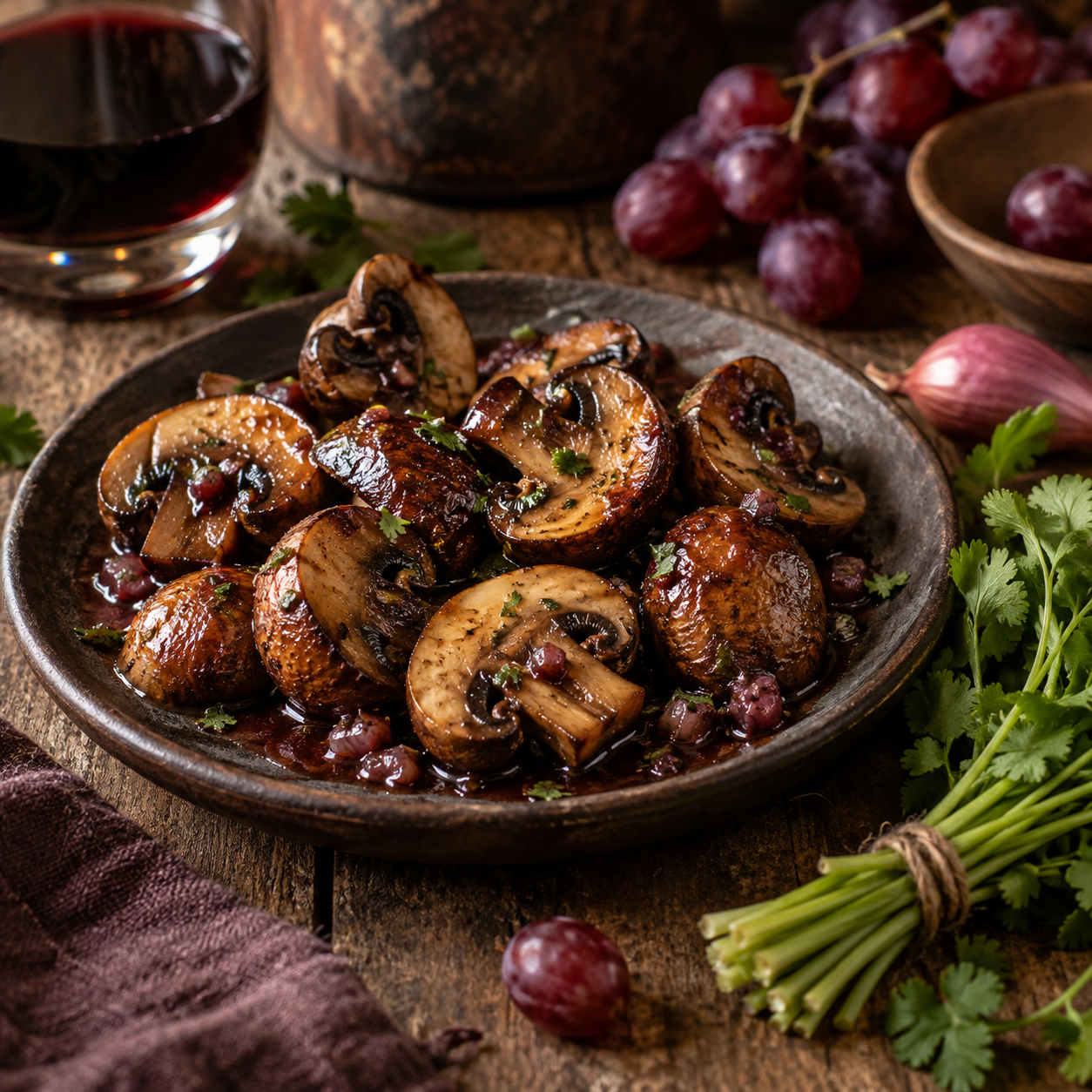
A recipe that almost fits in a breath
Among Apicius's elaborate sauces are instructions that feel radically spare. The Latin mushroom instruction in Book VII calls for caroenum, a concentrated grape product rendered as “reduced wine” in Vehling’s older English translation, and a bundle of fresh coriander that is removed after cooking. The Latin wording for boletos fungos is compact enough to expose the central difficulty: much of what a present cook wants to know, including exact species, quantity, liquid volume, and heat, is not supplied.
That brevity should not be expanded into unsupported claims about a famous chef's intentions. It gives an ingredient-and-method framework, and no more. We can use it to make an accessible dish while explaining the necessary decisions. Commercially cultivated mushrooms replace any uncertain ancient identification, and a controlled small quantity of wine keeps the result practical for four side portions.
The meaning of reduced wine
Ancient concentrated grape products do not map perfectly onto a single modern bottle. Different reductions could be sweet, thick, or affected by their production vessels. This adaptation uses ordinary wine simmered down in a food-safe pan, with optional grape juice to soften its acidity. That is a modern substitute for the named grape product, not a claim that reducing any bottle of wine reproduces caroenum. No lead or reactive historical boiling vessel is used.
Mushrooms release liquid as they cook. The first part of the modern method lets that water evaporate, after which the reduced wine clings more clearly to their surfaces. This initial dry cooking is a practical choice, since the ancient line does not spell out a comparable sequence. The coriander bundle is retained because removing it is one of the unusually concrete instructions that survives. A few fresh leaves may be used to identify the flavour at serving, but they are optional.
Certainty belongs in the source note
Roman authors used mushroom terms that can be difficult to align with current species names. It would be irresponsible to turn a translation's mention of boletus or morel into permission to forage unfamiliar fungi. Cultivated cremini mushrooms give a robust substitute. They also remind us that a usable reconstruction can have a clear safety boundary without claiming an exact ancient taste.
The dish is placed within the late Roman Apicius compilation, approximately 390–450 CE. Cook the mushrooms thoroughly, reduce the sauce until it coats lightly, and serve hot. Its interest lies in a documented small combination of flavours and a specific herb-handling instruction, not ornamental volume or an invented banquet story.
Mushrooms with reduced wine and coriander
Serves 4 side portions · Preparation 10 min · Cooking 20 min · None.
A modern adaptation for home cooking. Times are approximate.
Ingredients
- 500 g cultivated cremini mushrooms, cleaned and halved
- 150 ml wine, red or white
- 1 tbsp unsweetened grape juice, optional modern adjustment
- 6 sprigs fresh coriander, tied with food-safe string
- 1 tbsp olive oil
- ¼ tsp each salt and black pepper, optional modern seasoning
Method
- In a small nonreactive saucepan, simmer the wine for 5–7 minutes until reduced to about 75 ml.
- Heat oil in a broad frying pan. Add mushrooms and cook 8–10 minutes, stirring, until their released water mostly evaporates.
- Add reduced wine, optional juice, and the coriander bundle. Simmer 5 minutes until mushrooms are fully cooked and lightly coated.
- Remove the bundle and string. Season lightly if desired and serve hot.
Substitutions and adjustments
- Use commercially cultivated button or oyster mushrooms; never identify wild fungi from this historical text.
- For an alcohol-free adaptation, use 100 ml grape juice plus 2 tsp wine vinegar and reduce briefly.
Historical choices: Apicius VII.13.4 records mushrooms with caroenum and a removable coriander bundle. Ordinary reduced wine is this adaptation’s substitute; mushroom species, oil, seasoning and quantities are modern choices.
Kitchen note: Use commercially cultivated edible mushrooms and cook thoroughly. Reduce wine in food-safe nonreactive cookware.
Sources and further reading
- Apicius, Book 7: English translation. Public-domain Vehling translation; editorial additions are distinguished from the ancient instruction.
- Bibliotheca Augustana: Apicius, Latin Book 7. University-hosted primary Latin text for the recorded ingredient and method framework.