ANCIENT MEALS · 044 / 100
Late Roman cookbook tradition · Roman Mediterranean · Approximately 390–450 CE compilation, with earlier material
Evidence: adapted surviving recipe. The historical evidence and modern cooking choices are distinguished below.
Grain can give a soup its body
Barley often appears in historical cooking as visible grains or thick porridge. This recipe explores another possibility: the body transferred into cooking liquid. In Apicius, Book V, the barley broth instruction, washed and softened barley is cooked with aromatic ingredients, then thinned and strained. The text includes further seasonings and a vegetable identified by the old translator with colocasium. Its directions are more involved than simply boiling a bowl of barley.
The surviving Latin text gives readers a basis for comparing the compressed wording with the expansive English commentary. Straining is the key distinction kept in this version. Our result is a smooth, lightly thickened savoury soup with only a few garnish leaves. It is deliberately different from a mixed grain-and-bean stew: the barley solids are removed after lending their texture to the liquid.
Aromatic choices with limits
Dill, onion, savoury herbs, coriander, cumin, vinegar, and a salty seasoning define the framework. The adaptation omits unfamiliar or potentially hazardous herbs instead of recommending them to the home cook. A small pinch of commercially prepared asafoetida supplies an aromatic approximation for laser-related ingredients, but there is no claim that it recreates the extinct or disputed plants behind every ancient reference.
The colocasium element is also omitted. Although taro is often discussed in connection with that ancient term, precise identifications and the handling of different edible aroids require care. This page focuses on the barley liquid and does not need an unsafe or uncertain tuber to make that technique usable. The modern preparation uses ordinary pearl barley and a stainless-steel pan; neither retail processing nor cookware is presented as a facsimile of a Roman kitchen.
Reading a practical gap
Apicius is a late Roman cookbook compilation, commonly placed around the fourth to fifth centuries CE, containing material with varied earlier histories. The barley passage offers evidence for this particular written preparation, not a complete picture of daily eating across the empire. Its comments about avoiding burning are especially useful when translating it into a present kitchen: starchy liquid can catch on the bottom if neglected.
Stir gently, strain while warm, and adjust with water after straining. A little vinegar should brighten the broth rather than overwhelm it. Its quantities, sieve size, cooking duration, and final consistency are modern interpretation. Keep the cooked solids for another immediate meal if desired, but this article's counted recipe is the strained soup.
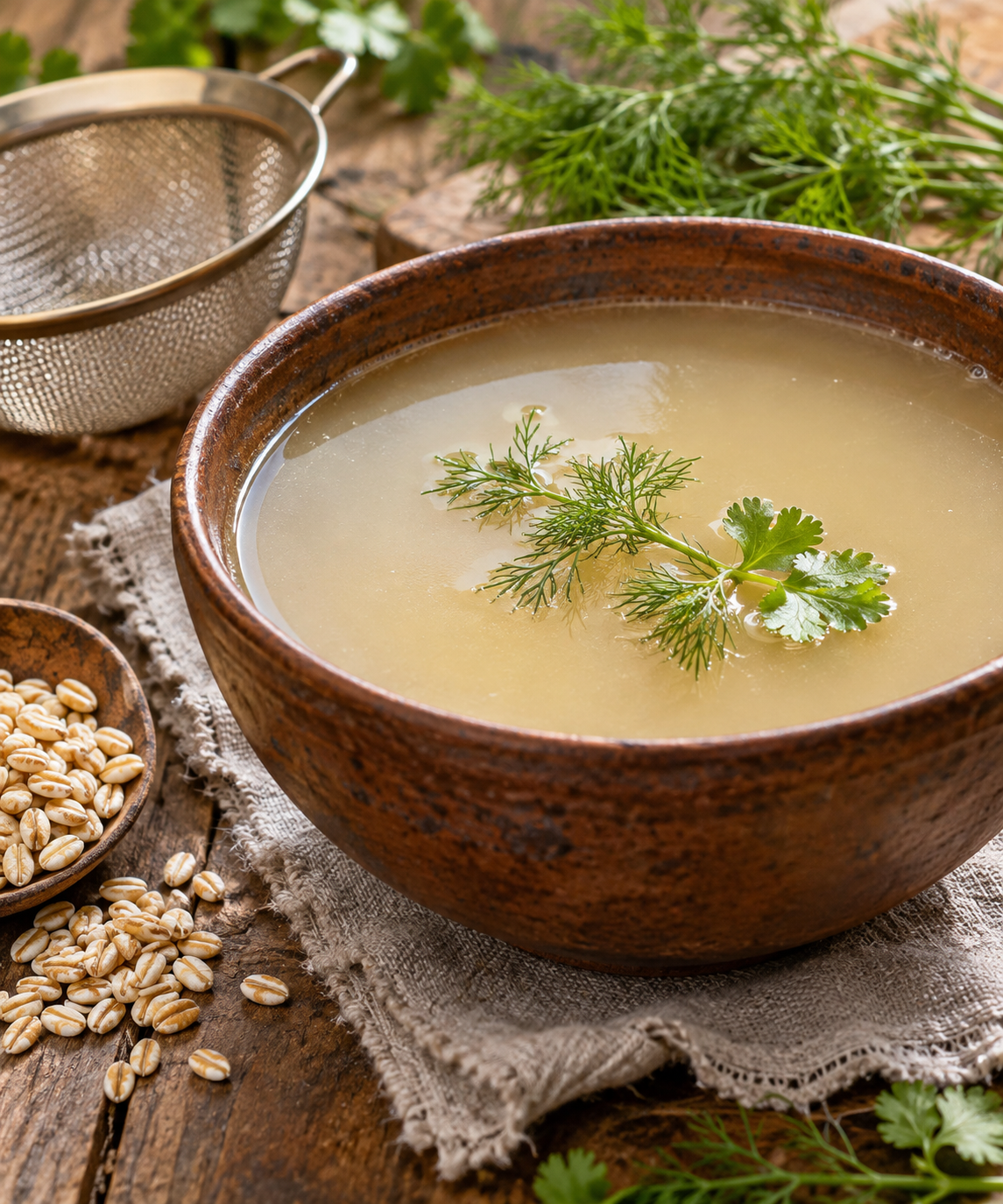
Dill-scented strained barley broth
Serves 4 small bowls · Preparation 10 min · Cooking 55 min · Optional overnight barley soaking in the refrigerator.
A modern adaptation for home cooking. Times are approximate.
Ingredients
- 150 g pearl barley, rinsed
- 1.4 litres water
- 1 small onion, chopped
- 4 sprigs fresh dill
- ½ tsp dried savoury or thyme
- ½ tsp ground cumin
- 1 pinch commercial asafoetida, optional
- 1 tbsp each olive oil and wine vinegar
- 1 tsp commercial fish sauce
- 1 tbsp chopped fresh coriander
- ¼ tsp ground black pepper
Method
- Combine barley, water, onion, dill, and savoury in a saucepan. Simmer gently 45–55 minutes until barley is very soft, stirring occasionally.
- Remove dill stalks. Stir in cumin, optional asafoetida, and pepper; cook 3 minutes.
- Strain through a fine sieve into a clean pan, pressing gently to collect thickened liquid. Do not force all the grain through.
- Add oil, vinegar, and fish sauce. Reheat gently; add hot water if thicker than a pourable soup.
- Serve in four bowls with chopped coriander.
Substitutions and adjustments
- Replace fish sauce with ¼–½ tsp salt for a vegetarian broth.
- Use thyme if savoury is unavailable; this is an aromatic substitution, not an exact ancient identification.
Historical choices: Adapted from Apicius V's barley-liquid method. Colocasium and unsafe or uncertain herbs are omitted; modern pearl barley and the final consistency are interpretive.
Kitchen note: Cook barley fully. Cool soup and any reserved solids promptly and refrigerate.
Sources and further reading
- Apicius, Book 5: English translation. Public-domain Vehling translation; editorial expansions and uncertain plant names require caution.
- Bibliotheca Augustana: Apicius, Latin Book 5. University-hosted primary Latin text used to check the recipe's ingredient and method framework.