ANCIENT MEALS · 041 / 100
Roman literary foodways · Italian peninsula · Approximately first century CE
Evidence: adapted surviving recipe. The historical evidence and modern cooking choices are distinguished below.
A meal made before the day's work
The short Latin poem Moretum follows Simulus as he prepares food before going out to plough. Its cheese-and-herb mixture has become famous, but the poem is more than an ingredient list. Grinding grain, tending a fire, gathering plants, and pounding a spread all take time. A recent Classical Quarterly study examines the labour and social relationships in this literary scene, reminding readers that it should not be treated as a transparent documentary picture of every Roman farmer.
The food itself is useful evidence. The British Museum's discussion of moretum identifies garlic, cheese, herbs, oil, and vinegar in the preparation and shows the importance of the mortar. Those ingredients form a forceful accompaniment to bread. The poem is traditionally associated with Virgil, but its authorship is uncertain; calling it simply Virgil's own lunch would give a literary attribution more certainty than it deserves.
What pounding changes
Grating cheese and chopping herbs are only the beginning. A pestle crushes the garlic and works it into the other ingredients, making a cohesive paste rather than a scattered salad. The acid sharpens a fatty cheese, oil softens the texture, and green leaves colour the mixture. These are culinary observations about the adaptation, not measurements recovered from the poem. They explain why the order of preparation is more helpful than pretending every ingredient has an exact ancient weight.
Our version uses less garlic than many reconstructions, making a small portion practical alongside bread. That is a declared taste adaptation. Pasteurized sheep's cheese gives a salty, firm base, while celery leaf and coriander supply the green element. Rue, an herb found in the ancient account, is omitted rather than offered as a modern cooking ingredient. Its absence means this cannot reproduce the full ancient aroma, and that limit should remain visible.
A spread, not an origin myth
Moretum is sometimes called Roman pesto. The comparison can help explain a mortar-made paste, but it does not prove a direct historical ancestry for a modern regional sauce. This recipe contains cheese and garlic prominently and no basil or pine nuts. Serve small spoonfuls beside a cooked loaf, allowing the bread to carry the pungent mixture. Cheese saltiness and garlic strength vary, so taste before adding any salt. The quantities and short chilling period are modern practical decisions.
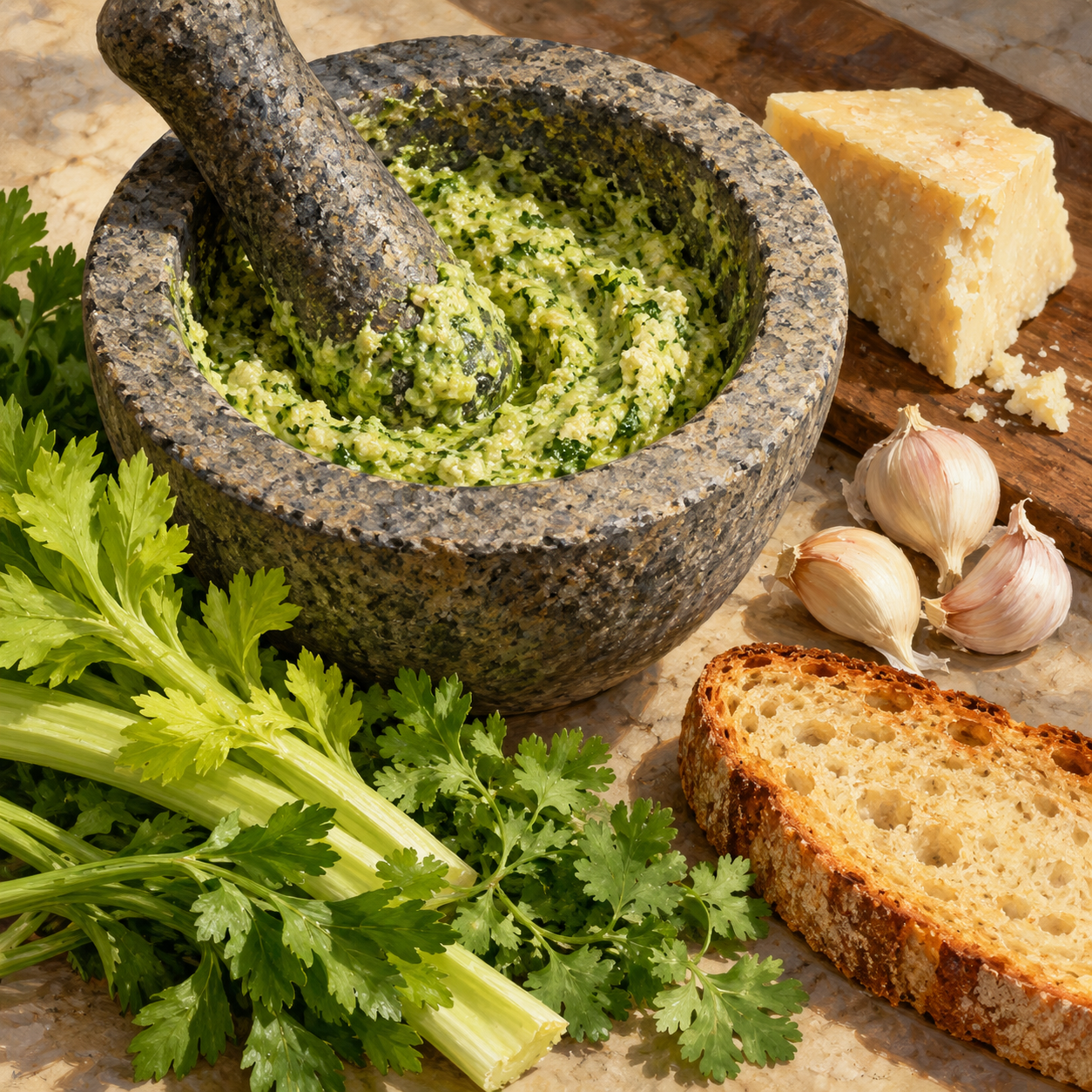
Garlic-herb moretum
Serves 6 small portions · Preparation 20 min · Cooking 0 min · Optional 20 minutes chilling.
A modern adaptation for home cooking. Times are approximate.
Ingredients
- 150 g pasteurized hard sheep's cheese, finely grated
- 3 medium cloves garlic, peeled and chopped
- 20 g fresh coriander leaves, washed and dried
- 1 tbsp finely chopped celery leaves
- 1 tbsp olive oil
- 2 tsp wine vinegar
- 300 g fully baked bread, to serve
Method
- Crush garlic in a mortar until pulpy; alternatively use a small food processor.
- Add cheese and the washed, dried herbs, then pound or process to a thick green-flecked paste.
- Work in oil and vinegar. Taste before adding salt because the cheese may supply enough.
- Shape a small mound, chill if desired, and serve in small portions with fully baked bread.
Substitutions and adjustments
- Pasteurized aged pecorino-style cheese works; a milder firm cheese changes the flavour.
- Parsley can replace coriander as a modern taste substitution; rue is intentionally omitted.
Historical choices: Adapted from the literary preparation in Moretum; reduced garlic, precise quantities, cheese choice, and omitted rue are modern changes. Attribution to Virgil is uncertain.
Kitchen note: Use pasteurized cheese and clean herbs. Refrigerate the finished spread; do not preserve garlic in oil at room temperature.
Sources and further reading
- British Museum: Cook a classical feast. Museum account of the poem's cheese-garlic-herb preparation; this version uses its own proportions.
- Who makes the pesto? Labour, social status and authorship in the Moretum. Peer-reviewed literary analysis of the poem's labour and uncertain social representation; not a household recipe survey.