ANCIENT MEALS · 040 / 100
Roman Republic · Italian peninsula · Approximately 160 BCE
Evidence: adapted surviving recipe. The historical evidence and modern cooking choices are distinguished below.
At the edge of the wine harvest
Mustacei take their character from must, the juice obtained during grape processing before it has become finished wine. Cato's recipe in On Agriculture 121 combines meal with must, anise, cumin, lard, cheese, and scraped bay material. Individual cakes are placed on bay leaves and baked. The list is wonderfully specific about aromatic ingredients, while remaining vague about the amount of liquid and the size of each cake.
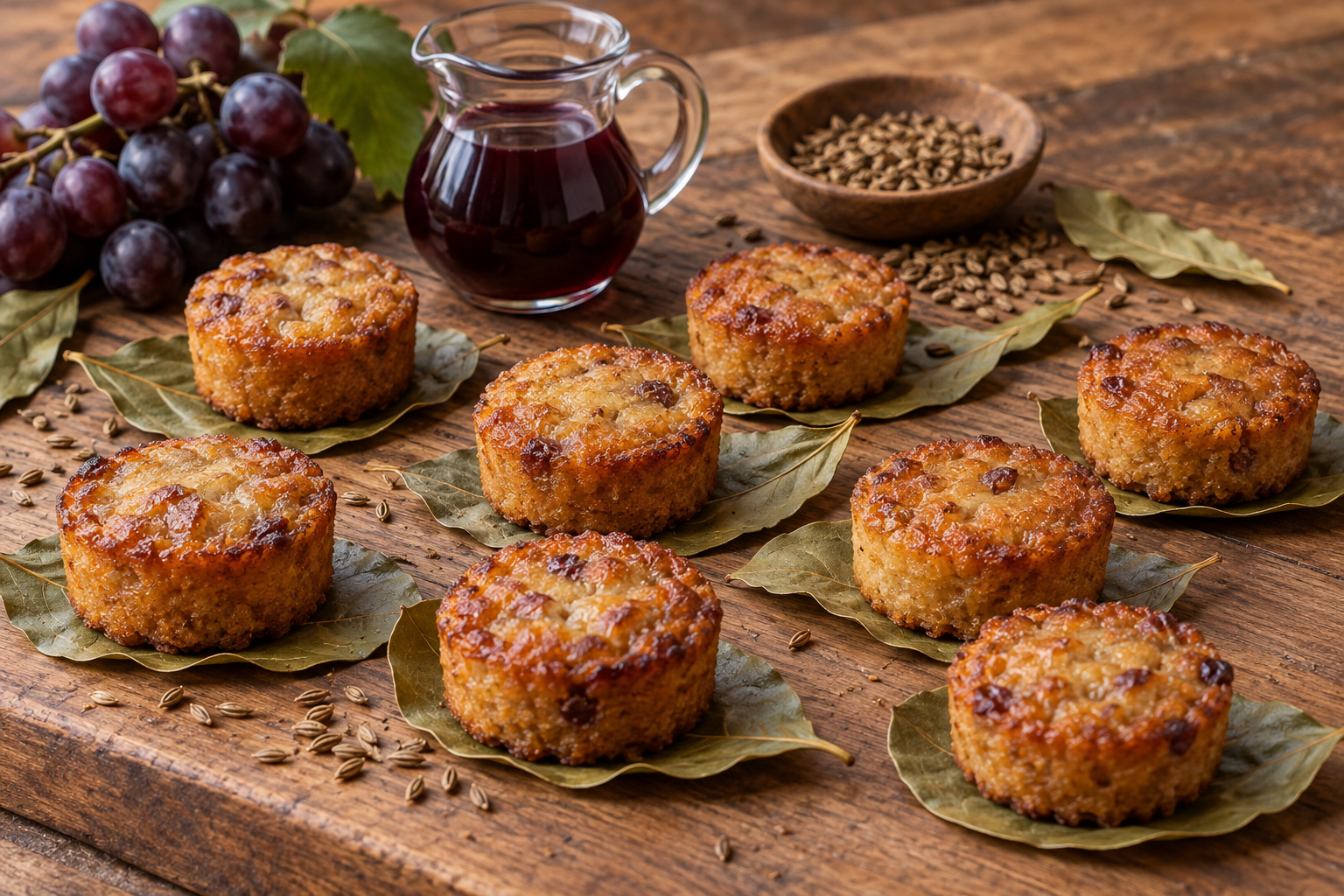
This is not simply a honey cake renamed. There is no honey in the recorded mixture, and grape juice provides the liquid as well as some sweetness. Cumin gives a savoury edge to the anise, while cheese and fat make a rich dough. The adaptation below keeps those tensions rather than adding sugar, vanilla, or a modern icing. Its cakes are compact and gently sweet, closer to an aromatic small bread than a contemporary cupcake.
Reading a short harvest recipe
Grape varieties, extraction methods, flour milling, and the condition of the cheese would all change the ancient result. Cato's agricultural context makes it reasonable to connect must with the working rhythms of a vineyard, but the recipe alone does not tell us exactly when or to whom the cakes were served. Nor does its silence establish whether all ancient bakers made the same leavening choices. This version adds no yeast or baking powder, yielding a deliberately close crumb.
The bay bark specified in the text is omitted. Modern bay products should be used only in familiar food-safe forms, and a leaf beneath each cake gives a controllable aromatic element without putting fibrous bark in the dough. Commercial pasteurized grape juice replaces fresh unfermented must, and olive oil replaces lard. Both changes are named so that convenience is not mistaken for historical identity. A small amount of grated cheese preserves the recorded cheese ingredient, although modern hard sheep's cheese differs from an unspecified ancient one.
A manageable bake
Keep the cakes low so that their dense centres can cook before the surface becomes dark. They need only light shaping; excessive kneading would toughen them. Use unsweetened grape juice and taste the cheese before deciding whether the dough needs salt. The leaves are discarded at serving. These quantities and the oven setting are a practical modern interpretation. The historical pleasure lies in exploring a documented flavour combination, not in claiming to recover a single lost Roman taste exactly.
Anise-and-grape mustacei
Serves 8 small cakes · Preparation 20 min · Cooking 25 min · Rest dough 10 minutes.
A modern adaptation for home cooking. Times are approximate.
Ingredients
- 250 g plain wheat flour
- 130–150 ml pasteurized unsweetened grape juice
- 45 ml (3 tbsp) olive oil
- 40 g finely grated pasteurized sheep's cheese
- 1 tsp anise seed, lightly crushed
- ½ tsp ground cumin
- 8 food-grade bay leaves
Method
- Heat the oven to 180°C/350°F. Line a tray and arrange eight bay leaves well apart.
- Mix flour, cheese, anise, and cumin. Stir in oil and 130 ml juice; add more juice by teaspoons to make a soft but shapeable dough.
- Rest 10 minutes, then divide into eight pieces. Shape low cakes about 6 cm wide and 1.5 cm thick.
- Place one cake over each leaf and bake 22–28 minutes until lightly browned and fully cooked at the centre.
- Cool 10 minutes, remove the leaves, and serve warm or at room temperature.
Substitutions and adjustments
- Commercial lard can replace olive oil to follow Cato's fat more closely.
- White or red grape juice works, but colour and sweetness will differ; avoid sweetened juice drinks.
Historical choices: Cato 121 attests must, grain meal, anise, cumin, lard, cheese, and bay. Juice, oil, cheese type, and oven method are modern choices; bark is omitted.
Kitchen note: Use food-grade bay leaves and discard them before eating. All flour must be fully baked.
Sources and further reading
- Cato, On Agriculture 121. Public-domain Loeb translation of the primary instructions; modern cooking quantities and heat are interpretive.
- Cato, On Agriculture: Loeb introduction. Historical context for Cato and the surviving agricultural text, not proof of the dish's everyday frequency.