ANCIENT MEALS · 038 / 100
Roman Republic · Italian peninsula · Approximately 160 BCE
Evidence: adapted surviving recipe. The historical evidence and modern cooking choices are distinguished below.
The centre is the challenge
Some ancient recipes offer little more than a list of flavours. Savillum is more helpful. In On Agriculture 84, Cato gives cheese, flour, honey, and an egg, then instructs the cook to grease the dish and pay special attention to its centre because it is deepest there. After baking, the cake receives more honey and poppy seeds and returns briefly to the heat. It is served in its dish with a spoon.
That last instruction changes how we imagine the result. Savillum need not be a freestanding, neatly sliced cheesecake with a biscuit base. Its recorded serving method suits a soft, cheese-rich pudding. The adaptation below follows that clue: a shallow baking dish supports a moist filling, and diners take small spoonfuls. There is no crust, vanilla, citrus zest, or refined sugar. Its principal flavour comes from fresh cheese and honey.
Distinct from the other cheese cakes
Cato compares the mixing to libum, but savillum has its own balance and finishing sequence. It contains considerably more cheese relative to flour, incorporates honey before baking, and is finished in the vessel. These differences are substantial enough to produce another food format, not merely a different garnish on the same bread. The poppy seeds add a visible final layer and a little texture, though their precise ancient variety cannot be recovered from the recipe alone.
The Loeb introduction to Cato places the collection within the surviving agricultural prose of Republican Rome. Cato's many instructions are useful evidence for written food preparation in second-century-BCE Italy, but they do not represent a complete Roman diet. This particular sweet does not tell us how often it was made or who received a portion. We can retain that uncertainty without making the food-history story less interesting: a cook's concern about a deep, underbaked middle is recognisable across time.
A modern oven reading
Our use of drained pasteurized ricotta simplifies an ancient cheese whose exact moisture, acidity, and salt level are unknown. The oven temperature and thermometer check supply safeguards missing from the short text. Bake until the centre is set but still tender, then apply the honey finish briefly. Cool slightly before serving; the aroma of warm honey is part of the experience, while scalding cheese is not. Consider the time approximate and judge the centre directly rather than relying on colour alone.
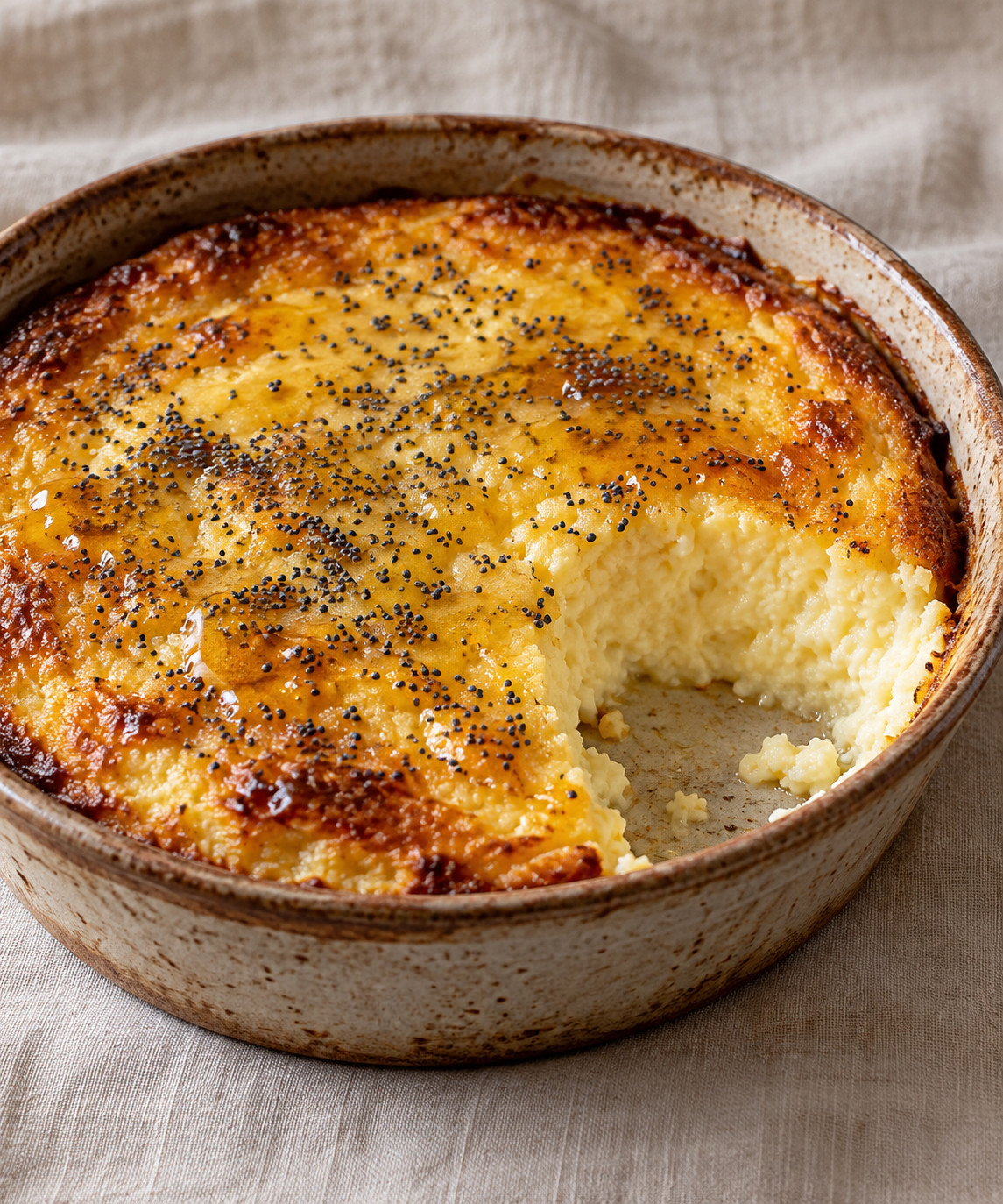
Spoonable honey savillum
Serves 6 small portions · Preparation 15 min · Cooking 40 min · Cool 15 minutes before serving.
A modern adaptation for home cooking. Times are approximate.
Ingredients
- 500 g pasteurized ricotta, well drained
- 100 g plain wheat flour
- 50 g honey, plus 2 tbsp to finish
- 1 large egg
- 1 tsp olive oil for dish
- 1 tsp food-grade poppy seeds
Method
- Heat oven to 170°C/340°F. Grease a shallow 20 cm ovenproof dish with the oil.
- Mash ricotta until smooth. Mix in flour, 50 g honey, and egg until evenly combined.
- Spread in the dish, keeping the depth fairly even. Bake 30–40 minutes until the centre is set and reaches 71°C/160°F.
- Brush or drizzle with the remaining honey and sprinkle on poppy seeds.
- Return to the oven for 3–5 minutes to warm the topping. Cool for 15 minutes and serve from the dish with a spoon.
Substitutions and adjustments
- Use a pasteurized unsalted fresh cheese of similar moisture; mash or sieve coarse curds.
- A 22 cm dish makes a thinner pudding that may bake faster.
Historical choices: Cato 84 supplies this ingredient combination, greased dish, centre check, honey-poppy finish, and spoon service. Modern heat, proportions, and cheese choice are adaptations.
Kitchen note: Bake egg mixture through, use pasteurized cheese, and refrigerate leftover portions within two hours.
Sources and further reading
- Cato, On Agriculture 74–90. Public-domain Loeb translation of the primary instructions; modern cooking quantities and heat are interpretive.
- Cato, On Agriculture: Loeb introduction. Historical context for Cato and the surviving agricultural text, not proof of the dish's everyday frequency.