ANCIENT MEALS · 037 / 100
Roman Republic · Italian peninsula · Approximately 160 BCE
Evidence: adapted surviving recipe. The historical evidence and modern cooking choices are distinguished below.
A different way to cook cheese
Globi turn cheese and grain into small fried spheres. The recipe in Cato's On Agriculture 79 is brief: make the cheese-and-spelt mixture, fry one or two balls at a time, turn them, and finish with honey and poppy seeds. The combination has an obvious contrast of textures. A firm exterior carries a moist interior, while honey makes the seeds cling. That contrast is a reasonable culinary reading of the method, rather than evidence from a tasting conducted in an ancient kitchen.
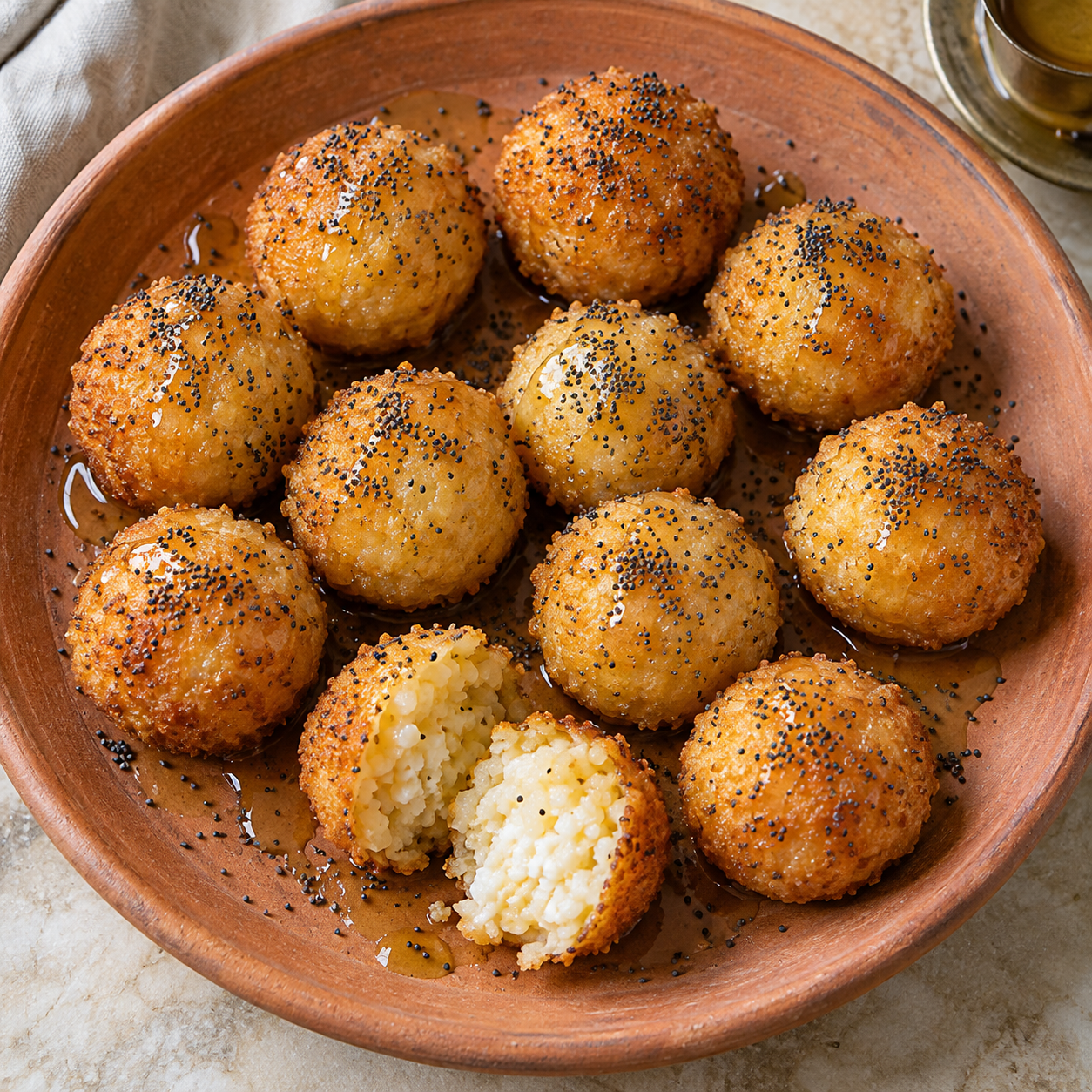
This recipe deserves its own place beside libum and placenta because the technique and serving format change substantially. Globi are individual pieces cooked in fat, not slices of an oven-baked loaf or a layered pie. Cato even specifies handling them with two rods. That detail conveys the cook's work more vividly than an ingredient list: the balls had to be controlled and turned in a small hot vessel.
Interpreting the grain
Translating Roman grain names into a modern shopping list is rarely simple. The English Loeb version uses spelt, while the broader recipe sequence involves groats and dough preparations. We use fine spelt flour for a manageable mixture and clearly identify this as a simplification of the grain texture. A coarse cracked grain added raw would not necessarily cook within a small fritter's frying time. The proportions below are modern, since Cato asks for enough mixture to make the desired number without giving this recipe a separate measured formula.
The introduction to Cato's surviving work helps place these instructions in an agricultural text transmitted across many centuries. Its preservation is not a guarantee that our modern interpretation of every preparation is exact. It does, however, let us follow the recorded sequence with care. Cheese and spelt, frying, honey, and poppy seeds are the secure anchors. A thermometer, a heavy modern saucepan, and an absorbent plate are practical additions.
Small batches, clear limits
The ancient text specifies lard. This version offers commercial lard or refined olive oil and keeps the batch small enough to turn safely. Heat control matters: very hot fat can brown the outside before the middle cooks, while cool fat makes the balls absorb oil. Do not fill the pan high or drop wet dough into it. Serve promptly for the clearest texture contrast. Test one ball first and check its centre before frying the rest.
Honeyed globi with poppy seeds
Serves 4 servings, about 24 small fritters · Preparation 20 min · Cooking 30 min · Rest mixture 10 minutes.
A modern adaptation for home cooking. Times are approximate.
Ingredients
- 250 g pasteurized fresh farmer's cheese or thoroughly drained ricotta
- 100–120 g fine spelt flour
- ¼ tsp salt, optional
- 400 ml refined olive oil or melted commercial lard for frying
- 3 tbsp honey
- 1 tbsp food-grade poppy seeds
Method
- Mash the cheese with 100 g flour and optional salt. Rest 10 minutes. Add up to 20 g more flour if the mixture is too loose to roll.
- Divide the mixture into about 24 portions of 14–15 g each. Roll into balls approximately 3 cm across, using dry hands.
- Put the fat in a heavy saucepan no more than one third full and heat to about 170°C/340°F.
- Fry one test ball for 4–5 minutes, turning gently, until deep golden. Cut it open to check the flour centre is cooked and no wet dough remains.
- Fry the remaining balls in small batches of about four, maintaining the temperature and allowing room to turn them. Remove to a rack or absorbent paper. Total frying time is approximately 25–35 minutes, depending on pan size.
- Drizzle with honey, sprinkle with poppy seeds, and serve warm.
Substitutions and adjustments
- Plain wheat flour can replace spelt flour; add it gradually because cheeses differ in moisture.
- Refined olive oil is an adaptation of the lard specified in Cato.
Historical choices: Based on Cato 79. Fine flour, quantities, temperature, and small ball size are modern decisions; no egg is added because the individual instruction does not require one.
Kitchen note: Use a deep heavy pan, keep water away from hot oil, and cook the centres fully. Honey is unsuitable for children under one year.
Sources and further reading
- Cato, On Agriculture 74–90. Public-domain Loeb translation of the primary instructions; modern cooking quantities and heat are interpretive.
- Cato, On Agriculture: Loeb introduction. Historical context for Cato and the surviving agricultural text, not proof of the dish's everyday frequency.