ANCIENT MEALS · 036 / 100
Roman Republic · Italian peninsula · Approximately 160 BCE
Evidence: adapted surviving recipe. The historical evidence and modern cooking choices are distinguished below.
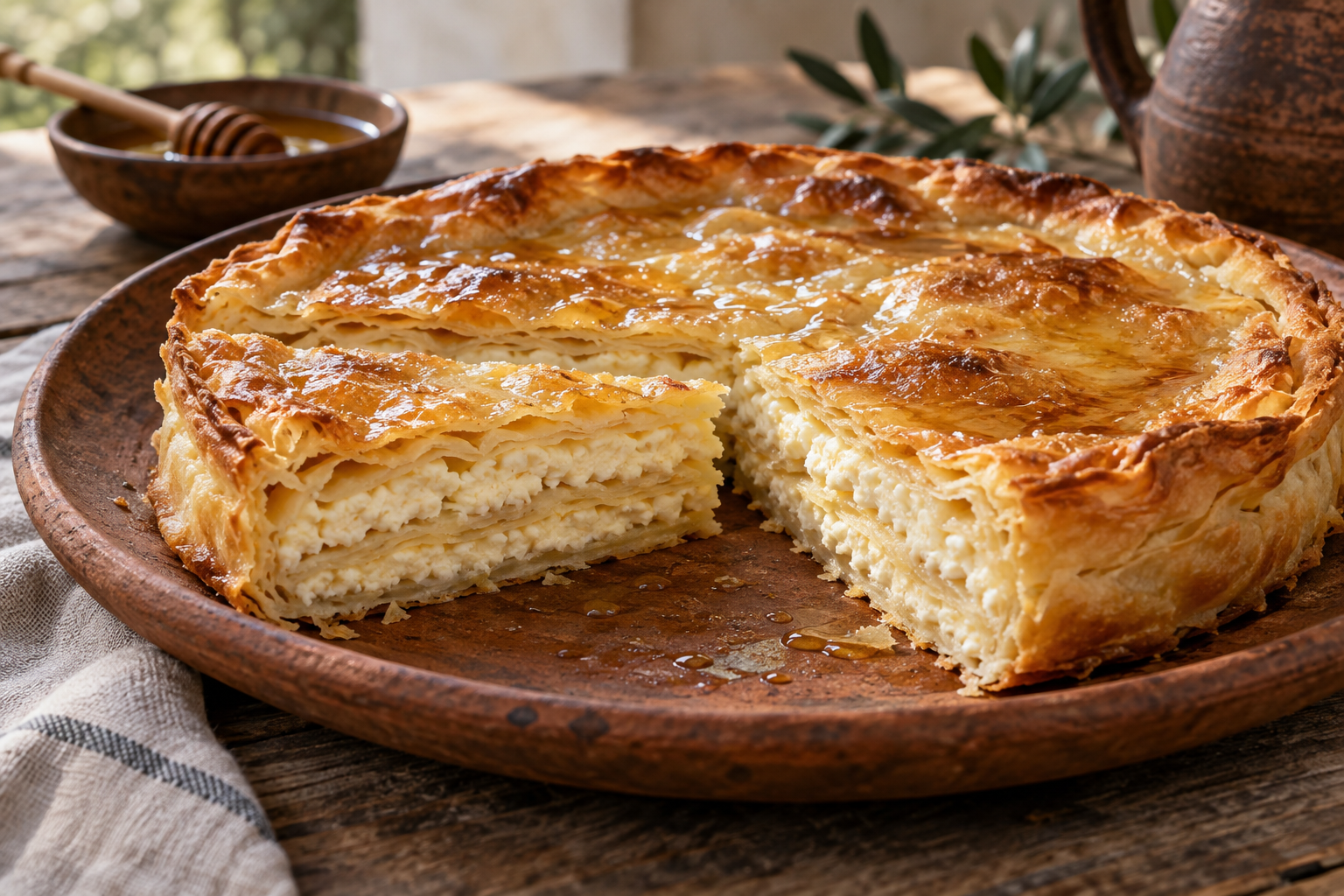
Layers rather than sponge
The Latin name placenta can startle a modern reader, but here it belongs to an elaborate layered food. Cato's recipe in On Agriculture 76 describes a lower crust, prepared sheets called tracta, sheep's cheese, and honey. Layers of dough and cheese filling are built inside a crust before the whole pie is covered and baked. Its architecture matters more than any easy claim that it was an ancestor of one particular modern pastry.
The original quantities are enormous by present household standards. Cato also asks for a long sequence of soaking, draining, kneading, drying, oiling, and repeated inspection during baking. This was organised work, not a quick dessert assembled from a packet. A cook reading only the ingredients would miss the preparation that made them usable: salty cheese was washed, softened grain was worked into dough, and the cheese filling was made smooth before layering.
What the surviving directions leave open
Tracta are not precisely equivalent to commercial filo. They were made from a grain-and-flour mixture and dried before assembly. Their thickness, final texture, and handling are debated, and the text does not supply a modern photograph to settle them. This adaptation uses homemade wheat sheets briefly dried on a clean surface, with a separate enclosing crust. It preserves the layered construction while declaring that the sheets are a practical approximation. They are thicker than filo and should yield a soft, substantial pie.
The Loeb introduction to Cato's agricultural writing provides context for a work that combines practical estate management with many other instructions. A surviving cake recipe in such a book does not establish that every Roman household ate it regularly. Cheese and honey, the attention to preparation, and the large batch make this a particularly purposeful food. We can describe its recorded method without assigning it an undocumented feast or ritual.
Building a smaller pie
Fresh, pasteurized ricotta avoids the prolonged washing that Cato recommends for his sheep's cheese. The adaptation uses less honey relative to the filling, since modern honey and cheese vary in sweetness and moisture. No sugar syrup, nuts, or spices are added. Bake it slowly enough to cook the internal sheets, allow a short rest, then cut modest slices. Its stated diameter, layer count, timing, and oven temperature are transparent modern choices, not recovered Roman measurements.
Layered cheese-and-honey placenta
Serves 8 slices · Preparation 45 min · Cooking 55 min · Rest dough 20 minutes; dry sheets 15 minutes; cool pie 20 minutes.
A modern adaptation for home cooking. Times are approximate.
Ingredients
- 250 g plain wheat flour
- 135–150 ml water
- 2 tbsp olive oil, divided
- 500 g pasteurized ricotta, very well drained
- 120 g (about ⅓ cup) honey, plus 1 tbsp to finish
- ¼ tsp salt
Method
- Mix the flour and salt with 135 ml water and 1 tbsp oil, adding a little more water if needed for a firm dough. Knead 5 minutes; cover and rest 20 minutes.
- Set aside one third for the outer crust. Divide the remainder into five pieces. Roll each to a thin 18 cm round and let dry on clean towels for 15 minutes.
- Heat the oven to 170°C/340°F. Lightly oil a 20 cm shallow pie dish. Roll the reserved dough to about 30 cm and line the dish, leaving overhang.
- Mash ricotta with 120 g honey. Layer five dough rounds with five thin portions of filling inside the crust, brushing the rounds lightly with remaining oil. Fold the outer crust over the edges.
- Bake 50–65 minutes until browned and the dough layers are cooked rather than pasty; cover the top loosely if necessary.
- Brush with the extra honey, rest 20 minutes, and slice.
Substitutions and adjustments
- Use drained pasteurized fresh sheep's cheese if available.
- Commercial filo can replace the inner sheets for convenience, but produces a different texture and is a clearly modern shortcut.
Historical choices: Cato 76 attests the crust, tracta layers, cheese, honey, and covered slow baking. This smaller wheat-sheet version simplifies ancient grain preparation.
Kitchen note: Use pasteurized cheese. Bake until every dough layer is fully cooked; refrigerate leftovers within two hours.
Sources and further reading
- Cato, On Agriculture 74–90. Public-domain Loeb translation of the primary instructions; modern cooking quantities and heat are interpretive.
- Cato, On Agriculture: Loeb introduction. Historical context for Cato and the surviving agricultural text, not proof of the dish's everyday frequency.