ANCIENT MEALS · 034 / 100
Post-Meroitic Nubian food-processing context · Qasr Ibrim, Lower Nubia, modern southern Egypt · Approximately 350–600 CE
Evidence: historically informed adaptation. The historical evidence and modern cooking choices are distinguished below.
A liquid with a long question
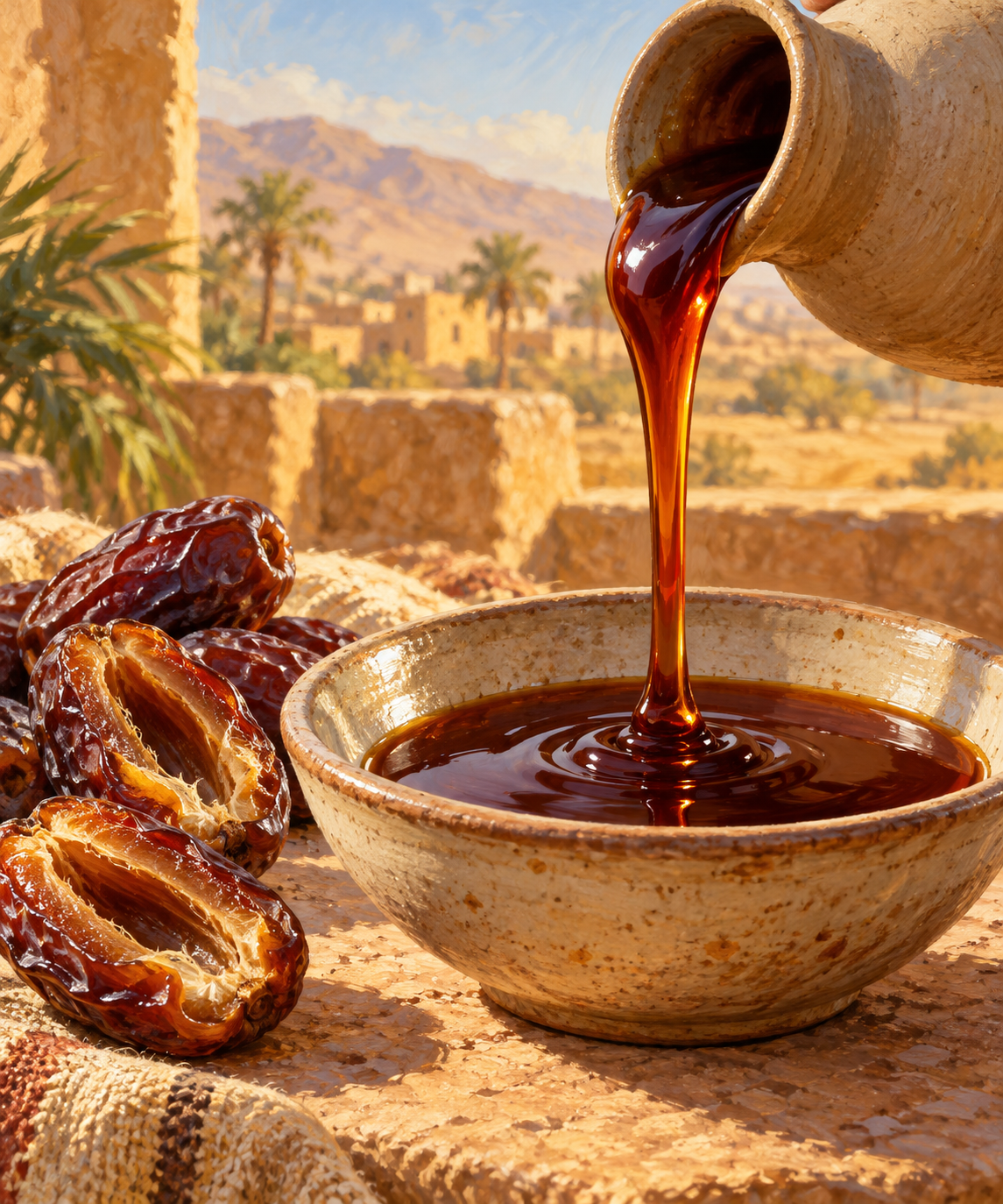
A spoon lifts dark date syrup and leaves a thin ribbon falling back into the bowl. Its modern method begins with boiling fruit, but its historical starting point is pottery. Mark Copley and colleagues’ study of residues from Qasr Ibrim identified a distinctive lipid pattern resembling material from date and doum palm kernels. It provides evidence for processing palm fruits in vessels, rather than an ancient recipe written in words.
The evidence needs careful handling. A kernel-related chemical signature does not identify a jar of our pitted-date syrup. In their handbook chapter on Nubian agriculture, Dorian Fuller and Leilani Lucas discuss boiling dates for sugar as an interpretation of Post-Meroitic cooking-pot evidence. That is the particular processing hypothesis explored here. The proportions, pit removal, straining cloth and final consistency below remain modern choices.
Extraction before concentration
We first soften commercially sold dates in water. Mashing opens the fruit so the liquid can take on its sweetness. Straining separates that liquid from much of the pulp, after which a gentle reduction concentrates it. This sequence distinguishes the syrup from date paste or a shaped date sweet: the goal is something that pours and can be spooned sparingly over another food.
Remove every hard pit before cooking. The archaeological discussion of kernel lipids is not an instruction to grind date stones into an edible mixture. Nor do we ask a cook to collect wild doum fruit or reproduce a fermentation. Commercial pitted dates and a short refrigerated storage period keep the practical recipe straightforward.
How far a residue can take us
The companion Antiquity report on Qasr Ibrim palm processing makes the broader point that pottery chemistry adds information beyond identifiable plant remains. It still does not determine the viscosity of the original product or who consumed it. Those details cannot be supplied by an attractive image of a jug.
Different dates release different amounts of sugar and water. Watch the spoon rather than forcing the liquid to a fixed volume: it should pour while warm and will thicken as it cools. Use a little on bread or another freshly prepared food as a modern serving suggestion. The syrup is a useful way to explore a documented processing interpretation, with the gap between ancient chemical evidence and today’s measured saucepan method left plainly visible.
Fresh reduced date syrup
Serves 8 · Preparation 15 min · Cooking 65 min · 15 minutes draining and cooling time
A modern adaptation for home cooking. Times are approximate.
Ingredients
- 300 g commercial soft pitted dates, checked for remaining pits and chopped
- 900 ml water, plus extra if needed
Method
- Put dates and water in a saucepan. Bring to a boil, then cover and simmer gently for 30 minutes. Mash with a clean potato masher.
- Pour through a fine sieve lined with clean food-safe cloth into a heat-safe bowl. Let drain for 15 minutes; press gently with a spoon, keeping hands clear of hot liquid.
- Return the strained liquid to a clean saucepan. Simmer uncovered for 20–35 minutes, stirring more frequently as it concentrates, until it lightly coats a spoon and still pours. Add a little water if it becomes too thick.
- Cool promptly in a shallow clean container and refrigerate within 2 hours. Serve by the tablespoon and use within 3 days.
Substitutions and adjustments
- Commercial dried dates can be used; increase the first simmer until soft and add water as needed.
- Commercial date syrup can stand in at service, but skips the extraction exercise.
Historical choices: Palm-fruit processing is supported by Qasr Ibrim residues; boiling dates for sugar is a scholarly interpretation. This pitted-fruit extraction and reduced syrup is a modern measured adaptation.
Kitchen note: Check for hard pits and do not grind or eat them. This is not a tested shelf-stable preserve or canning recipe; refrigerate and use within 3 days.
Sources and further reading
- Copley et al.: Detection of Palm Fruit Lipids at Qasr Ibrim. Primary chemical evidence resembles date/doum kernel lipids and indicates processing; does not identify exact syrup.
- Fuller and Lucas: Savanna on the Nile. Scholarly interpretation links Post-Meroitic residues with boiling dates for sugar.
- Copley et al.: Processing Palm Fruits in the Nile Valley. Companion report on palm processing in pottery; exact recipe and concentration remain unknown.