ANCIENT MEALS · 033 / 100
Kerma Nubia · Kerma, Middle Nile Valley, modern Sudan · Approximately 2500–1500 BCE
Evidence: historically informed adaptation. The historical evidence and modern cooking choices are distinguished below.
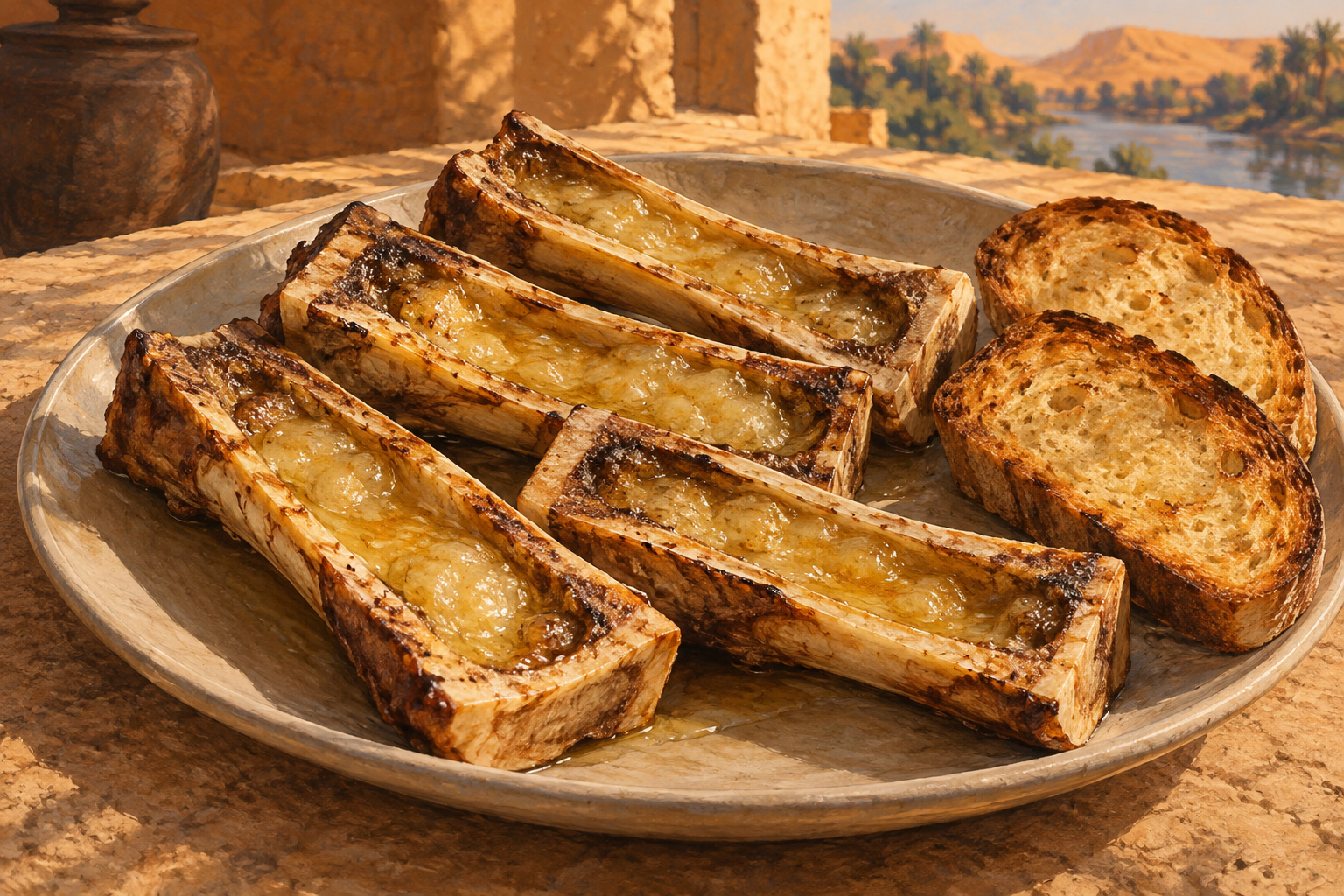
A food inside another food
Bone marrow invites a different way of looking at an animal meal. The useful portion is enclosed inside the bone, rather than cut from the muscle around it. The scholarly Bestiary of Ancient Nubia, in Laura Harris’s chapter on swine, discusses marrow among foods supplied by livestock in predominantly pastoral Nubian cultures, including Kerma. That broad interpretation provides context for this modern starter, not a preserved roasting instruction.
At Kerma itself, Louis Chaix and Annie Grant’s study of animal remains reports cattle dominating the town’s animal-bone food refuse. Their research also stresses the difficulty of separating economic and ritual meanings in the wider assemblage. Cattle skulls arranged around a tomb are not the same evidence as discarded food bones in a settlement, and neither establishes our exact marrow-bone preparation.
A modern opening into an old resource
We buy marrow bones already cut lengthwise by a commercial butcher. That makes the edible interior accessible without asking a cook to break bones or imitate ancient tools. An oven then heats the marrow until it softens. The long split, tray arrangement, temperature check and measured salt belong entirely to this recipe.
Choose bones with enough marrow visible to make a modest shared starter. A large bone does not necessarily contain a large edible portion. Keep them refrigerated before cooking and stand the cavities upward so the softened fat has somewhere to remain. Some fat will run onto the tray; lift the bones carefully and never mistake the hot sheen for a safe handling temperature.
Small portions, specific evidence
Plain commercially baked bread provides a convenient surface for the marrow. Kerma archaeology includes evidence of bread production, but that does not prove this particular pairing was served together. Our recipe uses toast as a modern serving choice and keeps the marrow portion small enough to remain the focus.
Serve it promptly after roasting, allow a brief pause for the heat to subside, and scoop only the soft edible contents rather than scraping fragments from the bone. The historical connection is a documented cattle-rich food economy and a scholarly discussion of marrow use in Nubia. The resulting plate is intentionally more tentative than a dish translated from an ancient cookbook. By distinguishing the resource from the method, it makes an overlooked part of animal food tangible while refusing to turn a modern oven image into archaeological proof.
Roasted beef marrow bones on toast
Serves 4 · Preparation 10 min · Cooking 30 min · 3–5 minutes cooling before eating
A modern adaptation for home cooking. Times are approximate.
Ingredients
- 4 halves (about 800 g bone weight) commercial food-grade beef marrow bones, butcher-split lengthwise into 8–10 cm sections
- ¼ tsp salt
- 4 slices commercially baked plain bread
Method
- Heat oven to 220°C/425°F. Put cold marrow bones cavity-side up in a sturdy roasting tray; support against one another if needed. Sprinkle with salt.
- Roast for 20–30 minutes until marrow is softened and its thickest edible centre reaches at least 71°C/160°F. Check with a food thermometer and continue cooking if necessary.
- Toast bread while the bones finish. Carefully move the hot bones to a platter, keeping them upright to retain marrow.
- Wait 3–5 minutes, then serve one bone half and one toast slice per person. Scoop the soft marrow onto toast; do not eat the bone.
Substitutions and adjustments
- Commercial cross-cut marrow bones can be used, with a different presentation and variable timing.
- Plain commercially baked flatbread can replace toast.
Historical choices: Cattle-rich food refuse is documented at Kerma; marrow consumption is discussed more broadly for Nubian pastoral cultures. Butcher-splitting, roasting and toast service are modern.
Kitchen note: Buy bones sold for human food by a reputable butcher. Keep raw bones refrigerated, cook marrow to at least 71°C/160°F, and handle hot fat carefully. Refrigerate leftovers within 2 hours.
Sources and further reading
- A Bestiary of Ancient Nubia, chapter 10. Broad scholarly discussion includes livestock marrow as food in pastoral Nubian cultures; not an exact Kerma marrow recipe.
- Chaix and Grant: Palaeoenvironment and Economy at Kerma. Site dates, cattle bones in domestic food refuse, and distinction between domestic and funerary evidence.