ANCIENT MEALS · 032 / 100
Meroitic Kush · Dangeil, Middle Nile Valley, modern Sudan · Approximately 300 BCE–100 CE in the temple archaeological setting
Evidence: archaeological reconstruction. The historical evidence and modern cooking choices are distinguished below.
The mould changes the question
A low mound of sorghum porridge stands on its plate after the bowl is lifted away. That simple modern demonstration addresses a real archaeological question. At Dangeil’s Amun temple in Sudan, conical pottery was initially understood as bread moulds. Julie Anderson and colleagues’ 2007 report identifies sorghum evidence on mould fragments and associated equipment, leading the investigators to question what the vessels actually held.
The report describes experiments with stiff sorghum porridge, which can retain a mould’s shape. It also leaves a beverage or beer interpretation open. The later research on Dangeil’s temple context continues to describe the alternatives as porridge or beer. The broad setting is Meroitic Kush; some offering fragments preceded the temple’s final first-century CE phase. Neither publication gives an ancient measured porridge recipe.
Stiffness is the useful distinction
This reconstruction chooses the porridge hypothesis and makes it usable without home fermentation. Commercial sorghum flour is whisked into water and cooked until a spoon can draw a path through a dense mixture. A damp bowl gives it a simple hemisphere shape. The ancient cones were different vessels, and our readily available bowl does not claim to reproduce their size or ceremonial use.
The starch must cook fully. Dry flour sprinkled carelessly into hot water can create lumps that remain powdery inside; mixing a cold slurry first makes the modern process easier to control. Keep stirring down to the bottom of the pan as the mixture stiffens. Add a little boiling water if necessary to keep it workable rather than forcing a scorched mass into the mould.
A hypothesis you can handle
The Fuller and Lucas handbook chapter places the Dangeil evidence in a broader discussion of Nubian cooking traditions. That helps explain why grain identification matters: a familiar vessel shape should not automatically dictate a wheat-based food. Our kitchen exercise asks what sorghum can do while leaving the unresolved archaeological alternatives visible.
Unmould the porridge while warm and divide it with a damp spoon. A small plain portion makes its texture easiest to notice; accompanying foods can be chosen separately without being attached to the historical evidence. Its water ratio, salt, saucepan and bowl are modern decisions. Its particular inspiration is the meeting of a documented sorghum residue, an offering vessel and a published moulding experiment, not a claim that every ancient Nubian meal resembled the hemisphere on this plate.
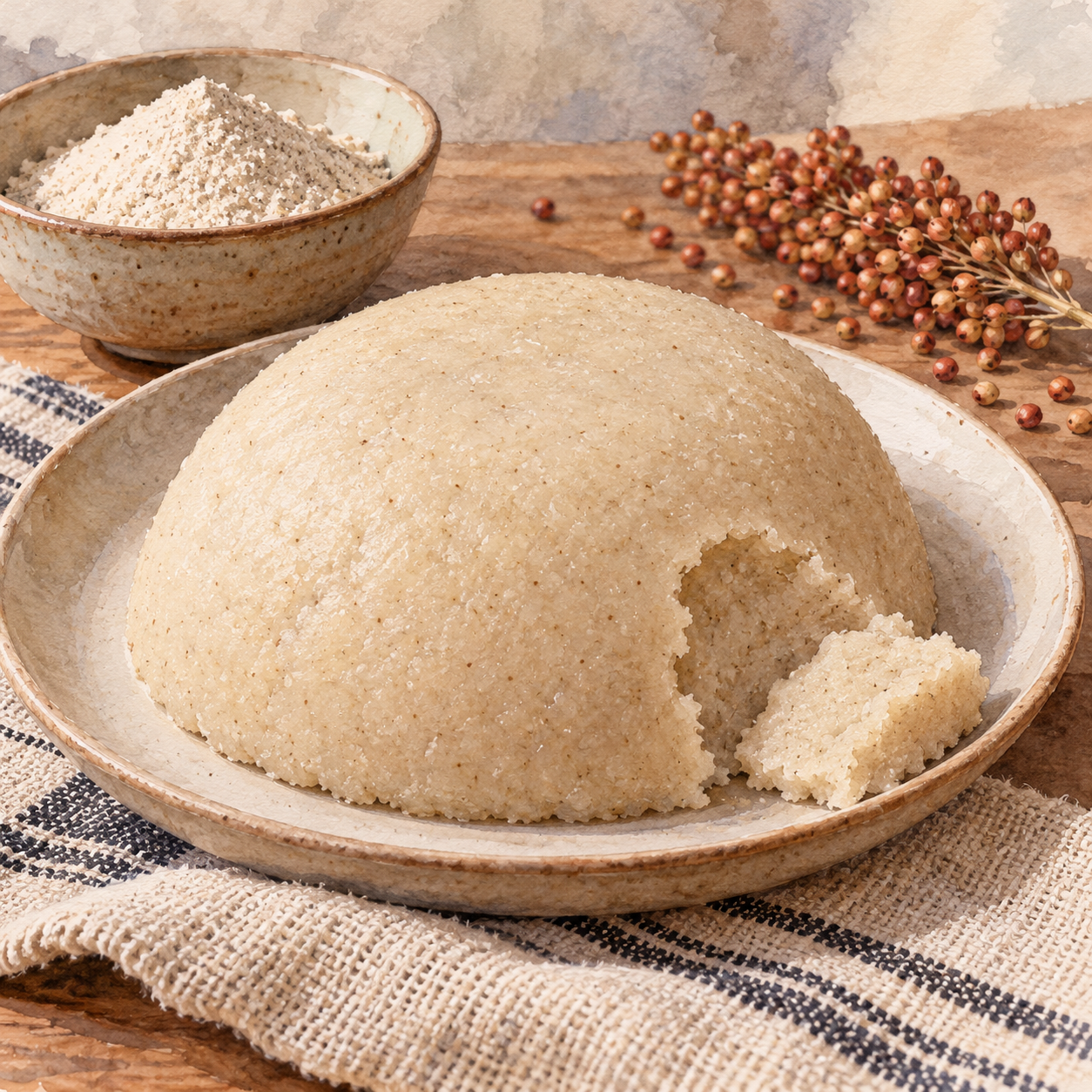
Unfermented moulded sorghum porridge
Serves 4 · Preparation 10 min · Cooking 25 min · 5 minutes setting in the bowl
A modern adaptation for home cooking. Times are approximate.
Ingredients
- 200 g commercial food-grade sorghum flour
- 800 ml water, divided, plus boiling water if needed
- ¼ tsp salt, a modern seasoning choice
- 1 tsp olive oil, optional for greasing the bowl
Method
- Whisk sorghum flour with 300 ml cold water until smooth. Bring the remaining 500 ml water to a boil in a heavy saucepan.
- Lower heat and pour in the slurry gradually while whisking. Stir continuously for 5 minutes as it thickens.
- Cook over low heat for another 15–20 minutes, stirring firmly to the bottom of the pan, until fully cooked, dense and smooth with no dry flour pockets. Add boiling water by the tablespoon if it becomes too dry to stir.
- Stir in salt. Dampen a heat-safe bowl, or grease lightly with the optional oil. Spoon in the hot porridge and level its surface.
- Rest 5 minutes, turn onto a plate and serve warm in four portions. If it does not release, serve directly from the bowl.
Substitutions and adjustments
- Use commercially sold white or red sorghum flour; colour and absorbency vary.
- Serving the porridge directly from the cooking pan avoids moulding and is discussed as an option in the experimental report.
Historical choices: Explores the published stiff-porridge hypothesis for Dangeil sorghum offerings. A beverage remains possible; this unfermented saucepan method and bowl shape are modern.
Kitchen note: Use food-grade commercial flour and cook thoroughly. Handle the dense hot mixture carefully. Cool leftovers in shallow containers and refrigerate within 2 hours.
Sources and further reading
- Anderson et al.: Bread Moulds from the Amun Temple at Dangeil, an Addendum, Sudan & Nubia 11 (2007), pp. 89–93 — author copy. Exact 2007 paper deposited by lead author Julie R. Anderson; sorghum evidence, modern moulded-porridge experiments and unresolved porridge-versus-beverage question. Author-deposited reading copy.
- Dangeil crucible and temple-context study. Chronology and continuing description of food-offering alternatives; not a porridge recipe.
- Fuller and Lucas: Agricultural Diversification in Nubia. Scholarly synthesis of grain foods and the Dangeil mould evidence.