ANCIENT MEALS · 027 / 100
Hittite · Central Anatolia, modern Turkey · Approximately 1600–1200 BCE
Evidence: historically informed adaptation. The historical evidence and modern cooking choices are distinguished below.
A cut of meat survives in writing
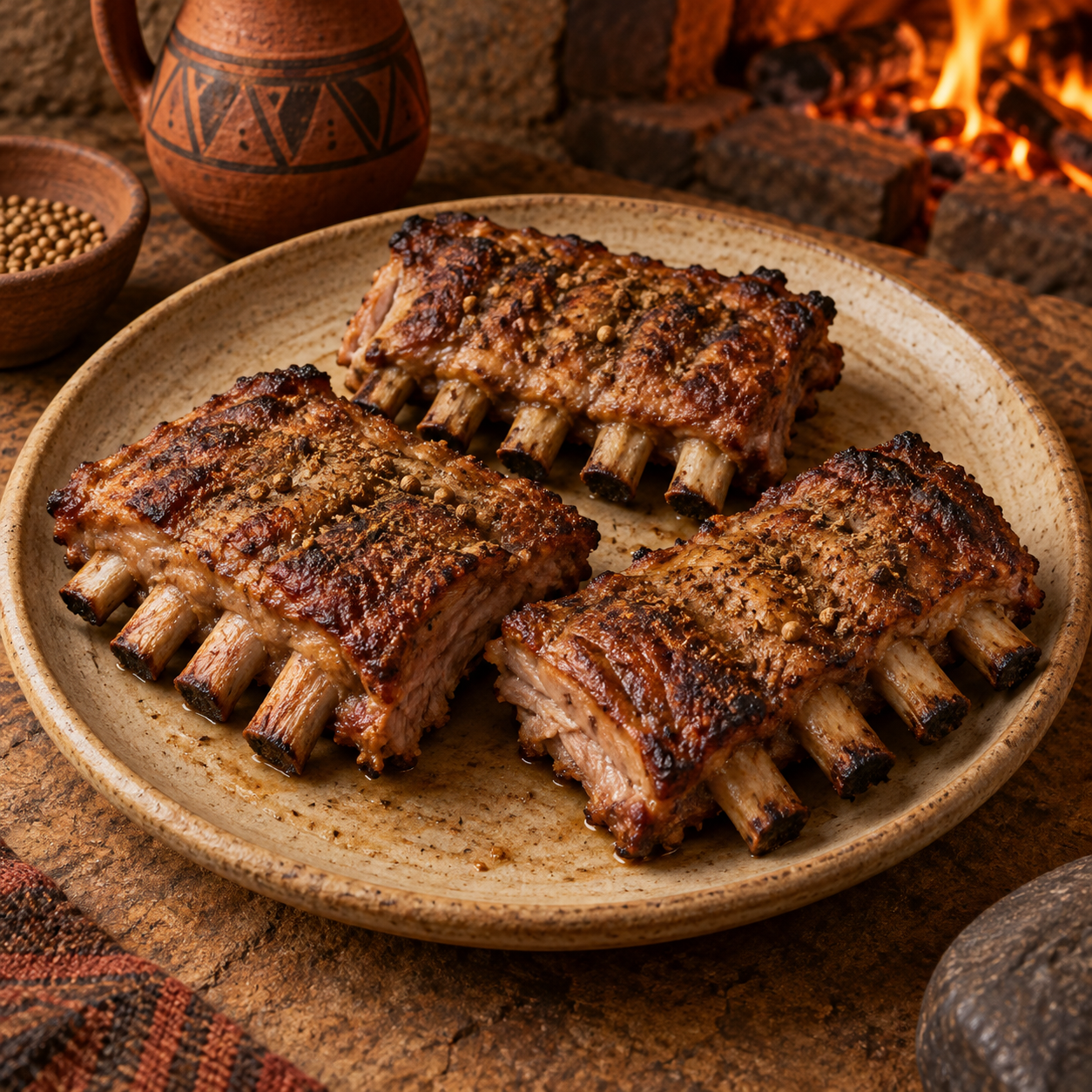
A rack of ribs makes the act of portioning visible: meat, bone and the spaces between them determine how the meal is shared. Hittite sources mention ribs among edible animal parts, alongside cooking by grilling and in broths or stews. Theo van den Hout’s scholarly account of Hittite eating, pages 8–10, also includes pork among consumed meats. These are specific textual clues from second-millennium BCE Anatolia, although they do not supply a measured recipe for pork ribs.
Our preparation combines a gentle simmer with a short grill finish. The sources support those broad cooking methods separately; their order here is a modern choice. The combination makes tough ribs easier to manage and allows their surface to brown quickly. We cannot infer that a Hittite cook used this same two-stage procedure simply because both techniques existed.
The seasoning stays modest
A small amount of coriander and salt seasons the finished meat. Coriander appears among the culinary ingredients in van den Hout’s discussion, but its application to this particular cut is ours. The recipe avoids building a complex glaze from a list of foods that happened to be available. A list of ingredients can establish possibilities without establishing a historical sauce.
Buy ribs from a commercial butcher, keep them cold and separate their preparation from ready-to-eat foods. Simmering time is an estimate: the meat should yield readily when pierced but retain enough structure to be transferred safely. A spoonful of cooking liquid helps the seasoning coat the surface before grilling. The modern temperature check belongs to food safety, not to the ancient text.
Food and its social setting
Another study by van den Hout discusses a recorded dream of the Hittite queen Puduhepa involving stored foods. It places food concerns in a thirteenth-century BCE royal setting, but is not evidence for ribs or a grilling method. Such texts remind us that surviving writing can concern dreams, obligations and court life rather than ordinary kitchen instructions.
Serving ribs on a shared platter offers one possible present-day meal; it does not reconstruct a named Hittite festival. Let diners separate the portions after the meat has rested, and keep the cooking broth for a fresh, properly refrigerated use rather than an imagined ancient preservation process. Its value is a clear relationship between an attested animal, cut and cooking vocabulary, with the exact seasoning, sequence and serving arrangement honestly supplied by a modern kitchen.
Simmered and grilled coriander pork ribs
Serves 4 · Preparation 15 min · Cooking 110 min · 5 minutes drying and 5 minutes resting
A modern adaptation for home cooking. Times are approximate.
Ingredients
- 1.2 kg commercial pork spare ribs, cut into four sections
- 1.8 litres water, enough to cover
- 1 tsp ground coriander
- ¾ tsp salt
- 1 tbsp olive oil, a modern finishing choice
Method
- Put ribs in a large pot and cover with water. Bring to a boil, then lower heat and simmer gently for 80–95 minutes until tender but still holding together.
- Lift ribs onto a tray and let steam dry 5 minutes. Reserve 2 tbsp cooking liquid. Heat the grill/broiler to medium-high.
- Mix coriander, salt, oil and reserved liquid. Brush onto both sides of the ribs.
- Grill/broil on a broiler-safe metal tray for 8–12 minutes, turning once, until the surface browns. Monitor closely to prevent burning. Ensure the thickest meat reaches at least 71°C/160°F.
- Rest 5 minutes, cut between bones and serve.
Substitutions and adjustments
- Commercial lamb ribs are a modern alternative; their fat level and cooking time differ.
- Omit coriander for a plain version without claiming the text specified a particular seasoning.
Historical choices: Pork, ribs and grilling/broth cooking are attested in Hittite textual discussion. Combining simmering and grilling and applying coriander and oil are modern decisions.
Kitchen note: Keep raw pork separate from ready-to-eat foods. Cook to at least 71°C/160°F; handle hot bones and fat carefully. Refrigerate within 2 hours.
Sources and further reading
- Theo van den Hout: Eating in Hittite Anatolia. Pork and ribs in a reconstructed textual menu; grilling and broth cooking, not this exact sequence.
- Theo van den Hout: A Hittite Queen and James Henry Breasted, News & Notes 184 (Winter 2005), pp. 5–6. Official current issue archive; Download PDF contains the article on pp. 5–6. Discussion of food storage in Puduhepa’s dream is context, not a rib recipe.