ANCIENT MEALS · 024 / 100
Hittite · Central Anatolia, modern Turkey · Approximately 1600–1200 BCE
Evidence: historically informed adaptation. The historical evidence and modern cooking choices are distinguished below.
What a name can preserve
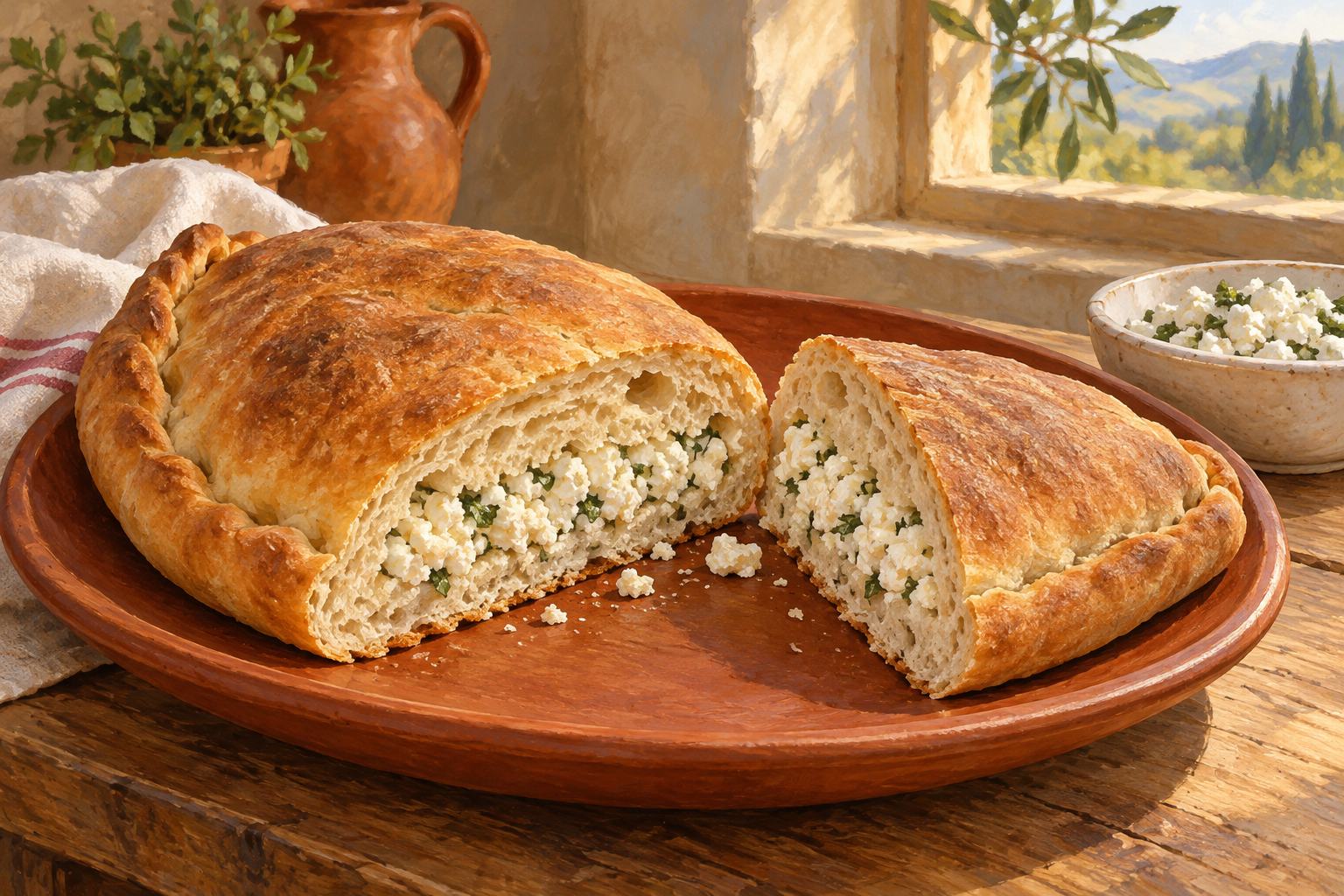
Cut into a warm loaf and a band of cheese appears between the browned crusts. This is a modern way to explore a specific ancient clue: cheese could help identify a kind of Hittite bread. In his account of eating in Hittite Anatolia, pages 8–10, Hittitologist Theo van den Hout describes bread names referring to ingredients, including cheese, alongside names describing shape, colour and other qualities. The setting is second-millennium BCE central Anatolia.
A name is valuable evidence, but it is not a complete recipe. It does not tell us whether cheese was mixed into flour, spread between layers, enclosed as a filling or served in some other form. Our folded loaf chooses one of those possibilities for practical cooking. It should not be called a recovered Hittite cheese turnover, nor used to prove the antiquity of a particular modern Anatolian pastry.
Bread with an interior
The recipe uses a simple wheat dough raised with commercial yeast. Rolling it into an oval, adding cheese and folding the dough produces an obvious contrast between bread and filling. These decisions deliberately make this article different from a plain ancient-inspired loaf. They are also modern decisions: neither the packet of yeast nor the measured water ratio comes from a deciphered Hittite instruction.
Use a commercially produced pasteurized cheese with enough firmness to crumble. A feta-style cheese is accessible, although its salt level varies. Rinsing an exceptionally salty cheese and drying it before filling can help; adding extra salt to the dough before checking the cheese cannot. Keep the filling away from the edge so the seam has a chance to hold. A little escaping cheese is a kitchen result rather than a historical clue.
Reading beyond the loaf
A University of Helsinki seminar report on ancient bread production explains how scholars bring written records and images together. Its discussion ranges across Near Eastern societies; it is background to the method, not a second attestation of this exact filled bread. That distinction helps us resist treating every ancient baker as someone following our recipe.
Serve the loaf warm, cut across the filling so its construction is visible. Check that the seam and centre are fully baked, and allow it to settle before cutting. What survives historically is a named relationship between bread and cheese. What this kitchen supplies is a usable form in which to taste that relationship, with the uncertainty kept in view.
Modern cheese-filled wheat loaf
Serves 4 · Preparation 30 min · Cooking 30 min · 60–90 minutes first rise, 20 minutes second rise and 10 minutes resting
A modern adaptation for home cooking. Times are approximate.
Ingredients
- 350 g plain wheat flour
- 5 g commercial instant yeast
- 210 ml lukewarm water
- 1 tbsp olive oil
- ¼ tsp salt
- 180 g pasteurized feta-style cheese, crumbled
Method
- Mix flour, yeast and salt. Add water and oil; knead 8 minutes into a soft dough. Cover and let rise 60–90 minutes, until noticeably expanded.
- Heat oven to 200°C/390°F. Roll dough into a 30 × 22 cm oval on a lightly floured surface.
- Put cheese on one half, leaving a 2 cm border. Fold the other half over, pinch the edge firmly and transfer to a lined tray.
- Rest 20 minutes. Make three shallow slashes in the top. Bake 25–30 minutes until browned, including the seam, and the bread centre is cooked through.
- Rest 10 minutes before cutting into four portions.
Substitutions and adjustments
- A pasteurized firm fresh sheep cheese can replace feta-style cheese.
- Use plain wholemeal flour for up to one third of the flour; add water a teaspoon at a time if dry.
Historical choices: Hittite cheese bread names are attested; filling placement, loaf shape, yeast, quantities and baking schedule are modern.
Kitchen note: Use pasteurized cheese and fully bake the flour dough. Refrigerate cooled leftovers within 2 hours.
Sources and further reading
- Theo van den Hout: Eating in Hittite Anatolia. Names of cheese-containing breads, not a preserved filled-loaf formula.
- University of Helsinki: Food in the Ancient Near East. Bread scholarship and different types of evidence; its commercial-production examples span several societies.