ANCIENT MEALS · 023 / 100
Bronze Age central Levant · Tell Kamid el-Loz/Kumidi, Beqa’a Valley, Lebanon · Approximately 1550–1200 BCE for relevant Late Bronze Age context
Evidence: archaeological reconstruction. The historical evidence and modern cooking choices are distinguished below.
A dry seed in a connected town
Tell Kamid el-Loz, ancient Kumidi, stood in the Beqa’a Valley at a crossroads of the central Levant. A peer-reviewed dietary study discusses chickpeas among the important legumes in earlier botanical samples from the site. The relevant food context includes the Late Bronze Age, roughly the middle to later second millennium BCE. A preserved seed gives a more specific anchor than saying that “ancient people ate beans.”
The study also stresses the limited resolution of some evidence. A botanical find can identify a plant, while dental micro-remains and isotopes address different questions about diet. None provides a complete roast-chickpea recipe. The research on Southwest Asian founder crops adds the crop’s wider early history, without determining what every household at Kumidi cooked.
One useful modern preparation
We make a snack by fully cooking chickpeas and then roasting them with a little oil and salt. This is a practical reconstruction of a food form, not proof that the excavated chickpeas were treated in that sequence. Canned cooked chickpeas make the method accessible and remove the uncertainty of undercooked dry pulses. The oven finish creates a surface contrast while the centre remains edible.
Dry the chickpeas well after draining. Moisture on the outside slows browning and makes the result softer. A tray with room between the chickpeas helps heat reach them evenly. These are modern equipment decisions, and they should not be translated into a confident story about the ovens used for one ancient batch.
Small foods can expose large gaps
A bowl of chickpeas looks simple, yet its preparation can range from boiled meal to puree or crisp snack. That range explains why the seed alone cannot settle a recipe. Our chosen version gives the cook an enjoyable way to encounter a documented crop while keeping the interpretive step visible. Serve it warm as a small accompaniment, rather than claiming to reproduce a complete Bronze Age menu.
Depending on the brand and oven, the chickpeas may be crisp on the outside and softer within; the recipe does not require them to become hard. Cool any uneaten portion, refrigerate and use promptly. The generated illustration depicts our modern snack and preparation stages. The archaeological anchor is the crop at a particular site; boiling, roasting, oil quantity and seasoning belong to the accessible contemporary method described here.
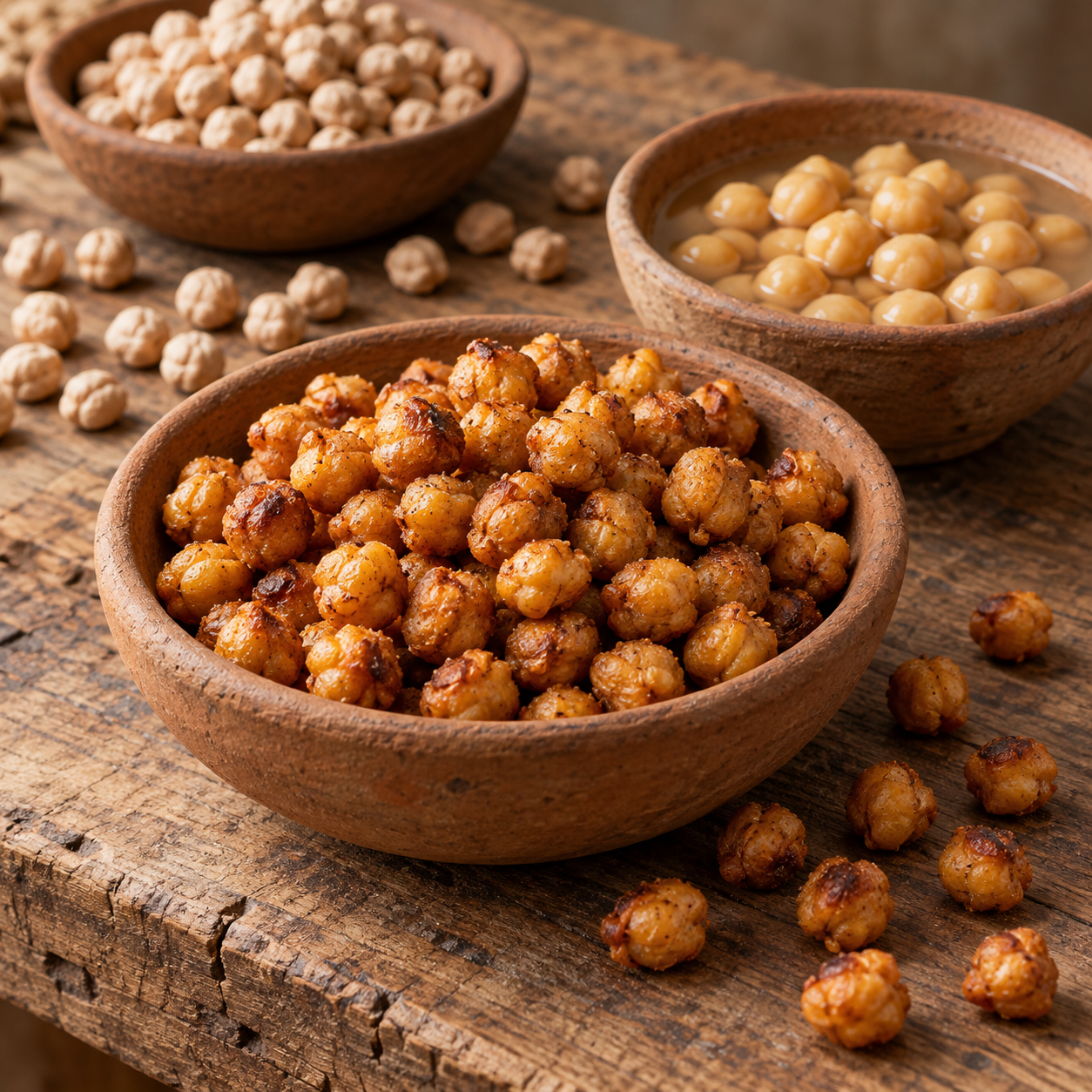
Cooked-then-roasted chickpea snack
Serves 4 · Preparation 10 min · Cooking 35 min · None
A modern adaptation for home cooking. Times are approximate.
Ingredients
- 500 g cooked canned chickpeas, drained and rinsed
- 1 tbsp olive oil
- ½ tsp salt
Method
- Heat oven to 200°C/390°F. Dry chickpeas thoroughly with a clean towel.
- Toss with oil and spread in one layer on a lined tray.
- Roast 30–40 minutes, shaking the tray twice, until lightly browned with firm surfaces.
- Sprinkle with salt and serve warm. Stop before the chickpeas become painfully hard.
Substitutions and adjustments
- Use home-boiled commercial dry chickpeas only when fully cooked.
- A different cooked commercial pulse makes a modern snack but changes the site-specific ingredient.
Historical choices: Archaeological reconstruction anchored in chickpea finds; the cooked-then-roasted sequence and quantities are not attested at the site.
Kitchen note: Use fully cooked chickpeas, not raw dried beans. Refrigerate leftovers; this recipe is not a preservation method.
Sources and further reading
- Gur-Arieh et al.: dietary practices at Kamid el-Loz. Specific chickpea assemblage and explicit methodological limits.
- Southwest Asian founder crops. Primary crop-history research, not a roast recipe.