ANCIENT MEALS · 022 / 100
Greek literary and commentary tradition · Athens and the Greek-speaking Mediterranean · Fifth century BCE dish references; later descriptions through second century CE and after
Evidence: adapted surviving recipe. The historical evidence and modern cooking choices are distinguished below.
The leaf gives the dish a name
Thria were food bundles associated with fig leaves in ancient Greek descriptions. Suda On Line’s scholarly entry traces references in Aristophanes and later commentary, while preserving more than one filling description. A dish name in classical comedy and a recipe in later explanation are related evidence, but they do not make every version contemporary or identical.
Bilabel’s public-domain study of ancient cooking texts reproduces a commentary recipe in which cooked groats are combined with soft cheese and eggs, enclosed in fig leaves and cooked further. It supplies a particular food structure: a starchy mixture is held together and carried through cooking by a leaf wrapper.
A wrapper changed for a reason
Our version uses commercially prepared grape leaves. This is a substantial, openly named substitution. It avoids instructing readers to collect or process unfamiliar fig leaves, and it changes the flavour and texture. We do not describe the dish as proof that modern dolmades have an uninterrupted history from antiquity. The ancient form here used a different leaf and could have a different filling.
Cooked wheat groats, pasteurized cheese and egg form the filling. The mixture is kept soft enough to spoon, but not wet enough to escape when rolled. A covered pan with a small amount of stock supplies controlled heat. We keep the edible commercial wrappers on the finished parcels; the source’s handling of leaves and later finishing stages differs, so the method remains an adaptation.
The bundle is the cooking idea
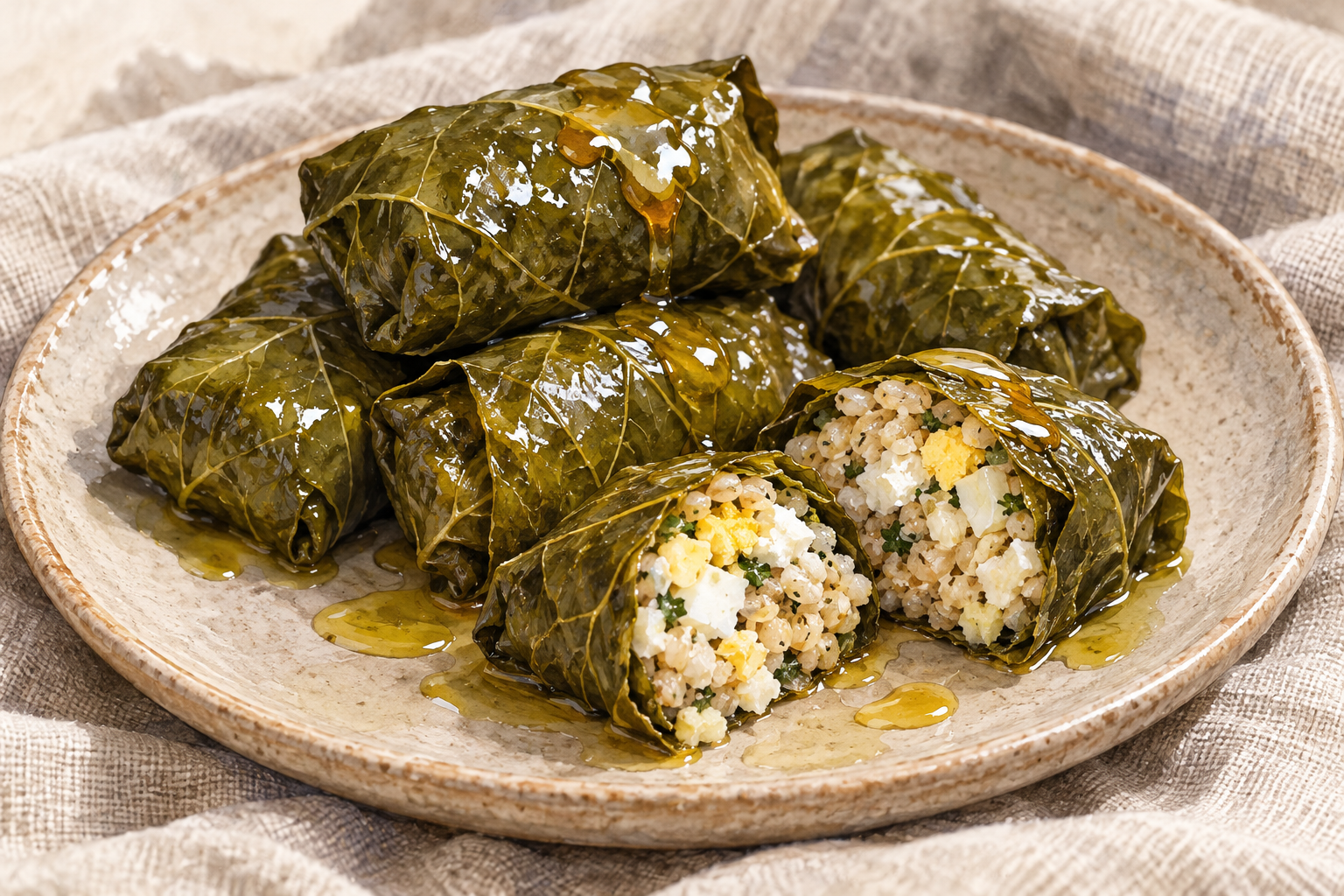
Place one parcel cut-side up when serving so the reader can see how the grain mixture is enclosed. A wrapper does more than decorate food: it holds a filling, limits movement and creates a portion. That is the specific ancient idea being explored. A little honey at the table adds a finishing contrast associated with some surviving descriptions, with its quantity set here for modern tastes.
Check that the egg filling is fully cooked and let the parcels stand briefly before lifting them. Commercial leaf sizes vary, so use smaller spoonfuls when necessary. The generated illustration shows grape-leaf parcels made from this recipe, not ancient fig-leaf food. Written descriptions supply the bundle format and groat–cheese–egg combination; wrapper, proportions, equipment, stock amount and safe cooking endpoint are explicitly modern decisions.
Groat, cheese and egg leaf parcels
Serves 4 · Preparation 30 min · Cooking 45 min · Cooling the grain and 5 minutes final standing
A modern adaptation for home cooking. Times are approximate.
Ingredients
- 120 g dry cracked wheat groats or bulgur
- 250 ml water, for grain
- 120 g pasteurized soft goat cheese or ricotta
- 1 egg
- 16 large, plus a few spare commercial brined grape leaves, drained and rinsed
- 250 ml commercial vegetable or poultry stock
- 2 tbsp olive oil
- 2 tsp honey, to serve
Method
- Cook groats in water as package directs until tender; drain well and cool.
- Mix cooled groats with cheese and egg, then divide the filling into 16 equal portions. Lay large grape leaves vein-side up, put one portion near each stem end, fold the sides in and roll. Use spare leaves to patch tears; if your leaves are small, make more smaller parcels and share them evenly among four people.
- Arrange snugly seam-side down in a wide pan. Add stock and oil. Cover, bring to a gentle simmer and cook 25–30 minutes.
- Check the centre of a parcel reaches 74°C/165°F. Let stand 5 minutes.
- Lift carefully and share the parcels evenly among four people with a light honey drizzle.
Substitutions and adjustments
- Commercial food-safe cabbage leaves, blanched, are another modern wrapper substitution.
- Ricotta replaces soft goat cheese.
Historical choices: Adapted from a surviving groat–cheese–egg bundle description. Commercial grape leaves replace fig leaves; no continuity claim for later named leaf dishes.
Kitchen note: Use pasteurized cheese and commercial edible wrappers. Cook egg filling to 74°C/165°F.
Sources and further reading
- Suda On Line: theta 489, thria. Scholarly translation and notes on classical references and varied fillings.
- Bilabel: Opsartytika und Verwandtes. Public-domain reproduction of commentary recipe with groats, soft cheese, eggs and fig wrapper.