ANCIENT MEALS · 021 / 100
Classical Greek descriptions of Persian food · Ancient Media/Persian world, described in Greek sources · Approximately 400–300 BCE references, preserved in later texts
Evidence: historically informed adaptation. The historical evidence and modern cooking choices are distinguished below.
A taste described from outside
Greek references to abyrtake associate the food with the Persian or Median world and emphasise pungency. The scholarly Suda On Line translation preserves a description involving leek, cress and pomegranate, with notes tracing earlier comic quotations. The Suda is a much later lexicon; the ancient context comes from the older material it quotes, not from pretending its medieval compilation is a classical cookbook.
The same entry’s notes mention a different connection, capers in a Persian royal food list. Encyclopaedia Iranica’s study of ancient Iranian cooking discusses that list and warns about the limitations of the surviving sources. The evidence suggests a sharp sauce or relish category with varying descriptions, rather than one fixed, fully known household formula.
Make the interpretation visible
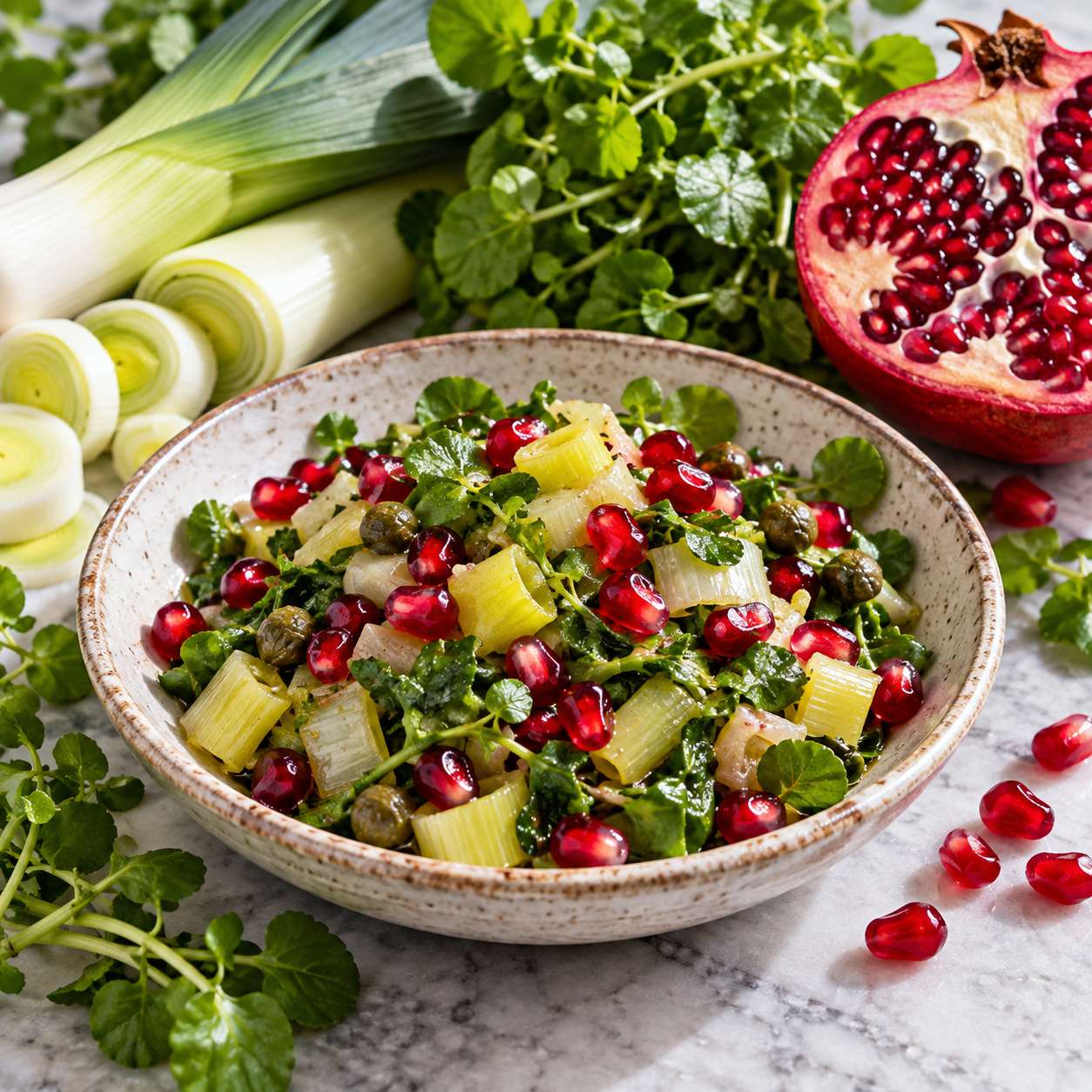
Our measured relish centres on leek, commercial watercress and pomegranate arils. Leek is briefly softened to make a usable accompaniment, while the greens and fruit are added after cooling. Commercial capers are optional, acknowledging a separate ancient association without asserting that every source lists them together. Vinegar and oil are modern balancing quantities.
The cress term can refer to a sharper plant or seed preparation than the watercress sold today. We choose a familiar commercial edible green instead of inventing an exact botanical equivalence or asking the cook to forage. The result will be fresh and pungent, but it cannot tell us how strong the Greek writer’s original dish was.
A small dish with a large viewpoint
Serve a spoonful beside plain roasted meat or cooked beans. A relish is meant to contrast with another food, so tasting it only by itself can exaggerate its sharpness. Pomegranate seeds provide both juicy acidity and texture; chopped greens make that texture different from a smooth modern sauce. Start with a little vinegar and adjust after mixing, since the fruit’s acidity varies.
Its historical interest is as much about description as flavour: a Greek label and comic reference give us a view of Persian food through an outsider’s vocabulary. We need not repeat the ancient writer’s judgement as our own. The generated illustration depicts this modern relish. Leek, cress and pomegranate are textually anchored; softened leek, watercress choice, optional capers, proportions and contemporary serving suggestions remain interpretations.
Leek, cress and pomegranate relish
Serves 4 · Preparation 15 min · Cooking 5 min · 10 minutes cooling
A modern adaptation for home cooking. Times are approximate.
Ingredients
- 1 small (150 g) leek, thoroughly washed and finely chopped
- 40 g commercial watercress, washed and chopped
- 100 g pomegranate arils
- 1 tbsp olive oil
- 1–2 tsp wine vinegar
- 1 tsp commercial capers, drained, optional
- 1 pinch salt
Method
- Warm oil in a small pan. Soften leek over low heat for 4–5 minutes without browning.
- Spread leek on a clean plate and let cool 10 minutes.
- Mix with watercress, pomegranate, 1 tsp vinegar and optional capers.
- Taste, add a little salt and more vinegar if needed, and serve as a small accompaniment.
Substitutions and adjustments
- Commercial garden cress can replace watercress; use familiar food-grade greens only.
- Omit capers to keep the relish closer to the leek–cress–pomegranate description.
Historical choices: Adapted from Greek descriptions of a Persian relish; the sources preserve differing ingredient associations and no complete measured formula.
Kitchen note: Wash produce. Use commercially prepared capers; do not make an unsafe home preserve.
Sources and further reading
- Suda On Line: alpha 103, abyrtake. Scholarly translation with earlier comic fragments and ingredient notes; late lexicon preserves ancient material.
- Iranica: Cooking in ancient Iran. Classical royal food list and cautions about the limited evidence.