ANCIENT MEALS · 015 / 100
Ancient Egyptian garden and ritual foodways · Nile Valley, Egypt · Approximately 2000–1000 BCE; model’s exact date not supplied by cited record
Evidence: historically informed adaptation. The historical evidence and modern cooking choices are distinguished below.
A vegetable made of faience
A green ceramic fragment can tell a food story even when there is nothing edible left. UCL’s record of lettuce model UC 34696 identifies it as a possible votive offering from Min’s temple at Koptos. It links lettuce with the god and with reliefs near his chapel. The object is evidence for a plant’s cultural importance, not for the dressing on an ancient salad.
The University of Manchester study, The Lettuce Connection, examines representations across Egyptian periods. Its range is a reminder that images require interpretation: a depicted plant’s form, context and association should not be flattened into one timeless Egyptian dinner. The broad historical setting here is the second millennium BCE; the short UCL object page does not supply an exact date for this particular model.
A modern plate that makes the plant visible
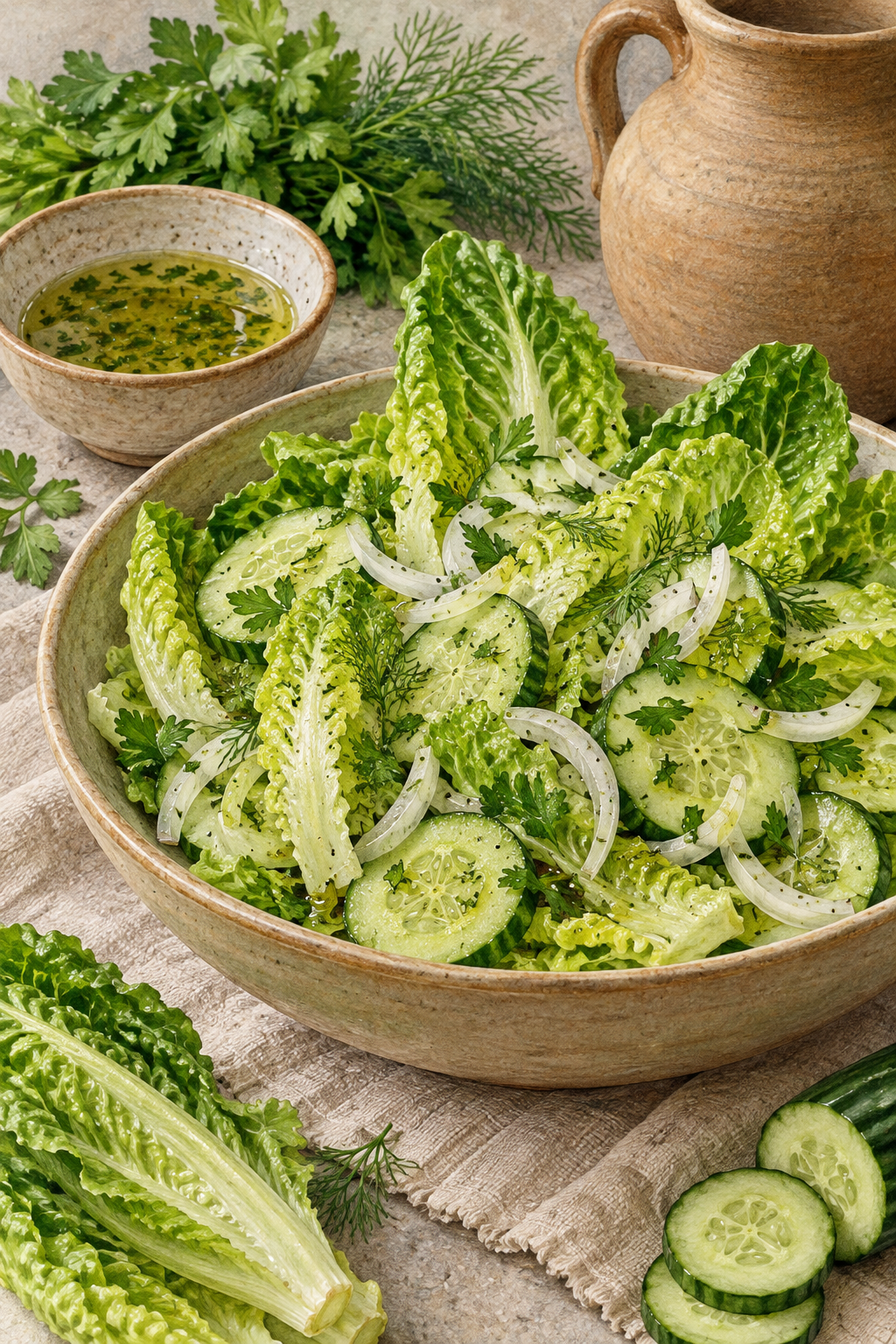
The recipe uses long romaine leaves, cucumber and onion with a small herb-and-oil dressing. It is intentionally presented as an adaptation using historically relevant garden produce, rather than a recovered ancient lettuce recipe. Modern romaine also differs from the plant varieties represented in Egyptian art. The shape gives the reader something concrete to compare without claiming a botanical match.
Keep the leaves large instead of shredding everything into one uniform mixture. Their ribs, bitterness and crispness are part of the eating experience. Cucumber adds a different texture, while finely sliced onion makes a little seasoning spread across the plate. Mint and commercial olive oil are the modern recipe’s choices. The dressing amount is small so the lettuce remains the focus.
Food can carry several meanings
A vegetable can be cultivated for eating and also have religious significance. The votive model does not force us to choose only one role, but it also does not prove that a particular temple used our combination of ingredients. This distinction keeps the story interesting: ordinary garden produce can enter an offering context, acquire associations and survive in a form that cannot decay like a real leaf.
Wash produce thoroughly, dry the lettuce and dress it just before serving to keep it crisp. The resulting salad is a fresh modern meal component and a way to notice the central plant. Its generated botanical illustration is not a record of an ancient Egyptian plate. The archaeology supplies the lettuce object and its context; the cucumber proportions, dressing, knife work and serving arrangement are openly modern.
Romaine, cucumber and onion plate
Serves 4 · Preparation 15 min · Cooking 0 min · None
A modern adaptation for home cooking. Times are approximate.
Ingredients
- 1 large (250 g) romaine lettuce, washed and dried
- 1 (250 g) cucumber, washed and sliced
- ½ small onion, very thinly sliced
- 2 tbsp olive oil
- 1 tbsp commercial wine vinegar or water
- 8 g fresh mint leaves, chopped
- ¼ tsp salt
Method
- Separate lettuce into large leaves and arrange on a platter.
- Add cucumber and thin onion slices.
- Whisk oil, vinegar or water, mint and salt.
- Drizzle lightly just before serving. Serve immediately.
Substitutions and adjustments
- Use another commercial lettuce; ancient plant forms are not matched exactly.
- Water replaces vinegar for a milder modern dressing.
Historical choices: A historically informed garden-food adaptation, not a surviving Egyptian salad recipe. Lettuce is anchored in a specific object; dressing and composition are modern.
Kitchen note: Wash produce under running water and use clean equipment. Refrigerate any leftovers promptly.
Sources and further reading
- UCL: faience lettuce UC 34696. Specific model, temple context and possible votive function; no exact date on page.
- Manchester: The Lettuce Connection. Detailed study of Egyptian plant representations and their interpretation.