ANCIENT MEALS · 009 / 100
Middle Kingdom, Dynasty 12 · Thebes, Upper Egypt · Approximately 1981–1975 BCE for the excavated loaves
Evidence: archaeological reconstruction. The historical evidence and modern cooking choices are distinguished below.
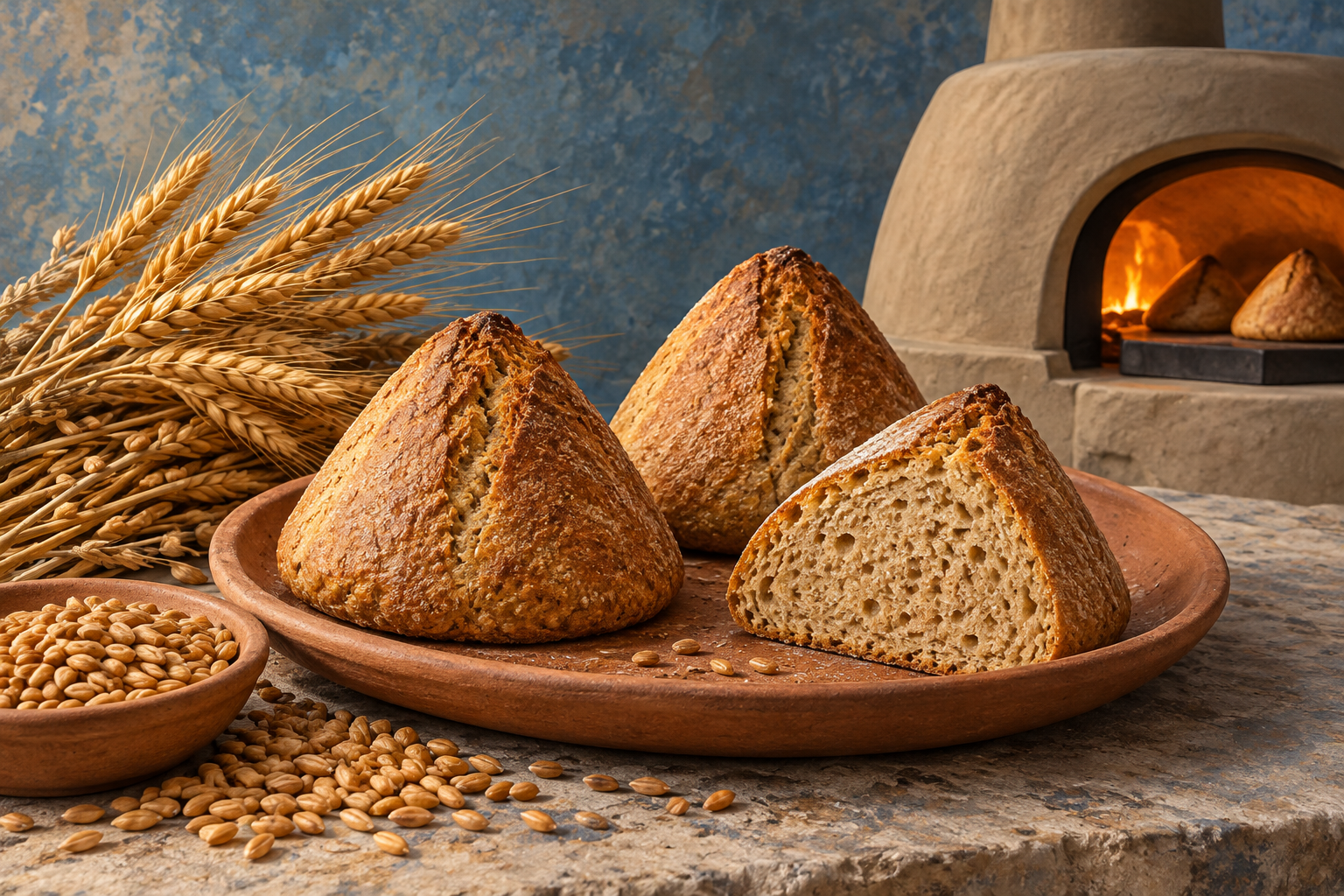
The bread itself survived
Some food history begins with a drawing; this one begins with bread. The Metropolitan Museum’s conical loaves from Wah’s tomb date to approximately 1981–1975 BCE. They were found at Thebes in Upper Egypt. A surviving food offering supplies a specific shape and context, making this a more grounded starting point than an imaginary pyramid-builder’s recipe.
It still does not supply a baker’s measurements. The museum record identifies cereal as the material, while the broader Egyptian importance of emmer is supported by UCL’s research on ancient Egyptian wheat. Emmer in our recipe is a historically relevant grain choice; using it does not establish the exact grain composition of these particular museum loaves.
Shape is evidence; the dough is interpretation
The modern dough combines emmer flour with some bread flour so it can be handled without requiring specialist grain processing. Commercial yeast gives predictable rising, and a conventional oven provides controllable heat. Those decisions are plainly contemporary. Our small cones are formed by hand, rather than by copying a hypothetical mould or inserting the dough into archaeological ceramics.
Keep the cones squat, with a broad base. That helps them stand and gives the heat less distance to travel. The ancient loaves may have been made differently, and their survival should not be mistaken for proof of our technique. Looking at their form encourages a useful question: how much of bread’s identity is carried by the grain, and how much by the way it is shaped and baked?
From offering to accessible meal
A funerary context also changes the story. The loaves were preserved as offerings, not as leftovers from a fully documented ordinary supper. Their appearance tells us something about a food selected for a tomb, while the relationship to day-to-day baking requires other evidence. A modern cook can appreciate that distinction and still serve the resulting bread with soup or vegetables.
Slice a cone from top to base so both crust and crumb are visible. It should be cooked through, with no wet flour at the centre. Flour absorption and rising time may need adjustment. The conical shape remains the historical anchor; commercial yeast, flour blend and oven temperature are practical additions. The generated illustration shows our modern loaves and should never be confused with a photograph of Wah’s excavated bread.
Small emmer-inspired conical loaves
Serves 6 · Preparation 25 min · Cooking 30 min · 60–90 minutes first rise, 25 minutes final rest, 20 minutes cooling
A modern adaptation for home cooking. Times are approximate.
Ingredients
- 300 g emmer flour
- 200 g strong bread flour
- 7 g commercial instant yeast
- 320 ml lukewarm water, plus 1–2 tbsp if needed
- 1 tsp salt
- 1 tbsp olive oil, for handling
Method
- Mix flours, yeast and salt. Add water and knead 6 minutes; dough should be soft but hold its shape.
- Cover and leave 60–90 minutes at room temperature until visibly risen.
- Heat oven to 210°C/410°F. Divide dough into six portions. Using lightly oiled hands, form squat cones with broad flat bases.
- Place on a lined tray, cover loosely and rest 25 minutes.
- Bake 25–30 minutes until browned and fully cooked; if checking, the centre should reach about 95°C/203°F. Cool 20 minutes before slicing.
Substitutions and adjustments
- Spelt flour replaces emmer when unavailable; it is a modern grain substitution.
- All wholemeal wheat flour makes a different modern loaf.
Historical choices: Reconstruction anchored in surviving conical offering bread. Emmer choice, wheat blend, commercial yeast and hand-shaping method are modern interpretations.
Kitchen note: Cook flour fully. Use modern baking equipment rather than unevaluated antique ceramics.
Sources and further reading
- Met: conical bread from Wah’s tomb. Specific excavated food, dates, location and form.
- UCL: Egyptian emmer genome. Grain history and distinction between ancient and modern wheat.