ANCIENT MEALS · 004 / 100
Elamite-labelled dish in an Old Babylonian text · Elam and southern Mesopotamia, modern Iran and Iraq · Approximately 1750–1700 BCE
Evidence: historically informed adaptation. The historical evidence and modern cooking choices are distinguished below.
A flavour with a place-name
A recipe can carry a geographical label even when it has travelled far from home. One Old Babylonian instruction is called Elamite broth, pointing toward Elam in what is now southwestern Iran. The CDLI discussion of the cooking tablet singles out dill in this preparation. That detail gives the dish a different aromatic emphasis from the leek and coriander combinations found elsewhere in the collection.
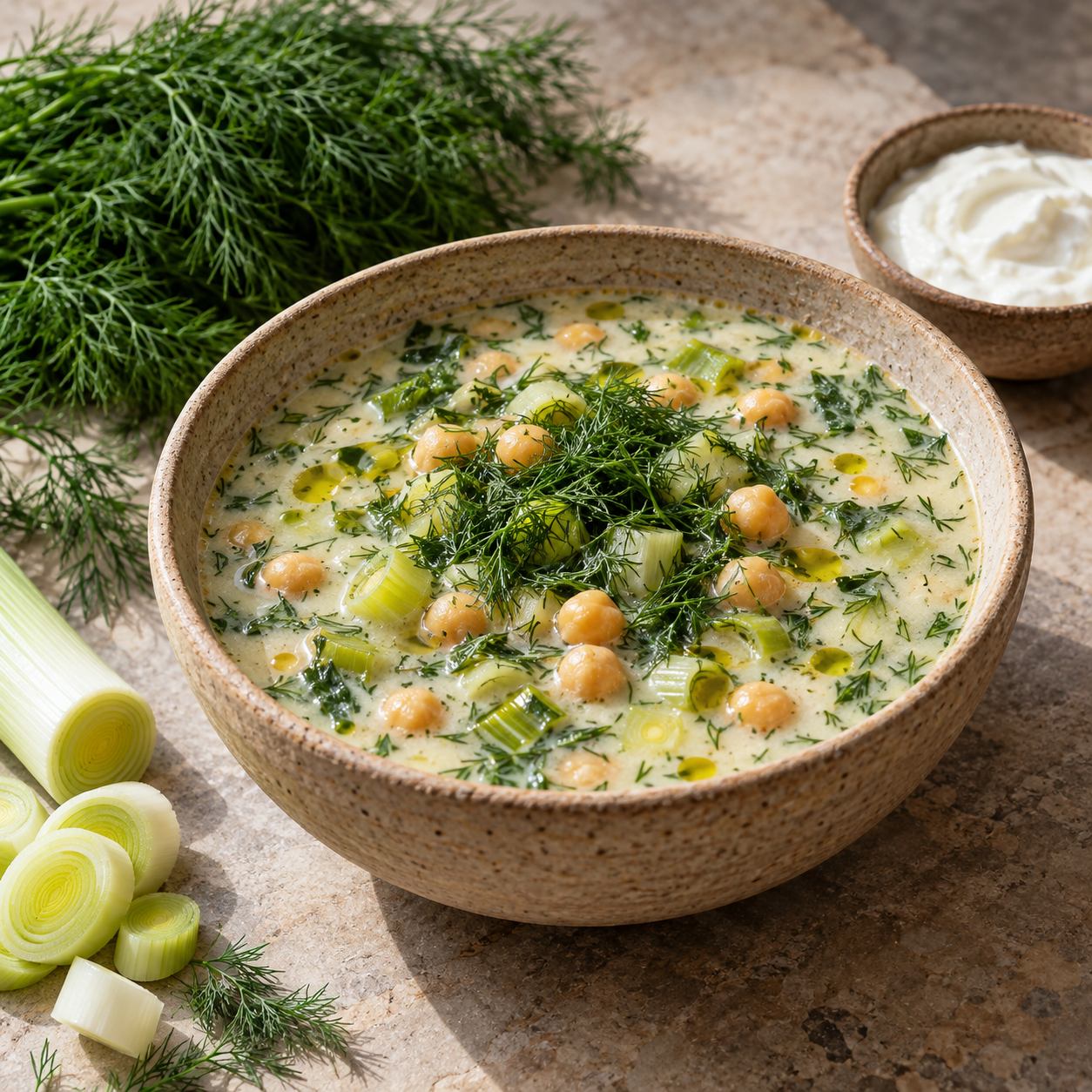
The surviving recipe is also a useful reminder that an ancient source can be less comfortable than an attractive food photograph. The scholarly translation and commentary discusses sour milk and blood in the historical preparation. Our recipe does not instruct you to source blood or reproduce historical handling practices. It is a clearly labelled modern adaptation that keeps dill and sour dairy while using cooked chickpeas for body.
Changing an ingredient changes the evidence
Replacing a central thickener is a substantial change. Chickpeas do not behave or taste like blood, and the pale bowl below cannot be described as the original dish with one invisible alteration. It is better understood as a way to explore part of the surviving flavour design safely and accessibly. Leek and garlic make a savoury foundation; pasteurized yogurt contributes acidity; dill stays noticeable rather than disappearing beneath a long list of spices.
We blend some chickpeas into the liquid and leave others whole. That is a modern technique to create a soup with both smoothness and texture. It also keeps the ingredients economical. Tempering the yogurt with warm broth before returning it to the pot makes its addition easier to control. The pot should remain below a hard boil once dairy has been added, so the cook can preserve the chosen texture.
Cooking a labelled encounter
The place-name invites questions rather than an easy claim about continuous national cuisines. Did the Babylonian writer identify an origin, a style or an association familiar to diners? The text does not let us follow every stage of that journey. Nor does the use of dill in later Iranian cooking prove an unchanged recipe running through four millennia.
At the table, try noticing dill before comparing the bowl with a modern soup you already know. That pause lets a particular historical clue stay central. This measured adaptation is intentionally more distant from its source than the collection’s lamb-and-beet stew. Its value is in making the boundary explicit: an ancient geographical label and aromatic choice are attested; the chickpea thickener, amounts and dairy technique belong to this modern recipe.
Dill, chickpea and yogurt broth
Serves 4 · Preparation 15 min · Cooking 25 min · None
A modern adaptation for home cooking. Times are approximate.
Ingredients
- 400 g cooked canned chickpeas, drained and rinsed
- 200 g leek, thoroughly washed and sliced
- 3 garlic cloves, crushed
- 25 g fresh dill, chopped
- 10 g fresh coriander, chopped
- 250 g pasteurized plain yogurt
- 800 ml water
- 2 tbsp untoasted sesame oil
- ½ tsp salt, or to taste
Method
- Cook leek and garlic in oil over low heat for 6 minutes.
- Add water and chickpeas, reserving 100 g chickpeas. Bring to a boil and simmer 12 minutes.
- Blend the soup carefully until smooth, or mash well with a potato masher. Add reserved chickpeas.
- Whisk yogurt with 150 ml warm soup in a bowl. Take the pot off the heat, stir in yogurt, dill and coriander, then warm gently without a hard boil for 2 minutes.
- Season and serve immediately.
Substitutions and adjustments
- Use pasteurized lactose-free yogurt if needed.
- White beans are a modern replacement for chickpeas.
Historical choices: The ancient instruction uses dill and sour dairy and includes blood. This recipe omits blood entirely and substitutes cooked chickpeas, making it a historically informed adaptation.
Kitchen note: Use pasteurized yogurt. Cool leftovers quickly and refrigerate within 2 hours.
Sources and further reading
- CDLI: A Babylonian Cookbook. Tablet context and dill in the Elamite-labelled preparation.
- Scholarly translation: Elamite Broth. Historical blood and sour-milk combination and limits of reconstruction.