ANCIENT MEALS · 002 / 100
Old Babylonian · Southern Mesopotamia, modern Iraq · Approximately 1750–1700 BCE
Evidence: adapted surviving recipe. The historical evidence and modern cooking choices are distinguished below.
The moment bread becomes broth
A handful of brittle bread crumbs hits a hot bowl and begins to soften. That small transformation is the point of this recipe. Pašrūtum, often translated as “unwinding,” is represented in Yale’s collection of reconstructed Babylonian dishes by a herb-rich broth finished with crushed barley bread. The recipe’s title is intriguing, but its precise reason remains uncertain.
The source belongs to the Old Babylonian world of southern Mesopotamia, approximately the eighteenth century BCE. In their account of the Yale–Harvard reconstruction project, researchers describe the uncertainty created by damaged tablets and hard-to-identify food words. A modern bowl can help us ask how an ingredient works; it cannot repair every missing word or tell us what the name meant to its first diners.
A different way to thicken soup
Here the bread is fully baked before it enters the liquid. That matters. Flour stirred straight into water behaves differently from a cooked loaf crumbled over broth. Bread already has a structure, a crust and a toasted aroma; it can soften at different speeds, leaving both silky liquid and little pieces. Our practical version uses commercially baked barley bread, or a plain wholemeal loaf when barley bread is unavailable. This is a deliberate substitution, not an assertion that the two breads are historically interchangeable.
The broth itself is modest. Leek, garlic and fresh coriander are allowed to remain the main flavours, with sesame oil carrying their aroma. There is no stock cube or tomato paste to hide that combination. Shortening the simmer compared with Yale’s experimental method is another modern convenience. A cook can keep the leek tender and the liquid light without trying to replicate the heat of an ancient hearth.
What the spoon can teach
Keep a little bread aside and compare a spoonful before and after adding it. The distinction shows why a terse instruction can contain more culinary information than its length suggests. “Finish with bread” is a technique, not simply an ingredient list. The way the bread is dried, crushed and introduced determines whether the result feels like broth, soup or a very soft bread dish.
The stated water quantity is a starting point: stale bread differs greatly in absorbency. Add hot water if the soup becomes too stiff. Serving it immediately preserves some contrast between the broth and its topping. We use an accessible measured recipe to explore a documented ancient preparation while leaving the interpretation of “unwinding” open.
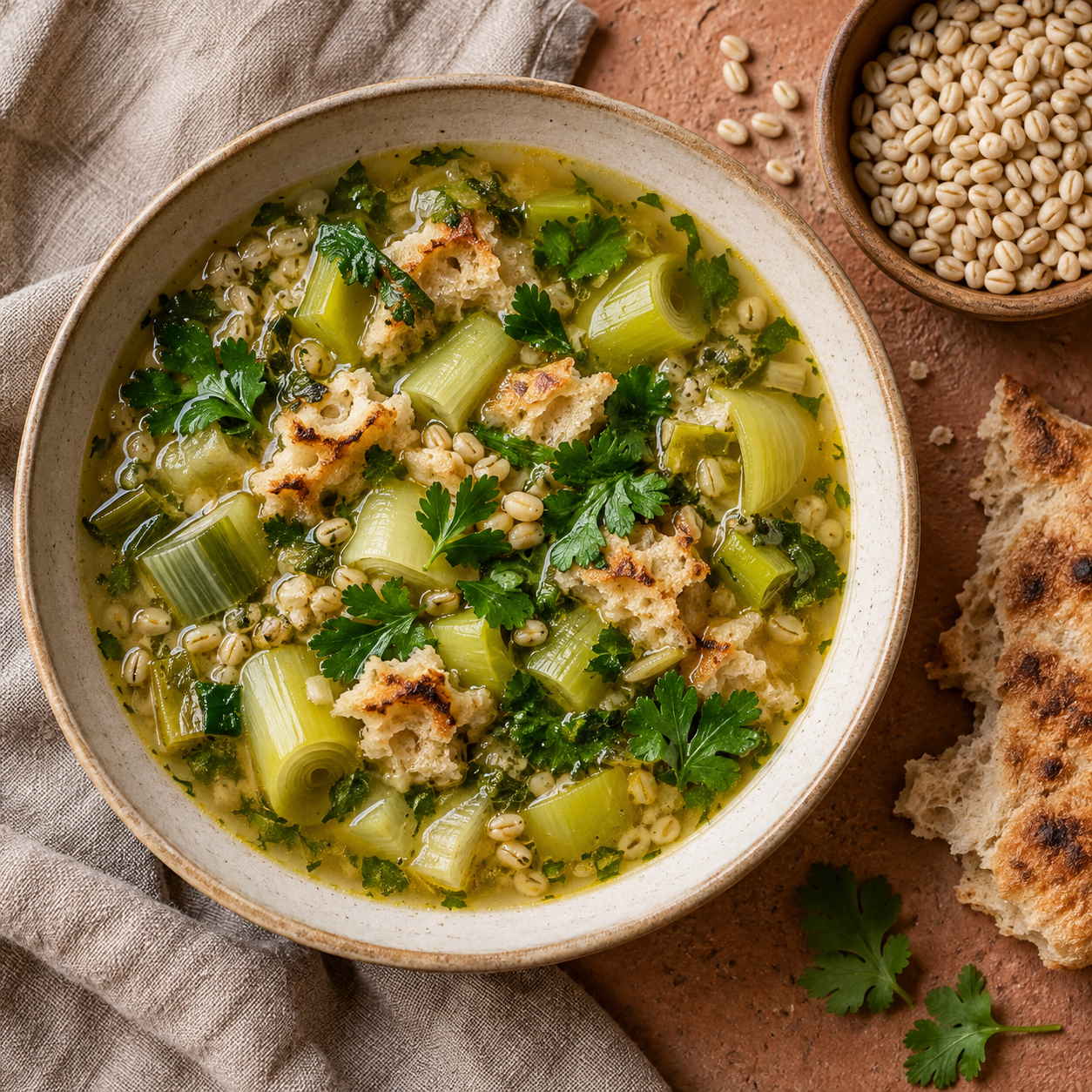
Leek, coriander and toasted-bread soup
Serves 4 · Preparation 15 min · Cooking 35 min · None
A modern adaptation for home cooking. Times are approximate.
Ingredients
- 300 g leeks, thoroughly washed and sliced
- 3 garlic cloves, crushed
- 4 spring onions, sliced
- 20 g fresh coriander, chopped
- 2 tbsp untoasted sesame oil
- 1.2 litres water
- 150 g commercially baked barley or wholemeal bread
- ¾ tsp salt, or to taste
Method
- Heat oven to 180°C/350°F. Tear bread into small pieces and bake on a tray for 12–15 minutes until dry and crisp. Cool, then crush coarsely.
- Heat oil in a saucepan. Cook leek and garlic over medium-low heat for 6 minutes without browning.
- Add water and salt. Bring to a boil, then simmer 20 minutes.
- Add spring onions and half the coriander. Simmer 3 minutes.
- Stir in bread crumbs immediately before serving; loosen with hot water if needed. Top with remaining coriander.
Substitutions and adjustments
- Plain wholemeal bread replaces barley bread.
- Olive oil replaces sesame oil, changing the flavour.
Historical choices: Adapted surviving recipe. Commercially baked bread replaces Yale’s experimental beer-bread; no home fermentation is required.
Kitchen note: Use clean equipment and commercial food-safe ingredients. Refrigerate leftovers promptly and use within 3 days.
Sources and further reading
- Yale: Babylonian Cooking. Published modern reconstruction of the bread-finished broth.
- Yale–Harvard recipe project. Explains translation uncertainty and experimental work.